


Diesel Engine Leak-Down Test Results by Engine Model
Last Updated: November 14, 2026
Quick Summary
Diesel engine leak-down test results by engine model are not published as a single factory percentage limit; most manufacturers specify a procedure and cylinder-to-cylinder comparison instead. Field practice treats under 10% loss as good and 20% or roughly twice the lowest cylinder as the trigger to investigate.
- Warm the engine, confirm each cylinder at TDC on the compression stroke, and calibrate the tester before testing.
- Input pressure, orifice size, engine temperature, piston position, and adapter seal all shift the percentage reading.
- Air at the intake points to the intake valve or guide; air at the oil filler points to rings and bore.
- Two adjacent cylinders with high readings and air at the neighbor hole suggest a head gasket fire ring breach.
- Re-test an abnormal cylinder to rule out adapter seal and TDC error before condemning the engine.
Table of Contents
- What a Diesel Leak-Down Test Actually Tells You
- How to Perform a Diesel Leak-Down Test Step by Step
- Choosing a Diesel Leak-Down Tester That Fits Your Engine
- Acceptable Diesel Leak-Down Test Results and Where the Ranges Come From
- Diesel Leak-Down Test Chart: Results by Engine Model
- Where the Air Escapes: Intake, Exhaust, Crankcase, or Coolant
- What to Do When Your Numbers Come Back Abnormal
- Matching a Replacement Diesel Engine to Your Test Findings
- Frequently Asked Questions
What a Diesel Leak-Down Test Actually Tells You
A diesel engine leak-down test measures how much compressed air escapes from a sealed cylinder, expressed as a percentage of the air you put in. That number tells you how well the piston rings, valves, and head gasket are holding pressure.
The test does not just say "bad" or "good." It tells you where the air is going, which is far more useful than a pass/fail grade.
Leak-Down vs. Compression Testing on a Diesel
A compression test measures peak cranking pressure. A leak-down test measures how well a cylinder holds air at a steady pressure. Compression testing is fast and useful for spotting a dead hole; leak-down testing is slower but pinpoints the leak path.
- Compression test: cranks the engine and reads peak PSI per cylinder
- Leak-down test: holds a cylinder at top dead center and reads percentage loss
- Best practice: run both, then compare the numbers
If you want the complementary compression numbers for your specific engine, see our guide to diesel engine compression test specs by model.
How to Perform a Diesel Leak-Down Test Step by Step
Run the test on a warm engine whenever possible. Warm parts seal better and match real running conditions. Cold tests still work, but note that in your records.
- Warm the engine to operating temperature, then shut it off.
- Remove the glow plug or fuel injector from the cylinder you are testing.
- Bar the engine over to bring that cylinder to top dead center on the compression stroke.
- Thread the correct test adapter into the glow plug or injector hole.
- Connect the leak-down tester to shop air and set the regulator.
- Zero the gauge, then open the valve and read the percentage loss.
- Listen for air at the intake, exhaust, oil filler, and coolant.
- Repeat for every cylinder and record each reading.
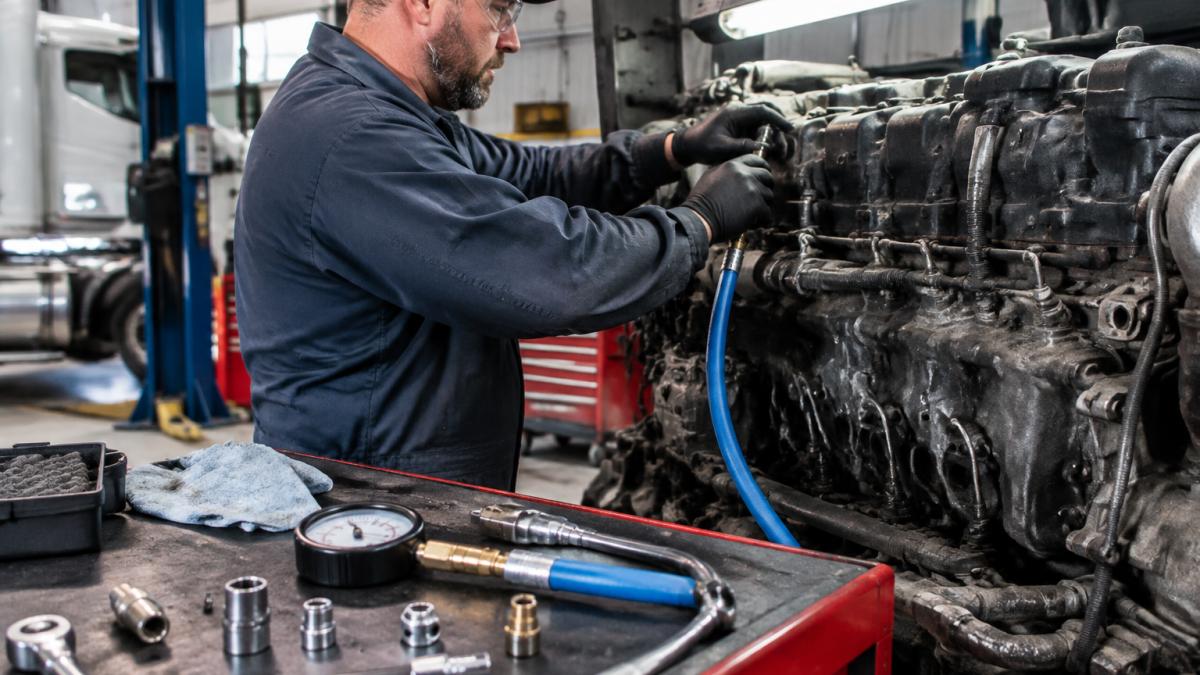
Warm-Up, Glow Plug and Injector Access, and Finding TDC
Getting the cylinder to top dead center (TDC) on the compression stroke is the step people rush.
Diesel access differs from gas engines: no spark plugs. You remove a glow plug or a fuel injector instead.
Watch out: pulling an injector without depressurizing the fuel system first can spray diesel under high pressure. Always relieve pressure before you crack a line.
Regulated Air, Calibration, and Reading the Gauge
Set your pressure regulator to the pressure the tester manufacturer specifies, typically a low, fixed shop-air pressure.
- Connect the tester to air with nothing in the cylinder
- Confirm the gauge reads 100% on the reference orifice
- If it does not, adjust or service the tester
The gauge shows leakage percentage. A low number means a tight cylinder; a high number means air is escaping. Reading the gauge is easy. Interpreting it is where the real work starts.
Choosing a Diesel Leak-Down Tester That Fits Your Engine
The right diesel leak-down tester matches your engine's glow plug or injector thread and handles diesel compression ratios. Buy one with a full adapter kit, not a single fitting.
- Adapter coverage: kits that fit common Cummins, Detroit, and Caterpillar glow plug and injector threads
- Dual gauges: one for regulated input pressure, one for percentage loss
- A quality regulator: a cheap regulator drifts and ruins repeatability
A common mistake is buying a gas-engine tester and forcing the adapters to fit. The threads and pressures are different. Get a diesel-specific kit.
Acceptable Diesel Leak-Down Test Results and Where the Ranges Come From
There is no single universal pass/fail number. Published ranges vary by source, and that is the honest answer.
- Under 10% loss is widely treated as good
- Roughly 10% to 20% is often called marginal
- Above 20% usually points to a problem worth investigating
These are general ranges, not model-specific manufacturer specifications. Treat any single number as a starting point, not gospel.
What matters more than the absolute number is cylinder-to-cylinder variation. If five cylinders read 8% and one reads 25%, that odd cylinder is your problem, even if 25% sounds borderline on its own.
Diesel Leak-Down Test Chart: Results by Engine Model
This is the part most articles skip. The keyword asks for results by engine model, but few diesel manufacturers publish a single leak-down percentage limit the way they publish compression specs.
| Engine Family | Typical Published or Field-Referenced Criterion | Investigate Above | Common Weak Point |
|---|---|---|---|
| Cummins ISX15 / X15 | Service information typically calls for comparing cylinders and checking leak path; field practice treats under 10% as good | 20% or roughly 2x the lowest cylinder | Injector cup seals, piston rings, valve seats |
| Cummins ISB / B-series | Field practice treats under 10% as good; many shop manuals emphasize variation over absolute value | 20% | Piston ring land wear, head gasket |
| Detroit DD15 / DD13 | Field practice treats under 10% as good; EGR and valve wear patterns are common discussion points | 20% | Exhaust valve wear, EGR-related carbon |
| Caterpillar C13 / C15 / C7 | Field practice treats under 10% as good; head gasket and valve seat failures are common | 20% | Head gasket, valve seats, injector sleeve seals |
| PACCAR MX-13 | Field practice treats under 10% as good; ring land and liner wear are common | 20% | Piston ring land wear, liner scuffing |
| Volvo D13 | Field practice treats under 10% as good; valve guide and seat wear are common | 20% | Valve guide and seat wear, injector copper sleeve |
| Duramax 6.6L (LLY, LBZ, LMM, LML) | Enthusiast and independent-shop practice treats under 10% as good; GM service information focuses on compression and cylinder balance | 20% | Head gasket, piston rings, injector bore |
| Ford 6.0L / 6.7L Power Stroke | Independent-shop practice treats under 10% as good; Ford service information focuses on compression and contribution tests | 20% | Head gasket, injector cup, valve seats |
Read the table this way: the middle column is a trigger, not a verdict. A cylinder at 22% on a warm engine with a verified adapter seal and confirmed TDC deserves a leak-path check before anyone condemns the engine.
Why the Same Engine Can Read Differently on Two Testers
Two shops can test the same engine on the same day and get numbers that differ by several points. That is normal, and it is why a model-specific chart without test conditions is misleading. The variables that move the number are:
- Input pressure. Most diesel testers are designed around a low, fixed input pressure, commonly around 100 psi on the regulated side, with a calibrated orifice that produces the percentage reading. If your regulator is set differently from the tester's design pressure, the percentage is not comparable to anyone else's.
- Orifice size. The reference orifice inside the tester sets the scale. A 0.040-inch orifice and a 0.060-inch orifice produce different percentages for the same physical leak.
- Engine temperature. A warm engine seals better at the rings and valve seats. A cold engine can read several points higher on the same cylinder.
A repeatable procedure fixes these variables: same tester, same input pressure, same warm-up, same TDC method, same adapter, and a calibration check against the reference orifice before the session. Record all of it next to the readings. A number without those conditions is a rumor, not a result.
Worked Example: Reading a Set of Results
Suppose a tech tests a 2016 Cummins ISX15 with a calibrated tester at the manufacturer's specified input pressure, warm engine, each cylinder confirmed at TDC on the compression stroke. The readings come back:
| Cylinder | Leak-Down | Leak Path Heard |
|---|---|---|
| 1 | 8% | None notable |
| 2 | 9% | None notable |
| 3 | 7% | None notable |
| 4 | 24% | Hiss at intake |
| 5 | 8% | None notable |
| 6 | 9% | None notable |
Cylinder 4 is the outlier, and the leak path points at the intake valve or seat rather than the rings. The correct next step is not an overhaul quote. It is a second test of cylinder 4 to rule out adapter seal and TDC error, then a valve-cover inspection and, if needed, a cylinder scope to confirm the valve.
Now suppose the same engine reads 18%, 19%, 17%, 20%, 18%, and 19%, all with air heard at the oil filler. That is a different story.
What the Manufacturer Actually Specifies
Diesel engine service information typically describes a leak-down or cylinder leakage test procedure and tells the technician to compare cylinders and confirm the leak path. Always confirm against the service manual for your exact model, CPL, and serial number range before making a repair decision on a single reading.
Where the Air Escapes: Intake, Exhaust, Crankcase, or Coolant
Listening for escaping air is an important part of interpreting the test. A percentage tells you how much is leaking; the leak path helps indicate what to inspect. The matrix below maps each listen point to the likely fault and the confirmation test that separates one cause from another.
| Listen Point | What You Hear or See | Likely Cause | Confirmation Test |
|---|---|---|---|
| Intake manifold or air inlet | Steady hiss at the intake | Intake valve or seat, valve guide | Remove the intake tract and listen at the port; scope the valve; check valve lash |
| Exhaust manifold or turbo inlet | Hiss at the exhaust | Exhaust valve or seat, valve guide, cracked seat | Listen at the exhaust port with the manifold off; scope the valve; check lash and rocker |
| Oil filler, dipstick tube, or crankcase breather | Air from the crankcase | Piston rings, ring lands, cylinder wall, piston | Compare to adjacent cylinders; scope the bore; check blowby on a running engine |
| Cooling system, radiator, or coolant reservoir | Bubbles or air in coolant | Head gasket, cracked head, injector sleeve seal | Coolant pressure test; combustion gas test in coolant; check for bubbles at the radiator neck |
| Adjacent cylinder glow plug or injector hole | Air at the neighboring hole | Head gasket breach between cylinders | Test both cylinders; a matched pair of high readings points at the fire ring |
| Injector bore or hold-down area | Air or fuel at the injector seat | Injector copper sleeve or seal, injector bore damage | Remove the injector and inspect the sleeve and seat; pressure test the cooling system with the injector out |
Diesel-Specific Leak Paths the Generic Guides Miss
A diesel has leak paths a gasoline engine does not, and they change how you read the matrix.
- Injector sleeve and cup seals. On many common-rail and unit-injector engines, the injector passes through a sleeve or copper washer that seals combustion gas and coolant. A failed sleeve can show up as air in the cooling system, air at the injector bore, or both, and it can mimic a head gasket. Pull the injector, inspect the sleeve and seat, then pressure test the cooling system with the injector out.
- EGR paths. On engines with cooled EGR, a leaking EGR cooler or valve can put air or coolant where you do not expect it. If you hear air at the intake on a cylinder that also shows coolant loss, check the EGR circuit before stopping at the intake valve.
- Adjacent-cylinder breach. A head gasket fire ring can fail between two cylinders. The tell is two adjacent cylinders with high leak-down and air heard at the neighboring glow plug or injector hole. Test both holes before you pull the head.
Watch out: air heard at the intake on a cylinder that is not confirmed at TDC is usually just an open intake valve, not a failed seat. Confirm TDC on the compression stroke before you record a leak path.
Turning the Matrix into a Repair Decision
Use the matrix in order. First confirm the reading is real: adapter seal, TDC, warm engine, calibrated tester. Second, identify the leak path with the listen points above. Third, run the confirmation test for that path.
The pattern across cylinders still matters. One high cylinder with air at the intake is a valve job at that hole. Two adjacent high cylinders with air at the neighbor hole is a head gasket.
What to Do When Your Numbers Come Back Abnormal
An abnormal reading is a starting point, not a death sentence. Work through it in order.
- Re-test the same cylinder to rule out a bad seal on the adapter
- Confirm TDC on the compression stroke
- Check the leak path using the matrix above
A common mistake is condemning an engine on one bad reading. Adapter leaks, a cylinder off TDC, and a cold engine all skew results.
If the diagnosis points to worn rings or a damaged bore across multiple cylinders, repair may cost more than a verified replacement.
Matching a Replacement Diesel Engine to Your Test Findings
When test results point to replacement, the goal is a verified engine that matches your application exactly. Our guide to diesel engine data plate details that decide fitment walks through the numbers that matter.
At DieselEngineKing, we help buyers match findings to the right engine.
If your numbers point to a Cummins X15, you can view a 2020 Cummins X15 engine for sale with 565HP and CPL 4343 that is fully run tested and inspected. See the 2016 Cummins ISX15 550HP CPL 4588 engine for sale.
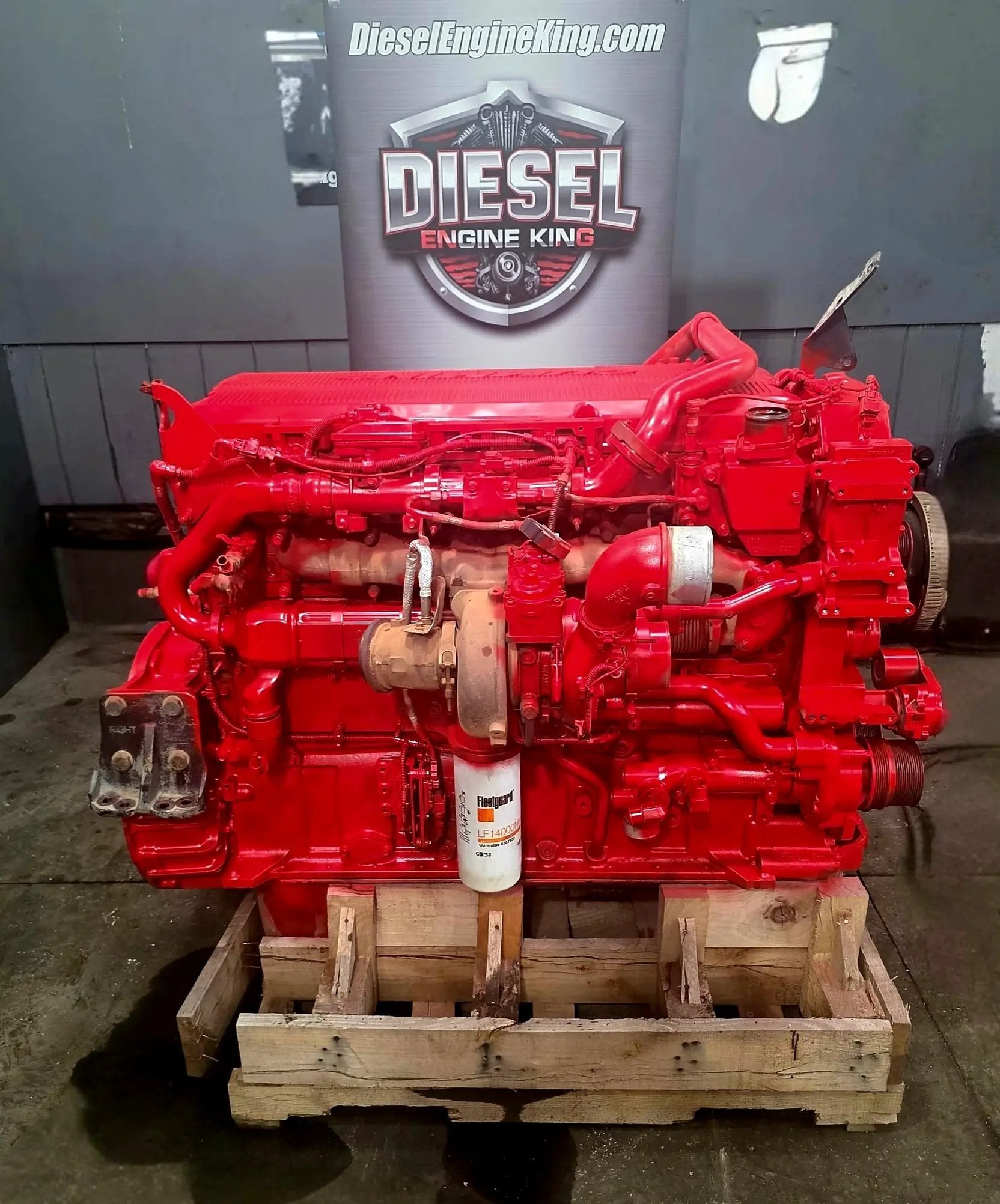
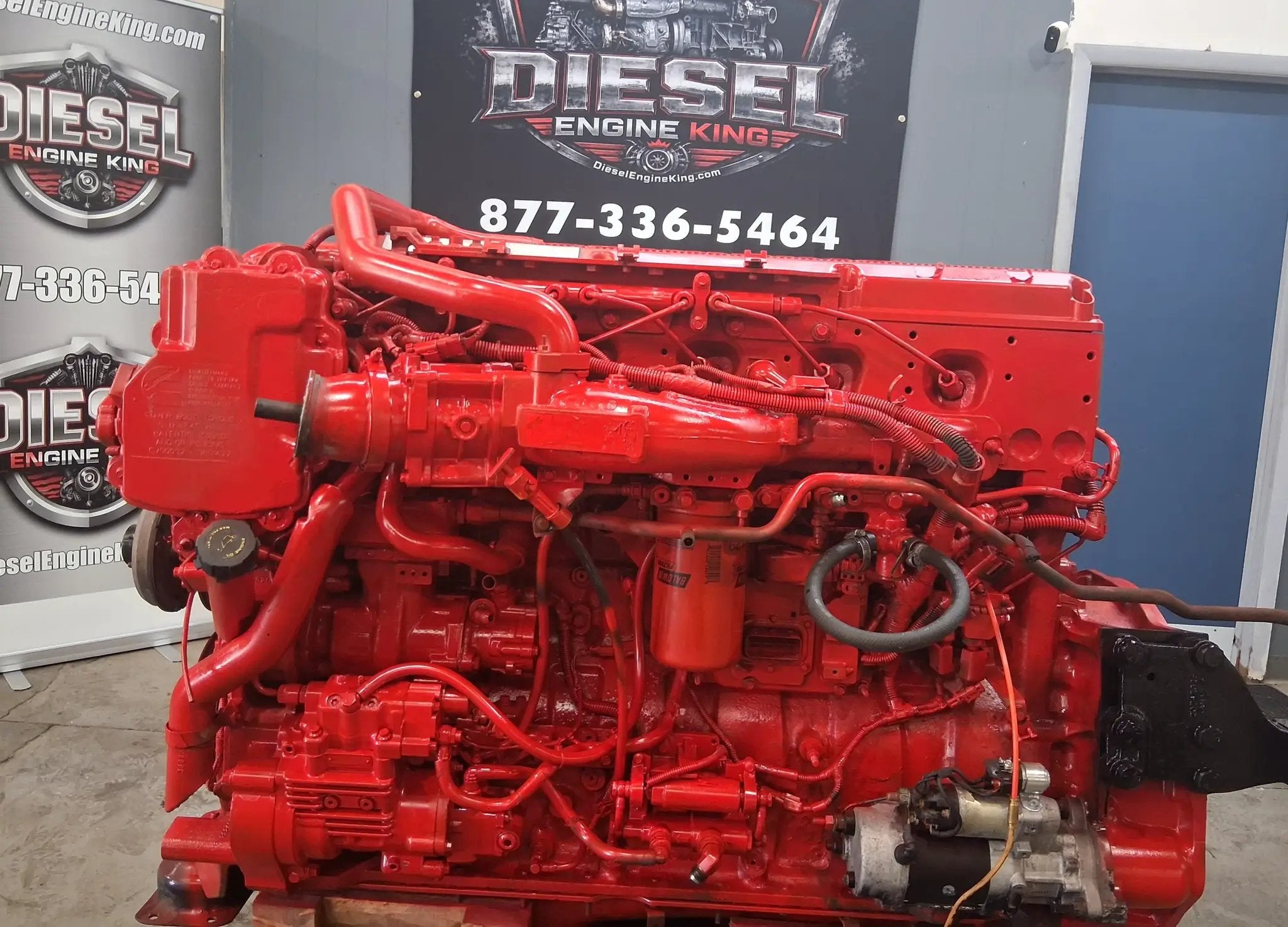
Our Buyer First process includes expert fitment assistance using your VIN and engine details, plus nationwide freight shipping. A leak-down test helps identify what to inspect.
A bad leak-down reading is a decision point, not a dead end. The right replacement engine, verified and matched to your application, gets you back to work faster.
Frequently Asked Questions
What are acceptable leak-down test results for a diesel engine?
Published guidance is not consistent, and none of the general bands are model-specific manufacturer specifications. Treat them as general starting points and confirm the limit for your engine before condemning it.
Do diesel leak-down test results vary by engine model?
Yes, and that is why a single universal pass/fail number is unreliable. Engine design details such as piston ring tension and combustion chamber design can differ between engine families. Build a baseline for your specific model and compare cylinders against each other on the same warm engine, same gauge, and same regulated air pressure.
What is a good diesel leak-down tester for diesel engines?
Look for a dual-gauge unit with an adjustable pressure regulator, and confirm the tester's specifications match your engine. The deciding factor is the adapter kit: diesel engines need glow plug or injector bore adapters, not 14mm spark plug threads. Confirm your adapter matches your bore size and seat before buying, and calibrate the tester against a known-good cylinder or a calibrated leak orifice.
What does air escaping from the intake, exhaust, or crankcase mean?
Air at the intake or exhaust can relate to the valves or their seats, while air from the oil filler or dipstick tube can relate to the piston rings or cylinder walls. Bubbles in the cooling system can indicate a head gasket issue. Confirm the source with a qualified technician before pulling the cylinder head.


