


7 Diesel Engine Data Plate Details That Decide Fitment
Last Updated: November 10, 2026
Quick Summary
A diesel engine data plate identifies the build configuration that decides fitment, so record every field, not just the serial number. The CPL or build code locks in pistons, injectors, turbocharger and calibration, and the emissions family confirms the certified tier. Compare those fields to the engine you are replacing before you order.
- Photograph the plate and the block stamping, since valve covers get swapped during rebuilds and the block is the authority.
- Two engines with the same model and different CPL numbers are not interchangeable.
- Read the serial number twice from two angles and watch for O versus 0 and I versus 1.
- Treat an ECM report as a cross-check, not proof of what engine sits in the truck.
- Ask for a plate photo showing model, CPL and serial number before approving any shipment.
Table of Contents
- Start With the Data Plate Before You Order Anything
- Engine Serial Number Location: Plate, Pad and Stamped Block Numbers
- Cummins Engine Data Plate Information Field by Field
- Diesel Engine Serial Number Lookup: Reading the Number Correctly
- Why an ECM Report Alone Will Not Confirm the Engine
- Replacement Diesel Engine Compatibility Beyond the Model Name
- How to Verify a Replacement Engine Before It Ships
- Send Us Your Plate Details and We Will Match the Engine
- Frequently Asked Questions
Start With the Data Plate Before You Order Anything
A diesel engine data plate identification for replacement engines is the single most reliable way to confirm what you are buying before money changes hands.
Here is the core problem. Two engines can share a model name and still differ in ways that stop a swap cold.
So before you call anyone, do this:
- Find the plate and photograph it
- Write down every field, not just the serial number
- Compare those fields to the engine you are replacing
That order matters. Below, we walk through each field, what it means, and how to verify a replacement engine before it ships.
Engine Serial Number Location: Plate, Pad and Stamped Block Numbers
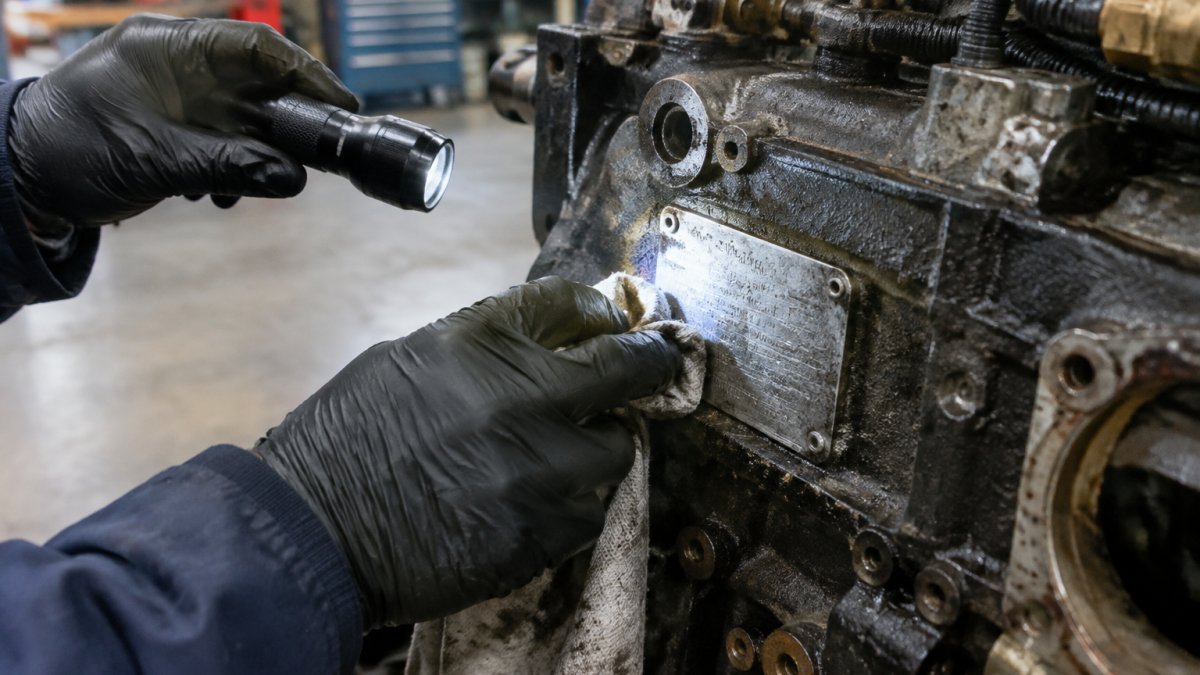
The engine serial number location varies by manufacturer, but it almost always falls into one of three places: a riveted plate, a machined pad, or a stamping cut straight into the block. The plate is the easiest to read; the block stamping is the one that cannot be swapped off.
Brand-by-Brand Plate and Stamp Locations
Use this as a starting map, then confirm against the service manual for the exact engine family. Locations shift between generations, so treat each line as a first place to look rather than a guarantee.
- Cummins (ISX15, X15, ISL, B-series): data plate is commonly on the side of the cylinder block near the oil cooler or above the pan rail; a machined pad on the block carries the stamped engine serial number. Valve-cover tags exist but are the least trustworthy because covers get swapped during rebuilds.
- Detroit Diesel (Series 60, DD13, DD15, DD16): plate is typically on the cylinder block or front gear housing; the stamped serial is on a machined pad on the block. The DD platform also carries an emissions label separate from the build plate.
- Paccar (MX-13, MX-11): plate is usually on the block near the oil filter housing or on the timing cover; the stamped number is on a block pad. Paccar also uses a separate engine identification label that can differ from the block stamping after a rebuild.
A common mistake is checking only the valve cover. Covers get swapped between engines during rebuilds, so a cover tag can lie. The block is the authority.
Reading Plate Fields With Examples
A plate mixes several kinds of numbers, and buyers often grab the wrong one. Here is how to tell them apart using a typical Cummins-style plate as the example:
- Engine model (for example, ISX15): the family and displacement. This is the starting point, not the answer.
- CPL number (for example, CPL 4588): the critical parts list. This is the build code that locks in pistons, injectors, turbocharger, and calibration. Two engines with the same model and different CPLs are not interchangeable.
- Engine serial number: the unique identifier for that specific block. This is the number you record and cross-check against the block stamping.
When you photograph the plate, frame it so every field is legible, then take a second photo of the block stamping. Store both with the service records. A phone photo of a dirty plate beats a clean memory every time.
When the Plate Is Missing, Damaged or Unreadable
Plates fall off. They corrode, get painted over, or disappear during a rebuild. When that happens, look for a stamped number on the block itself.
Try these steps:
- Clean the block pad with a wire brush and solvent. Work on a cold engine and keep hands clear of the fan, belts, and hot exhaust components.
- Shine a light at a low angle across the surface to raise the stamping.
- Check the timing cover and the area behind the fuel pump.
- Compare any stamped digits to service records and to any emissions label still on the engine.
If the stamping is truly gone, you need a different path. Our guide on how to ID a Paccar MX 13 engine serial number walks through the fallback locations step by step.
Watch out: a wire brush on a machined pad can round off a light stamping.
Cummins Engine Data Plate Information Field by Field
Cummins engine data plate information is dense, and each field answers a different question.
Here is what each field tells you:
- Engine model: the family and displacement, such as ISX15 or X15
- CPL number: the critical parts list, which locks in the exact build configuration
- Serial number: the unique identifier for that specific engine
The CPL is the field buyers skip and later regret. Two ISX15 engines with different CPL numbers can use different pistons, injectors, and turbochargers.
Write every field down. A phone photo of a dirty plate beats a clean memory every time.
Each field on a Cummins data plate answers a different question about the build.
| Field | What it tells you |
|---|---|
| Engine model | Family and displacement, such as ISX15 or X15 |
| CPL number | Critical parts list that locks in the exact build configuration |
| Serial number | Unique identifier for that specific engine |
| Engine family | Emissions certification grouping |
| Horsepower rating | Rated output at build |
| Valve lash and injection timing specs | Service settings for that build |
Diesel Engine Serial Number Lookup: Reading the Number Correctly
A diesel engine serial number lookup only works if you transcribe the number correctly. One swapped digit sends you to the wrong build record.
Watch for these traps:
- Letter and number confusion: O versus 0, I versus 1, S versus 5
- Worn stampings: a partially struck digit can read as two different characters
- Paint fill: thick paint rounds off corners and hides strokes
Read the number twice, from two angles, and photograph it under direct light. Then compare the plate serial to any stamped number on the block. If they disagree, the plate was likely replaced, and the block stamping wins.
Record the number exactly as stamped, including prefixes and suffixes. Those trailing characters often encode the build plant or a running change.
Why an ECM Report Alone Will Not Confirm the Engine
An ECM report is useful, but it is not proof of what engine sits in the truck.
So treat the ECM as a cross-check, not a source of truth. Pull the report, then confirm it against the physical plate and the stamped block number.
For a deeper look at why the plate outranks the ECM, read our breakdown on matching a replacement diesel engine to ECM specs.
Replacement Diesel Engine Compatibility Beyond the Model Name
Replacement diesel engine compatibility goes well beyond matching the model name on the valve cover. Model name gets you in the ballpark. The plate fields and the physical configuration get you to the right engine. This is the part most listings skip, and it is where wrong orders come from.
Matching CPL, Emissions Family and Sensor Configuration
Three things decide whether a replacement drops in cleanly:
- CPL or equivalent build code: confirms internals match. Two ISX15 engines with different CPL numbers can use different pistons, injectors, and turbochargers.
- Emissions family: confirms the engine is certified for the same tier. A truck that ran an EPA10 engine needs a replacement built to that same family. Bolt pattern may match while the aftertreatment strategy does not.
- Sensor and harness layout: confirms the electronics plug in without custom work. A different sensor count or connector style can turn a drop-in into a wiring project.
The Physical Variables That Break a Swap
These are the items a model-name match will not catch. Check each one against the engine you are replacing:
- Rotation: most heavy-duty diesels turn clockwise viewed from the front, but not all applications do. A reverse-rotation engine will not work in a standard application.
- Mounting and bell housing pattern: front engine mounts, rear bell housing bolt pattern, and flywheel housing must match the transmission and chassis.
- Accessory drive and PTO: alternator, air compressor, power steering pump, and PTO locations differ by application. An engine built for one chassis may not clear the frame rails in another.
Those are configuration differences, and the plate plus the application details are how you catch them before the engine ships.
If you are weighing used options, our guide on the best used diesel engines for heavy-duty trucks covers how to judge condition and compatibility together.
Watch out: a seller who lists only the model and horsepower, with no CPL, serial, or application details, is giving you too little to verify a fit.
How to Verify a Replacement Engine Before It Ships
Verification is where a good purchase is won or lost. Ask for evidence, not assurances.
Use this checklist before you approve any shipment:
- Plate photo showing model, CPL, and serial number
- Block stamping photo matching the plate
- Run video or test documentation
A seller who cannot produce a clear plate photo is a seller to walk away from. Watch out: a listing photo of a clean engine tells you nothing about the plate, and buyers who skip this step often discover a mismatch only after the engine arrives.
Our walkthrough on buying a reman Cummins X15 engine with confidence mirrors these same verification steps in more detail.
Send Us Your Plate Details and We Will Match the Engine
Send us a clear photo of your data plate, and our expert fitment assistance can help match the engine to your application.
Our 2016 Cummins ISX15 550HP CPL 4588 engine lists the CPL and engine number, priced at $18,000.00 with a 6 month warranty and $500 flat rate freight within the Lower 48 States.

Our Buyer First process includes fitment help using your VIN and engine details, plus access to testing details, photographs, and video of engines.
Contact us with your plate details to discuss fitment before you order.
Getting the plate right is the difference between a straight swap and a stalled truck.
Frequently Asked Questions
What information is found on a Cummins engine data plate?
A Cummins data plate typically carries the engine serial number, engine model, CPL number, engine family, horsepower rating and emissions configuration. The CPL is the field buyers most often overlook, and it is the one that decides whether a replacement engine matches your original build. Record every field exactly as stamped, including any suffix letters, because a single character difference can point to a different configuration. Photograph the plate before you clean it, then again after, so nothing is lost.
Where is the engine serial number located on a diesel engine?
The engine serial number location varies by manufacturer. It usually appears on a plate riveted to the block or valve cover, and on many engines the same number is stamped into a machined pad on the cylinder block. If the plate is gone, the stamped pad is your fallback. Check the block near the timing cover, the oil cooler housing and the area around the injection pump. Clean the surface with a wire brush and degreaser before reading, and take a photo with raking light so the stamping shows.
Can I identify a replacement engine by its serial number alone?
A serial number narrows the engine to a build record, but it does not confirm fitment by itself. Two engines can share a model name and still differ in CPL, emissions family, sensor layout and accessory mounting. Use the serial for a diesel engine serial number lookup, then cross-check the CPL and engine family against your original. A pre-purchase verification step that includes photos, a run video and the stamped number is what separates a confirmed match from a guess.
What should I verify before buying a replacement diesel engine?
Confirm four things: the stamped serial matches the listing, the CPL and emissions family match your application, the configuration details such as PTOX or SCR provisioning line up, and the seller can show testing evidence. Ask for any available run video or photos of the data plate and block pad, and confirm the warranty terms before purchase. On a 2016 Cummins ISX15 550HP CPL 4588 listed at $18,000.00, for example, the CPL is the number that tells you whether it drops into your truck or needs adapter work.


