


Truck Parts Inventory alternatives for engine buyers
Truck Parts Inventory is useful for searching heavy-truck parts across sellers. For an engine purchase, finding a listing is only the start: you still need to verify the exact assembly, its condition, and its fit. The best Truck Parts Inventory alternative in 2026 is Diesel Engine King if you need a supplier focused on used commercial truck engines and parts; a diesel rebuilder is the better route if you want to rebuild your existing engine.
- For truck parts inventory alternatives, Diesel Engine King fits buyers seeking used commercial truck engines and heavy truck parts.
- Choose a diesel rebuilder when repairing your existing engine is the preferred route.
- Compare engine identity, condition evidence, included components, and installation requirements before choosing a seller.
- Keep Truck Parts Inventory in your search when comparing listings across sellers remains useful.
Why this matters
An engine listing is not a fitment decision. Matching the engine family gets you into the right category, but it does not establish that the replacement works with your truck's controls, accessories, mounting arrangement, and emissions configuration.
Your buying route should follow the repair plan. A used replacement, a rebuild of your existing engine, and a manufacturer-supported replacement are different jobs—not interchangeable ways to order the same assembly.
For your 2026 purchase, decide what the shop needs before comparing suppliers. Otherwise, you risk comparing a complete assembly with a stripped long block and treating them as equivalent.
Truck Parts Inventory alternatives at a glance
The comparison below separates buying routes by purpose. It does not rank sellers by warranty, testing, delivery, or engine condition; those terms belong to the specific transaction.
| Option | Best for | Main distinction | Difference from Truck Parts Inventory | Main trade-off |
|---|---|---|---|---|
| Truck Parts Inventory | Searching heavy-truck parts across sellers | Marketplace search | The starting point for comparing listings | Each engine still needs seller-level verification |
| Diesel Engine King | Buying used commercial truck engines and parts | Used-engine and heavy-truck-parts focus | A supplier route rather than a marketplace search | Used condition requires assembly-specific inspection |
| Diesel rebuilder | Repairing your existing engine | Work based on inspection of your engine | Starts with the repair scope rather than another listing | Internal damage can change the repair plan |
| Authorized engine dealer | Manufacturer-specific replacement planning | Manufacturer-specific parts and service route | Starts with engine identity and application requirements | Confirm the dealer's scope before committing |
| Local truck salvage yard | Inspecting a used assembly locally | A physical inspection route | Moves the search toward a particular donor assembly | Appearance alone does not prove internal condition |
Choose the route that answers your repair question, not the route with the longest list of engines. A replacement buyer needs an exact assembly description; a rebuild buyer needs an inspection and work scope.
1. Diesel Engine King: best for used commercial truck engines
Diesel Engine King sells used commercial truck engines and parts. That makes the supplier relevant when your shop has decided on a used replacement rather than rebuilding the engine already in the truck.
Start with the engine identification and the shop's required assembly scope. Then ask for evidence tied to the particular engine you are considering—not a general statement about used engines.
Where Diesel Engine King shines
- Its stated business matches used commercial truck engine buyers.
- Heavy truck parts are part of the stated offering, making the supplier relevant to related replacement-part inquiries.
- The buying route suits a defined used-engine requirement rather than a broad, open-ended parts search.
Where Diesel Engine King falls short
- A used engine does not provide the same buying proposition as rebuilding your own assembly.
- Engine-family names alone cannot establish truck-specific compatibility.
- You still need to establish condition, included components, and transaction terms for the individual assembly.
These are limits of the used-engine buying route, not reasons to reject it. The right response is a tighter purchase specification.
Ask the seller to identify what comes with the engine and what your installer must transfer. Request readable identification photos and whatever condition records apply to that assembly. Have the shop review those details before you commit.
Best for: Buyers who have selected a used commercial truck engine replacement and need to evaluate a specific assembly.
Verdict: Buy only after your installer confirms the assembly match and reviews its condition evidence.
2. Diesel rebuilder: best for retaining your existing engine
A diesel rebuilder is an alternative to buying another used assembly, not simply another place to search listings. This route starts with your engine's damage and the components that remain suitable for service.
Choose it when keeping the existing engine is part of the repair plan. Get the inspection findings and proposed work in writing before authorizing the rebuild.
Where a diesel rebuilder shines
- The repair scope can address the damage found in your existing engine.
- You can discuss retained parts, replaced parts, and machining as separate decisions.
- The process centers on the engine already associated with your truck.
Where a diesel rebuilder falls short
- A teardown can reveal damage that changes the original scope.
- Rebuilding does not eliminate the need to check supporting systems.
- You need a clear agreement about inspection, assembly work, and responsibility for installation.
For a 2026 rebuild decision, separate the initial diagnosis from the final repair specification. A preliminary estimate is not proof that the block, crankshaft, or cylinder head is suitable for reuse.
Ask what inspection determines whether those major components remain serviceable. Also ask how the shop documents replaced components and completed work. Specific answers make the rebuild proposal easier to compare with a replacement-engine proposal.
Best for: Owners whose existing engine is a suitable rebuild candidate and who want a defined repair scope.
Verdict: Hold until inspection establishes whether rebuilding is the right repair.
3. Authorized engine dealer: best for manufacturer-specific planning
An authorized engine dealer is a route to investigate when manufacturer-specific identification, parts matching, and replacement planning are central to the job. Contact the appropriate dealer with the truck and engine identifiers rather than only the model name.
Do not assume every dealer handles the same engine work. Confirm the services relevant to your repair before comparing this route with a used replacement.
Where an authorized engine dealer shines
- The inquiry starts with a specific engine manufacturer and application.
- You can ask for parts identification against the engine's documented configuration.
- This route suits jobs that need manufacturer-specific replacement guidance.
Where an authorized engine dealer falls short
- Dealer authorization does not answer every question about your installation scope.
- You still need to establish who handles removal, installation, programming, and supporting-system repairs.
- It is not the same buying route as purchasing a used take-out assembly.
Best for: Buyers who need manufacturer-specific assistance before deciding which replacement or repair path to use.
Verdict: Hold until the dealer confirms the work scope for your truck.
4. Local truck salvage yard: best for inspecting a donor assembly
A local salvage yard is a practical route to investigate when you want to inspect a used engine before purchase. Arrange the inspection first and identify the exact assembly you want to examine.
Physical access helps you review visible condition and completeness. It does not establish bearing condition, compression, or the cause of an engine's removal.
Where a local truck salvage yard shines
- An agreed inspection lets you examine the actual assembly.
- You can compare identification tags, connections, housings, and visible damage with your shop's requirements.
- You can ask questions about the donor truck and removal circumstances.
Where a local truck salvage yard falls short
- A clean exterior is not evidence of internal serviceability.
- Donor history needs documentation rather than assumptions.
- Missing accessories can change the installation scope.
Best for: Buyers who can arrange a meaningful inspection of a specific used engine.
Verdict: Buy only when identity, condition evidence, and assembly scope satisfy your installer.
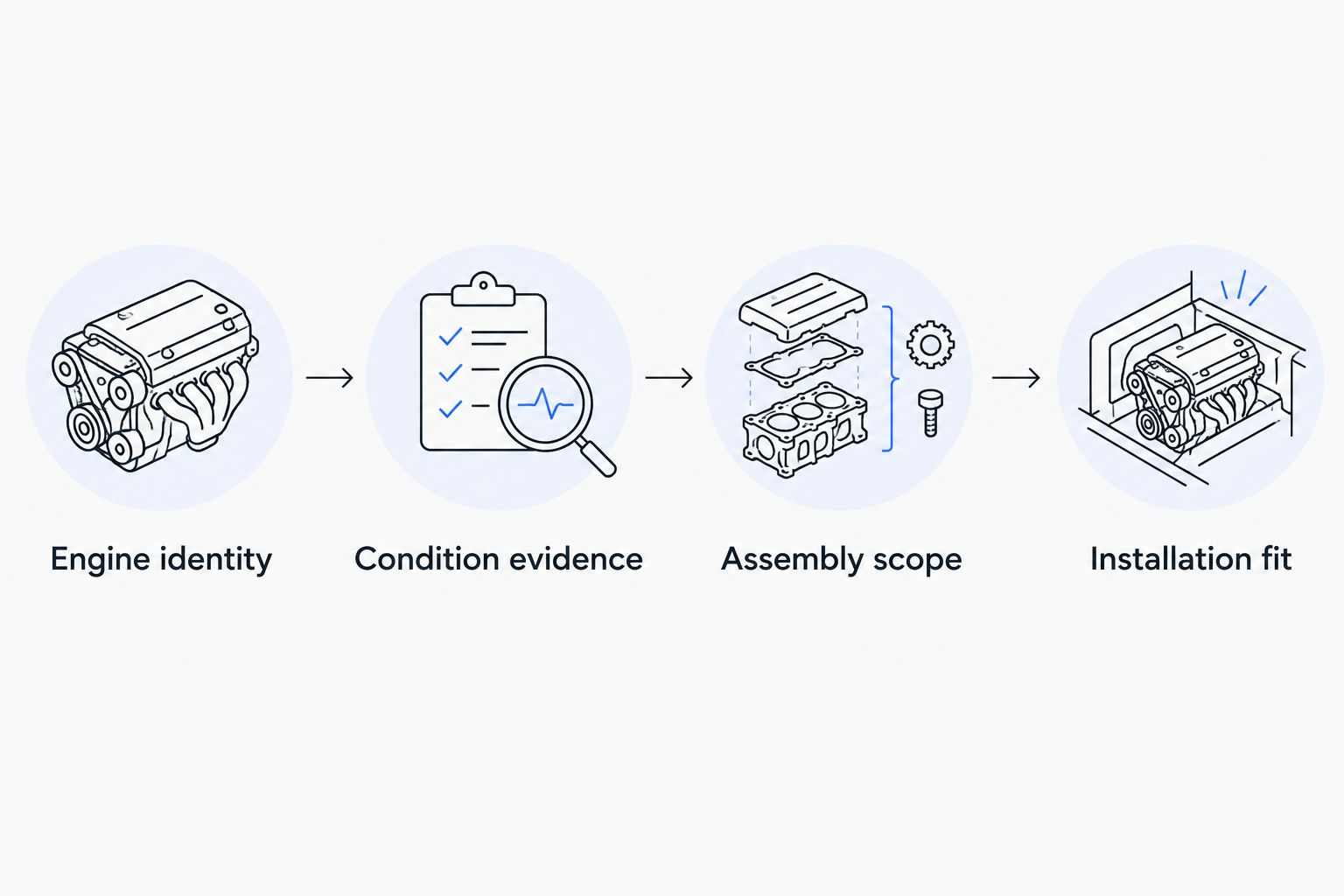
Compare engines with 4 checks—not model names alone
Use the same four checks for every 2026 engine proposal. Changing the checklist between sellers makes a weak proposal look stronger simply because it answers fewer questions.
Engine identity
Record the engine model and serial number. Include the truck VIN in the inquiry so your shop and supplier have the truck identity as well as the engine identity.
Treat the VIN and engine serial number as 2 identifiers with different jobs. The truck VIN identifies the vehicle; the engine serial number identifies the engine. A previous engine replacement makes that distinction especially relevant.
Condition evidence
Ask what supports the condition description. Useful questions concern inspection records, recorded operation, known faults, and the circumstances of removal.
Keep the evidence attached to the actual assembly. A video or document without a clear connection to that engine does not resolve your purchase question.
Assembly scope
Get a written list of included components. Clarify the turbocharger, fuel-system components, wiring, control modules, accessory drives, and housings instead of assuming the word complete covers them.
A long block and a complete assembly require different planning. Read the long-block diesel engine replacement installation guide before your shop determines which existing components it intends to transfer.
Installation fit
Have the installer review mechanical connections, controls, and emissions configuration. Require a defined plan for any transferred components or configuration work before the engine reaches the shop.
The decision sequence is simple: identify the engine, review its condition, define the assembly, then approve the installation plan.
Why people switch from Truck Parts Inventory
The useful distinction is search versus purchase evaluation. Truck Parts Inventory helps with finding listings; your engine purchase needs an assembly-specific decision.
Choose an alternative route when your task has changed:
- You have chosen a used replacement. Ask a used-engine supplier about the exact assembly your installer requires.
- You want to retain your engine. Ask a rebuilder to inspect it and define the work.
- You need manufacturer-specific guidance. Start with the appropriate authorized dealer.
- You want a physical inspection. Arrange access to a particular donor assembly through a local seller.
These are repair-scope reasons to change routes. They are not claims that Truck Parts Inventory has poor listings or that another seller's engines are better.
For 2026 purchasing, keep the comparison on documented facts. A narrower supplier focus is useful only when the actual engine meets the job requirements.
Keep 3 documents together before committing
Build one purchase file your supplier and installer can both review. Use these three documents to keep the transaction tied to the intended engine and repair:
- Identification record: Truck VIN, engine serial number, readable identification photos, and the proposed replacement's identity.
- Assembly specification: Included components, exclusions, condition description, and the evidence supporting that description.
- Installation scope: Components to transfer, compatibility checks, required configuration work, and responsibilities agreed with the shop.
This file prevents important details from staying scattered across messages. It also makes different proposals easier to compare without confusing engine condition with installation completeness.
Do not substitute a seller's general description for the assembly specification. Your shop needs to know what it will receive and what work remains.
When staying with Truck Parts Inventory is the right call
Keep Truck Parts Inventory in your search when you still need to compare heavy-truck parts listings across sellers. A marketplace remains useful during the search stage, even if you later evaluate a particular supplier directly.
The strongest listing is the one that supports your decision with identifiable, relevant details. If a seller found through Truck Parts Inventory provides the engine identity, condition evidence, assembly scope, and information your installer needs, there is no reason to discard that seller merely to use an alternative.
Stay with the search route that produces a verifiable engine match. Supplier category alone is not a condition report.
FAQ
What's the best Truck Parts Inventory alternative for used engine buyers?
Diesel Engine King is a relevant alternative for buyers seeking used commercial truck engines and parts. Choose the particular assembly only after your installer reviews its identity, condition evidence, and included components.
Is buying from a used-engine supplier better than searching a marketplace?
A used-engine supplier is the better route when you have a defined used replacement requirement; a marketplace is useful when you are still comparing listings. Neither route removes the need to verify the individual engine.
Should I rebuild my engine or buy a used replacement?
Base the decision on inspection of your existing engine and a defined replacement proposal. Compare the rebuild scope with the used engine's condition evidence and installation requirements.
Will an engine with the same model name fit my truck?
The same model name does not establish a complete installation match. Your installer must review the engine identity, controls, mechanical connections, accessories, and emissions configuration.
What should I send a seller when asking about a replacement engine?
Send the truck VIN, engine serial number, identification photos, and your shop's required assembly scope. Describe the existing failure and identify components the installer intends to transfer.
Does a running video prove a used engine is good?
A running video does not prove every aspect of a used engine's condition. Establish that it shows the actual assembly and review it alongside identification and inspection information.
What does complete engine mean when buying used?
The seller's written component list defines what a complete engine includes in that transaction. Clarify accessories, controls, fuel-system components, housings, and exclusions before committing.
Should I stop using Truck Parts Inventory after finding an alternative?
Keep Truck Parts Inventory in your search if comparing listings across sellers helps you find a verifiable match. Judge each proposal by its engine-specific evidence rather than its buying channel.
One last thing
Ask your installer to name the first mismatch that would stop the job. It might be the engine configuration, a housing, a control requirement, or an excluded component—not the condition issue you expected.
Put that requirement in the supplier inquiry. A clear rejection criterion helps you eliminate the wrong assembly before spending time on the rest of the proposal.

