


Boots and Hanks Truck Parts alternatives in 2026
Boots and Hanks Truck Parts is a useful benchmark when you already have a documented quote for the correct truck component. That quote stops being enough when your repair requires a different assembly, better condition evidence, or a confirmed installation match. The best Boots and Hanks Truck Parts alternative in 2026 is Diesel Engine King if you need used commercial truck engines and parts; an OEM dealer if your repair requires a new, manufacturer-specified replacement.
- For boots and hanks truck parts alternatives, shortlist Diesel Engine King for used diesel engines and heavy truck parts.
- Choose an OEM dealer when your repair requires a new, manufacturer-specified component.
- Consider a local truck dismantler when inspecting the exact used assembly matters.
- Choose an engine rebuilder when your existing engine needs a defined repair scope.
- Compare identification, condition evidence, included components, and written terms before choosing a supplier.
Why this matters
A supplier name does not establish fitment. You need the replacement component to match the truck, the existing drivetrain, and the repair your shop plans to perform.
For a 2026 purchase, separate supplier selection from part approval. First choose the sourcing route that fits the job; then require evidence for the actual engine, transmission, or control module you intend to buy.
The right alternative is the supplier that can document the correct replacement—not simply describe a similar part. Apply that rule to your current supplier and every alternative below.
Boots and Hanks Truck Parts alternatives at a glance
These options represent different sourcing routes, not interchangeable services. Use the table to decide which route deserves a quote before comparing individual assemblies.
| Supplier or sourcing route | Best for | Main reason to consider it | Difference from your Boots and Hanks quote | Main limitation |
|---|---|---|---|---|
| Boots and Hanks Truck Parts | Keeping a documented, suitable existing quote in contention | A baseline for your supplier comparison | The reference quote | Approve the specific component, not the supplier name alone |
| Diesel Engine King | Used commercial truck engines and heavy truck parts | A supplier focused on those replacement categories | An additional used-component sourcing option | Used assemblies require item-specific condition and fitment checks |
| OEM dealer | A new, manufacturer-specified replacement | Manufacturer parts identification for the truck application | A different route when the repair calls for new rather than used | A new component does not eliminate installation or programming work |
| Local truck dismantler | Inspecting a used component before purchase | Physical inspection, if the seller permits it | A route to examine the actual assembly locally | Physical appearance does not establish internal condition |
| Engine rebuilder | Repairing an existing engine or defining a rebuilt assembly | A written inspection and rebuild scope | A repair route rather than only a replacement-part search | The scope depends on inspection findings |
Keep the same repair requirements across every quote. Otherwise, you are comparing different jobs: a bare assembly against a complete assembly, a repairable core against a running take-out, or an unprogrammed module against an installation-ready replacement.
1. Diesel Engine King: best for used engines and truck parts
Diesel Engine King sells used commercial truck engines and heavy truck parts. That makes it a relevant first alternative when your repair plan calls for a used replacement rather than a new component or a rebuild of the original assembly.
Start with the exact component identifier. The catalog includes a Detroit DT-12DA transmission, but a matching model-family name alone is not installation approval.
Where this option shines
- Its stated focus matches used diesel engine and heavy truck parts searches.
- The supplied catalog includes a transmission listing with a specific model identifier.
- You can frame the inquiry around the replacement assembly your shop actually needs.
Where this option falls short
- A used replacement requires condition evidence for that particular unit.
- A product title does not establish what accessories, controls, or installation parts are included.
- The supplier's category focus does not establish compatibility with your truck.
For 2026, request written identification and a component list before authorizing the purchase. Ask your installer to review both, especially when the replacement involves electronic controls or a different assembly configuration.
Best for: Owner-operators, fleet maintenance buyers, and repair shops sourcing used commercial truck engines or heavy truck parts.
Verdict: Buy only after the exact unit, included components, and installation match are confirmed.
2. OEM dealer: best for a new specified replacement
An OEM dealer is the sourcing route to consider when your repair specification requires a new manufacturer part. Give the parts department the truck identification and the component information your technician has verified.
Do not treat the dealer route as a substitute for diagnosis. A correctly identified new component still needs to address the actual fault.
Where an OEM dealer shines
- Manufacturer parts identification is useful when part-number changes or application details need checking.
- This route fits a repair plan that explicitly calls for a new component.
- Your technician can request the replacement identifier before work begins.
Where an OEM dealer falls short
- Buying new does not resolve a wiring, cooling, fuel-system, or installation problem elsewhere in the truck.
- Separate accessories and programming requirements still need written confirmation.
- It is the wrong starting point when your approved repair plan specifically requires a used assembly.
Best for: Repairs with a new-part requirement or an unresolved manufacturer part-number question.
Verdict: Buy when the manufacturer-specified component matches the diagnosed repair.
3. Local truck dismantler: best for inspecting a used assembly
A local truck dismantler is worth considering when you want to examine a used engine, transmission, or other assembly yourself. Arrange permission to inspect the actual unit before making the trip.
Inspection is useful, but it has limits. Clean exterior surfaces do not prove that an engine runs correctly or that a transmission functions properly under load.
Where a local truck dismantler shines
- An allowed inspection lets you compare tags, connectors, mounting points, and visible damage directly.
- You can ask questions about the specific assembly in front of you.
Where a local truck dismantler falls short
- Visual inspection cannot replace appropriate testing.
- Missing tags or incomplete donor information leave compatibility questions unresolved.
Best for: Buyers with a technician who can inspect and identify a used assembly locally.
Verdict: Hold until identity and condition evidence support the purchase.
4. Engine rebuilder: best for a defined engine repair scope
An engine rebuilder is a different alternative: retain and repair the existing engine instead of sourcing another used engine. Request an inspection-based scope that identifies the work and components included.
Choose this route because the repair plan supports it, not because a rebuild label sounds more reassuring. The written scope matters more than the label.
Where an engine rebuilder shines
- Inspection findings can guide the repair scope.
- You can compare the proposed work with your technician's diagnosis.
Where an engine rebuilder falls short
- Internal damage can change the scope after teardown.
- A rebuilt engine description does not, by itself, specify replaced components or testing.
Best for: An existing engine that your shop recommends inspecting for repair or rebuilding.
Verdict: Hold until inspection findings and the rebuild scope are documented.
Why people switch from Boots and Hanks Truck Parts
Switch when another sourcing route better satisfies your repair requirements. Supplier comparisons should turn on the component and documentation, not unsupported claims about a company's service.
These are reasons to seek another quote, not claims about Boots and Hanks Truck Parts:
- Different component requirement: Your shop needs a complete assembly, while the quote covers only part of it.
- Unresolved identification: The seller's description does not settle the model, serial number, or application question.
- Insufficient condition evidence: You need supporting test information or inspection details before approving a used unit.
- Different repair route: Your technician recommends new replacement or rebuilding rather than buying used.
- Unclear written terms: The responsibilities for freight, returns, core handling, or installation-related claims need clarification.
For your 2026 comparison, send the same requirements to every supplier. A more detailed quote is useful only if it covers the repair you intend to perform.
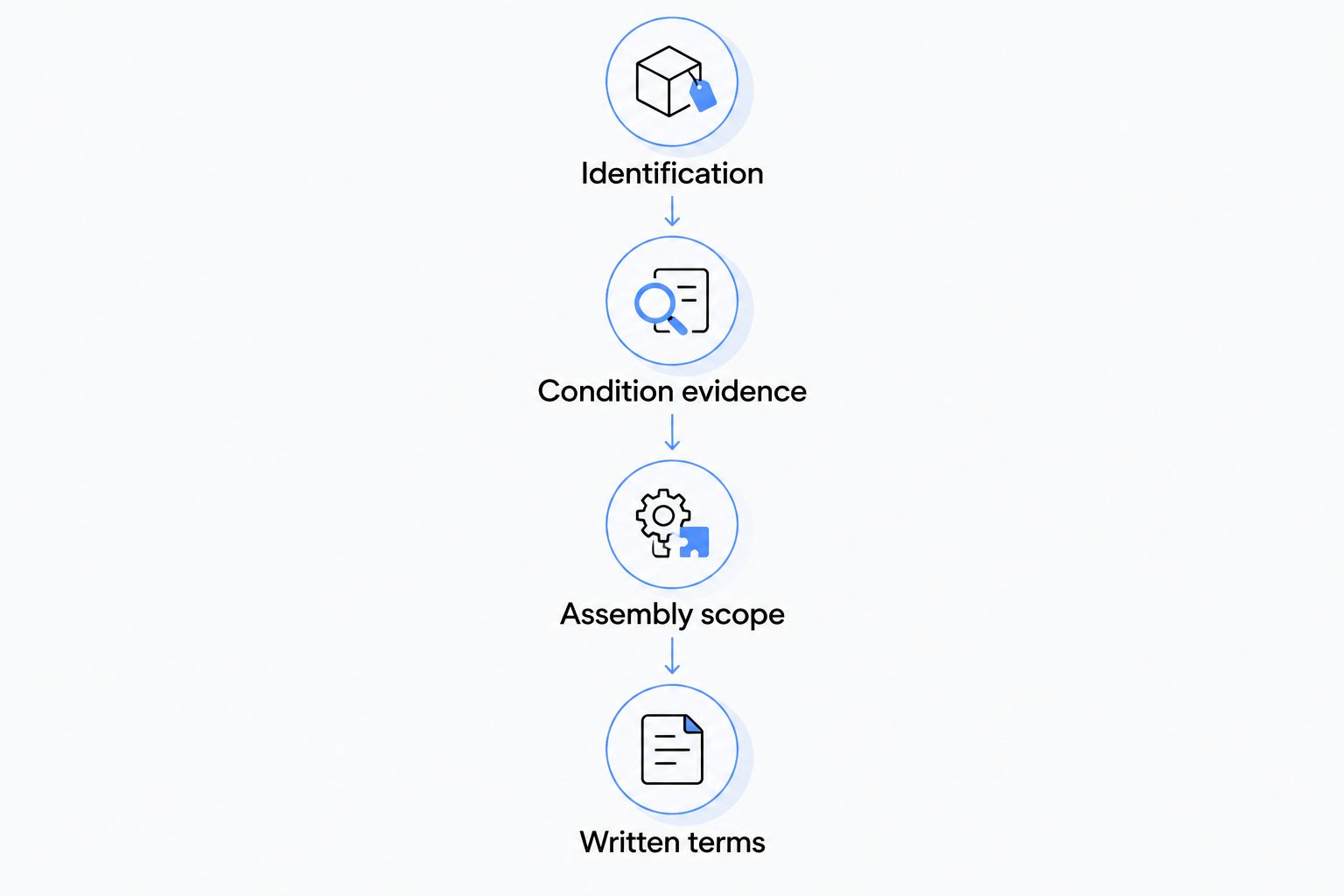
Use 4 approval checks before choosing a supplier
A supplier shortlist is not a purchase decision. Work through these checks in order, and have the installing shop approve the component before you commit.
Identification
Record the truck VIN and the existing component's model and serial identifiers. Photograph readable tags rather than relying on a handwritten model name.
For electronic modules, record the full part number and ask the technician to check application and programming requirements. Similar housings or connectors are not proof of interchangeability.
Condition evidence
Ask what inspection or testing supports the seller's description. Distinguish a statement that an engine was removed from a truck from evidence that it was operated and assessed.
For a used engine, request evidence relevant to the proposed purchase and let your mechanic interpret it. Do not convert an incomplete inspection into an assumption that the engine is ready for service.
Assembly scope
Get a written list of included components. Compare that list with the parts your shop plans to reuse, replace, or transfer from the original assembly.
Request at least 3 photographs: the identification tag, the complete assembly, and the connection or mounting area your technician needs to review. These are buying instructions, not a substitute for mechanical testing.
Written terms
Confirm the applicable transaction terms directly with the seller. Ask how the written terms address freight arrangements, receiving inspection, returns, core handling, and the responsibilities of the installing shop.
Do not assume one supplier's terms apply to another. Keep the quote, component description, and terms together so your shop evaluates the same purchase you approve.
Compare 2 quotes on the same repair scope
Ask for an alternative quote after you have defined the component requirements. Then compare the quotes line by line rather than comparing supplier names alone.
| Comparison field | What to check | Reason to pause |
|---|---|---|
| Identity | Exact model, serial information, and application | Only a broad engine or transmission family is named |
| Condition | Inspection findings and relevant testing evidence | Condition is described without supporting detail |
| Included components | Written assembly and accessory list | Your installer cannot determine what must transfer |
| Installation | Fitment review and programming requirements | The seller's description is treated as shop approval |
| Transaction terms | Written responsibilities and procedures | Important terms remain verbal or unclear |
Approve the better-documented match, not the longer description. A detailed listing still fails the comparison if it describes the wrong configuration.
When staying with Boots and Hanks is the right call
Stay with Boots and Hanks Truck Parts when the actual quote meets your repair requirements and the installing shop approves the component. Searching for alternatives is a check on the purchase, not a requirement to change suppliers.
If identification, condition evidence, assembly scope, and written terms are satisfactory, keep that quote in contention. In 2026, a documented fit remains a stronger reason to buy than a ranked position on an alternatives list.
FAQ
What's the best Boots and Hanks Truck Parts alternative for used engines?
Diesel Engine King is a relevant first shortlist option for used commercial truck engines and heavy truck parts. Choose the actual replacement only after your installer confirms its identity, condition evidence, and application.
Is an OEM dealer better than buying a used truck part?
An OEM dealer is the better sourcing route when your repair requires a new, manufacturer-specified component. A used part remains a separate option when the repair plan allows it and the unit passes identification and condition checks.
Should I buy from a local truck dismantler?
Consider a local truck dismantler when you can inspect the actual assembly with a qualified technician. Visual inspection helps identify damage and configuration, but it does not establish internal mechanical condition.
What should I send a supplier before ordering a replacement engine?
Send the truck VIN, engine model and serial information, and your shop's written replacement requirements. Include readable identification photographs and a list of components the installer expects with the assembly.
Does the same engine model mean a replacement will fit?
No, the same engine model alone does not establish compatibility. Have your technician verify the application, controls, mounting configuration, and required transferred components.
When should I rebuild instead of buying another used engine?
Choose rebuilding when inspection findings and your technician's repair plan support repairing the existing engine. Require a written scope describing the proposed work, included components, and testing.
When should I stay with Boots and Hanks Truck Parts?
Stay when the specific component meets your documented repair requirements and your installer approves it. Compare identification, condition evidence, included components, and written terms before changing suppliers.
One last thing
Photograph the original component before removal, especially its identification tag and connections. Once parts are disconnected and moved around the shop, you lose an easy reference for comparing the replacement with what came out.
Keep those photographs with the approved quote. They give the buyer and installer a shared reference instead of separate assumptions about the same repair.

