


Is the PACCAR MX-13 a good engine?
Yes—the PACCAR MX-13 is a good engine to consider when its maintenance history, mechanical condition, emissions system, and truck compatibility check out. For a used-engine purchase in 2026, unresolved faults and an undocumented service history matter more than the model's reputation; replacing the engine also does not automatically correct faults elsewhere in the truck.
- Is the PACCAR MX-13 a good engine? Yes, when inspection results and maintenance records support the purchase.
- Judge PACCAR MX-13 reliability by the individual engine, not mileage or a seller's running video alone.
- Check the engine and aftertreatment separately before approving a used diesel engine replacement.
- Diesel Engine King serves buyers sourcing used commercial truck engines and heavy truck parts.
Is the PACCAR MX-13 a good engine?
The PACCAR MX-13 is a sound candidate for a compatible truck, but the model name alone is not a buying recommendation. PACCAR's technical specifications identify the MX-13 as a 12.9-liter, 6-cylinder, 4-stroke diesel engine. Those specifications describe its architecture, not the remaining service life of a particular used unit.
Use this decision table to separate a suitable candidate from an engine that needs more investigation.
| Engine condition | Best for | Positive evidence | Limitation | Decision |
|---|---|---|---|---|
| Documented, inspected MX-13 | Buyers replacing a compatible engine | Traceable identity, service records, and satisfactory test results | Inspection cannot guarantee future service life | Consider buying after confirming fit |
| Running MX-13 with incomplete records | Buyers able to arrange further testing | Demonstrated operation | A running video does not establish internal condition | Hold pending inspection |
| MX-13 with unresolved faults | Buyers commissioning a defined repair project | A diagnosed fault can establish repair scope | An unexplained symptom leaves the scope uncertain | Skip until diagnosed |
Diesel Engine King supplies used commercial truck engines and heavy truck parts. Treat supplier selection and engine acceptance as separate decisions: you still need evidence tied to the exact unit.
Why this matters
A used engine is not just a block and cylinder head. Its operation depends on fuel delivery, cooling, lubrication, air handling, electronics, and the truck's emissions equipment working together.
For a 2026 purchase, separate three questions: Is the engine mechanically serviceable? Does the truck have unresolved supporting-system faults? Is the replacement compatible with the installation? A satisfactory answer to one does not answer the others.
Do not condemn an MX-13 solely because the truck has a warning light, and do not approve one solely because it starts. Diagnosis must establish which system caused the complaint.
What are the PACCAR MX-13's strengths and limitations?
The MX-13's clearest practical advantage in a replacement project is retaining the engine platform in a truck already configured for it. A correctly matched replacement avoids introducing a different engine family into the installation. That is a compatibility advantage, not permission to assume every MX-13 interchanges.
Its main purchasing limitation is the information required to judge a used example. Engine identity, electronic configuration, maintenance history, and inspection results all matter. A clean exterior cannot replace those checks.
Strength: retaining the correct engine platform
Best for: owners replacing an MX-13 in a truck whose original configuration is known. Start with the existing engine serial number and truck identification, then compare the proposed replacement against the required specification.
Even within the same engine family, verify the relevant hardware, wiring, controls, and emissions configuration. Have the installing shop approve the match before you authorize the purchase.
Limitation: a running engine is not a complete assessment
Best for: buyers who can obtain a documented inspection before committing. Starting and idling demonstrate operation under those conditions. They do not establish performance under load, oil consumption, cooling-system integrity, or the absence of intermittent faults.
Ask what was tested, under what conditions, and what the results showed. The useful evidence is the test record, not an unexplained description such as good runner.
Why PACCAR MX-13 reliability varies
The following factors determine how you should assess an individual used engine. None is a substitute for checking the others.
- Maintenance history: Review oil, filter, coolant, and other service records against the maintenance requirements for the exact engine and application. Gaps leave the engine's care unverified.
- Previous duty: Ask about route type, loading, idling, and operating conditions. Mileage alone does not describe how the engine accumulated its service.
- Cooling and lubrication: Investigate overheating, coolant loss, low oil pressure, contamination, and abnormal oil consumption. Establish the cause before deciding whether a repair or replacement addresses it.
- Air and fuel systems: Check intake restrictions, charge-air leaks, turbocharger operation, and fuel-system faults. These systems affect engine operation without necessarily proving internal engine damage.
- Emissions-system condition: Evaluate exhaust gas recirculation and the fitted aftertreatment equipment. A mechanically serviceable engine does not establish that the truck's emissions system is serviceable.
- Repair and installation quality: Confirm previous work and replacement compatibility. Reusing a failed supporting component can leave the original problem unresolved.
How do you inspect a used PACCAR MX-13 before buying?
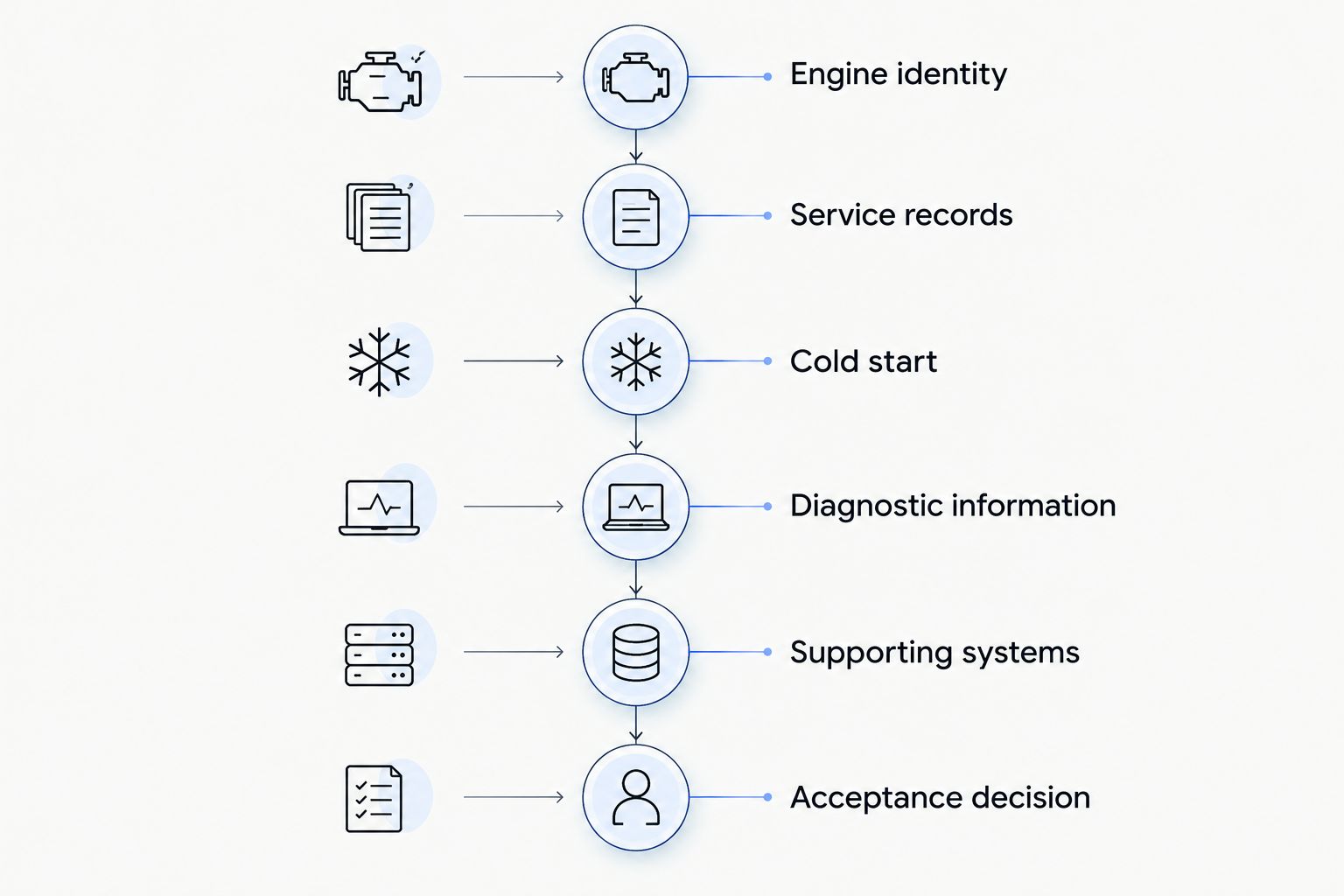
Use a qualified heavy-duty diesel technician with suitable diagnostic equipment. For a 2026 inspection, request a written record that identifies the engine and distinguishes observed results from seller statements.
The used PACCAR MX-13 inspection guide provides a focused companion checklist. The sequence below establishes the purchasing decision before installation work begins.
1. Confirm engine identity
Record the engine serial number, identification-label information, and donor-truck details when available. Compare them with the invoice, service records, and electronic identification retrieved during diagnosis.
Stop when identifying information conflicts. Resolve the discrepancy before treating maintenance records or test results as evidence for that engine.
2. Review service and repair records
Look for a traceable maintenance history and explanations of major repairs. An overhaul invoice is useful only when it identifies the engine and describes the actual work performed.
Ask what prompted removal. A collision-damaged donor truck and a truck removed from service for coolant loss present different inspection questions; neither explanation replaces testing.
3. Observe a genuine cold start
Arrange to see the engine before it has been warmed up. Have the technician assess cranking, starting behavior, abnormal noise, visible leaks, and smoke in context.
Do not diagnose an internal failure from smoke color alone. Temperature, fuel delivery, coolant entry, and combustion problems require different follow-up checks.
4. Retrieve diagnostic information
Request a diagnostic report before codes are cleared. Review active faults, stored faults, operating information, and available engine identification with the technician.
A report without active faults is useful, but it does not prove the absence of mechanical wear. Likewise, a fault code identifies a diagnostic starting point rather than automatically identifying the failed part.
5. Evaluate operation and supporting systems
Where the installation and test facilities permit, assess the engine beyond idle. Have the technician evaluate oil pressure, operating temperature, boost behavior, leaks, and other relevant parameters against the correct service information.
If load testing is unavailable, record that limitation. Do not treat an unloaded demonstration as equivalent to operating the engine under its intended work conditions.
6. Obtain a written acceptance decision
Separate confirmed findings, unresolved questions, and required repairs. Ask the installing shop to confirm both mechanical suitability and installation compatibility.
Approve the exact engine, not a general description of an MX-13. Keep the identification, inspection report, included-component list, and purchase terms together.
Which MX-13 symptoms deserve further diagnosis?
Treat symptoms as reasons to investigate, not proof that every MX-13 has the same defect. Inspection should establish whether the issue belongs to the engine, its supporting systems, or the truck's aftertreatment.
| Symptom | What to investigate | What not to assume |
|---|---|---|
| Repeated coolant loss | External leaks and possible internal leakage paths | Every coolant-loss complaint requires an engine replacement |
| Low power | Fuel supply, air handling, controls, exhaust restrictions, and derate status | The turbocharger is automatically defective |
| Excessive oil consumption | External leakage, ventilation, turbocharger condition, and internal wear | Mileage alone establishes the cause |
| Warning lights or derate | Fault details and the manufacturer's diagnostic procedure | Clearing codes repairs the underlying problem |
| Hard starting | Cranking performance, fuel delivery, controls, and mechanical condition | A successful warm start proves cold-start condition |
Never open a hot, pressurized cooling system. Follow the manufacturer's procedures for inspection and testing, and keep hands clear of moving components during operation.
Is a high-mileage PACCAR MX-13 still worth buying?
High mileage alone does not decide whether a PACCAR MX-13 is worth buying. Assess mileage alongside operating hours, maintenance records, repair history, and current test results.
A lower odometer reading does not prove better engine condition. The truck's odometer also does not independently verify the mileage of a replacement engine fitted during its service life.
For a 2026 purchase, ask how the seller established the engine's reported mileage. Compare available donor records and electronic information, and resolve discrepancies rather than selecting whichever reading looks most favorable.
Is a PACCAR MX-13 with emissions faults a bad engine?
Emissions faults alone do not establish that a PACCAR MX-13 has internal mechanical damage. They establish a need to diagnose the affected system and determine whether other faults are contributing.
Check the fitted exhaust gas recirculation, diesel particulate filter, selective catalytic reduction, and associated sensors as applicable to the exact configuration. Follow the manufacturer's diagnostic process rather than replacing parts from the fault description alone.
An engine swap is not a repair for every truck-side emissions problem. Confirm what remains on the truck and whether those components contributed to the original complaint.
Should you rebuild your MX-13 or buy a used replacement?
Choose between rebuilding and replacement only after diagnosing the existing engine. The decision depends on repair scope, the condition of reusable components, installation requirements, and evidence supporting the replacement candidate.
| Approach | Best for | Main advantage | Main limitation |
|---|---|---|---|
| Repair the existing engine | A diagnosed fault with a defined repair scope | Retains the known installation | Other wear remains outside the repair unless addressed |
| Rebuild the existing engine | An engine confirmed suitable for rebuilding | Allows inspection and repair of the agreed internal components | Results depend on scope, measurements, parts, and workmanship |
| Install a used replacement | A verified compatible engine with satisfactory inspection evidence | Replaces the existing engine assembly | Used condition and included components require verification |
Request written scopes for each approach. Compare what gets repaired, replaced, transferred, tested, and excluded—not just whether the proposal says rebuilt or replacement.
Diesel Engine King's used diesel engines and heavy truck parts are relevant to the sourcing stage. Engine selection still requires unit-specific inspection and confirmation from the installing shop; a supplier's general product category cannot establish compatibility.
FAQ
Is the PACCAR MX-13 a good engine for a used truck?
Yes, a PACCAR MX-13 is a good candidate when maintenance records, inspection results, and application compatibility support the purchase. Evaluate the engine and the truck's emissions equipment separately.
How many miles will a PACCAR MX-13 last?
A specific PACCAR MX-13's remaining service life cannot be established from mileage alone. Maintenance history, operating conditions, repairs, and current mechanical condition are necessary to judge the individual engine.
What should I check before buying a used PACCAR MX-13?
Check engine identity, service records, cold-start behavior, diagnostic information, mechanical condition, and installation compatibility. Have a qualified technician document unresolved faults before you commit.
Does an MX-13 derate mean the engine needs replacing?
No, an MX-13 derate does not by itself establish a need for engine replacement. Diagnose the underlying fault and determine whether it involves the engine, controls, or emissions equipment.
Will any PACCAR MX-13 fit my truck?
No, the MX-13 model name alone does not establish replacement compatibility. Match the engine's identity, hardware, controls, and emissions configuration to the truck with help from the installing shop.
Is a running video enough to approve a used MX-13?
No, a running video does not establish internal condition, performance under load, or installation compatibility. Request inspection results tied to the exact engine.
Does Diesel Engine King sell used commercial truck engines?
Diesel Engine King supplies used commercial truck engines and heavy truck parts. Confirm the exact engine specification, included components, inspection evidence, and purchase terms before ordering.
One last thing
Find out why the original engine failed before installing its replacement. A replacement engine does not correct a restricted cooling system, contaminated fuel supply, damaged wiring, or another unresolved truck-side fault.
For your 2026 purchase, make the failure diagnosis part of the installation plan. The strongest buying decision pairs a verified replacement with a documented correction of the problem that took the truck out of service.

