


How much horsepower does a PACCAR MX-13 have?
The PACCAR MX-13 produces up to 510 hp, but the horsepower of a specific engine depends on its factory rating and approved calibration. For a used-engine purchase in 2026, treat 510 hp as the engine family's published maximum—not proof that every MX-13 delivers that output.
- PACCAR MX-13 horsepower reaches 510 hp; verify the rating of the individual engine before buying.
- PACCAR lists peak torque up to 1,850 lb-ft, depending on the engine specification.
- An ECM part number alone does not establish an MX-13 engine's horsepower or replacement compatibility.
- Diesel Engine King serves buyers sourcing used commercial truck engines and heavy truck parts.
How much horsepower does a PACCAR MX-13 have?
A PACCAR MX-13 has up to 510 hp in published North American specifications. PACCAR also identifies the MX-13 as a 12.9-liter engine with peak torque up to 1,850 lb-ft. Those are engine-family specifications, not a substitute for the records attached to an individual engine.
When you compare used engines in 2026, separate the advertised rating from the engine's identity and current condition. Start with the serial number, then use the used PACCAR MX-13 inspection guide to organize the physical checks.
| Specification | Published MX-13 figure | What it tells you | What it does not establish |
|---|---|---|---|
| Maximum horsepower | Up to 510 hp | The engine family's published upper output | The rating of every used MX-13 |
| Maximum torque | Up to 1,850 lb-ft | The published upper torque specification | The torque calibration of a particular engine |
| Displacement | 12.9 liters | The engine's displacement | Horsepower, condition, or truck compatibility |
| Individual engine rating | Verify by engine records and calibration | The specification you need for replacement planning | Present mechanical health |
Source scope: PACCAR's published North American MX-13 engine specifications. For a 2026 purchase, confirm the applicable specification with PACCAR service information for the exact engine serial number; do not apply an engine-family maximum to every production version.
Why this matters
A horsepower mismatch is not just a disappointing number. When you replace a commercial truck engine, you also need the correct torque rating, controls, emissions configuration, and mechanical connections.
Match the replacement engine to the truck before comparing maximum horsepower. A correctly identified engine gives your installer a defined starting point; an unidentified engine leaves the rating and installation requirements unresolved.
A higher advertised rating also says nothing about wear. An engine's factory specification and its ability to produce rated power are separate questions, and both belong in the purchase decision.
Factory-rated output: up to 510 hp
The 510 hp figure describes the upper published MX-13 rating, not a universal setting. The MX-13 name identifies an engine family with different specifications across production generations and applications.
For a replacement, the best starting point is your truck's documented specification. If the truck already performs its assigned work satisfactorily, preserve that baseline while you check the replacement engine's identity and fit.
The advantage of matching the existing rating is a clearer replacement plan. The limitation is that a matching horsepower label still does not prove that the donor engine's electronics, accessories, or emissions equipment match your truck.
Ask the seller for evidence supporting the advertised horsepower. A readable identification label, engine serial number, donor information, and calibration record are more useful than a listing that only says MX-13.
Best for: a like-for-like replacement
Choose a documented match when the goal is to restore the truck's existing specification. Keep the original truck records available to the installer and resolve any differences before the engine moves into the shop.
Do not accept a verbal assurance that all MX-13 engines are interchangeable. Have the installer confirm the particular combination.
Peak torque: up to 1,850 lb-ft
PACCAR's published maximum torque figure is 1,850 lb-ft. Torque describes twisting force; horsepower describes the rate of doing work, so the two figures answer different questions.
Your transmission and driveline need to suit the engine's approved torque rating. Check those limits before requesting a different calibration, even when the horsepower increase sounds modest.
For working trucks, the usable torque curve and gearing matter alongside peak horsepower. A headline power figure does not describe engine speed at cruise, shift behavior, or how the truck responds under its normal load.
Best for: checking the complete powertrain
Use horsepower and torque together when evaluating a replacement. The benefit is a powertrain decision based on more than one peak figure; the limitation is that specifications alone cannot establish how a worn engine performs.
Ask your installer to compare the engine specification with the transmission, clutch where fitted, rear axle ratio, and intended work. Do not use the maximum torque figure as an automatic setting for every truck.
Why PACCAR MX-13 horsepower varies
The relevant differences are engine identity, approved configuration, and operating condition. Keep them separate when you evaluate a listing or diagnose low power.
- Production generation: Use specifications for the exact engine generation rather than applying a current family maximum to an older take-out engine.
- Factory rating: The MX-13 model name does not identify the horsepower rating of an individual unit.
- ECM calibration: The engine control module's software is part of the approved output configuration; its housing or part number is not a horsepower certificate.
- Truck configuration: Transmission limits, cooling requirements, and the rest of the installation affect which specification is appropriate.
- Operating condition: Faults, protective derates, and mechanical problems affect delivered power without changing the engine's nominal factory rating.
A low-power complaint is not proof that the truck needs a higher horsepower setting. Diagnose the operating problem before considering a rating change.
For a used engine evaluated in 2026, record the advertised rating and the evidence supporting it on the same inspection sheet. That keeps a seller's claim separate from a verified specification.
How do you verify an MX-13 engine's horsepower?
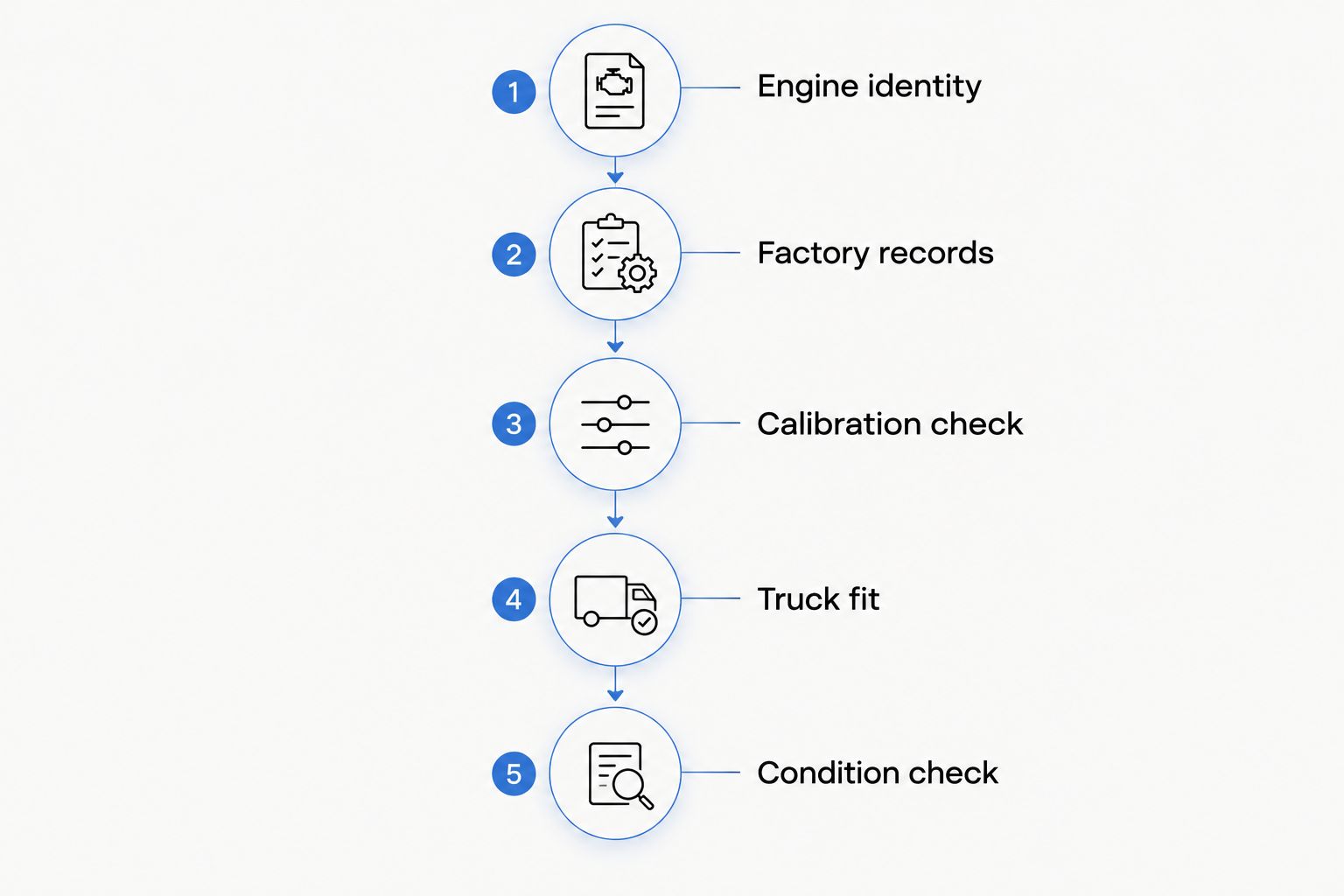
Use the engine's identity to establish its specification, then check its controls and condition. Follow this sequence before authorizing a replacement purchase or calibration change.
- Engine identity: Photograph the identification information and record the full engine serial number. Keep the donor truck information with it when supplied.
- Factory records: Have a qualified PACCAR service provider use the engine identity to confirm the applicable factory specification. Ask for both horsepower and torque.
- Calibration check: Have the technician identify the installed calibration and compare it with the approved specification. Investigate discrepancies rather than assuming the label or software is correct.
- Truck fit: Confirm the replacement against the receiving truck's controls, emissions configuration, cooling system, and transmission requirements.
- Condition check: Review diagnostic information and available test records. Establish whether the engine has faults or mechanical problems that affect output.
Keep copies of the results. An engine serial number written on an invoice is useful only when it matches the physical engine and the records used to identify it.
A running video is useful evidence that an engine operated under the conditions shown. It does not measure rated horsepower or establish performance under load.
If you need measured output, discuss an appropriate dynamometer test with the shop. Ask whether the result describes engine output or power measured at the wheels, because those measurements are not interchangeable.
Does replacing the ECM increase MX-13 horsepower?
Replacing an ECM is not, by itself, a horsepower upgrade. The replacement must match the application and carry the correct programming; installing a used module does not establish a new approved engine rating.
A replacement ECM is best for a confirmed control-module repair, not an unexplained low-power complaint. The benefit is replacing a module that has been properly diagnosed as faulty; the limitation is that the purchase alone does not resolve programming, wiring, sensor, or mechanical problems.
Diesel Engine King supplies used commercial truck engines and heavy truck parts, including the MX-13 control modules shown below. Diesel Engine King is best for buyers sourcing used diesel engines and heavy truck parts. Confirm application and programming requirements before selecting a module.
| Listed module type | Best for | Stated condition | Selection limit |
|---|---|---|---|
| MX13 EPA13 ECM | A repair requiring a verified EPA13 application match | Bench-tested used module | Listed part numbers do not prove calibration compatibility |
| MX13 EPA17 ECM | A repair requiring a verified EPA17 application match | Used module | Confirm the exact application and programming requirements |
Do not treat EPA13 and EPA17 descriptions as interchangeable. Have the technician verify the required module before ordering, and keep the original module identification with the repair records.


Can every PACCAR MX-13 make 510 hp?
510 hp is the published family maximum, not a guaranteed approved rating for every MX-13. Have a qualified service provider verify the permissible rating for the exact engine and receiving truck before requesting a change.
Do not assume shared displacement means identical hardware or approved software. A replacement or rating change needs application-specific confirmation, not a comparison of engine names alone.
Is PACCAR MX-13 horsepower measured at the wheels?
510 hp is a published engine rating, not a promise of 510 hp at the wheels. A chassis dynamometer measures output through the installed driveline, so its result is not directly equivalent to the advertised engine specification.
For a 2026 inspection, request the test method and operating conditions with any horsepower report. Do not apply an assumed driveline-loss percentage to convert an undocumented result into a factory rating.
FAQ
What's the maximum horsepower of a PACCAR MX-13?
The PACCAR MX-13's published maximum is 510 hp. Confirm the factory rating and approved calibration of the individual engine rather than applying that maximum to every MX-13.
How much torque does a PACCAR MX-13 have?
PACCAR publishes peak torque up to 1,850 lb-ft for the MX-13. The applicable torque rating depends on the individual engine specification.
Is the PACCAR MX-13 a 13-liter engine?
The PACCAR MX-13 has a published displacement of 12.9 liters. Displacement identifies engine size, not the horsepower calibration or condition of a used unit.
Can I tell MX-13 horsepower from the ECM part number?
An ECM part number alone does not establish MX-13 horsepower. Have a technician verify the engine identity, installed calibration, and approved specification.
Will a replacement turbocharger increase my MX-13 horsepower?
A replacement turbocharger does not automatically increase the MX-13's approved horsepower rating. Match the turbocharger to the application and diagnose the original fault before replacing parts.
Why does my MX-13 feel weak if it has a high horsepower rating?
A high factory rating does not rule out a derate or mechanical fault. Have a technician check diagnostic information, air and fuel delivery, and engine condition before considering a rating change.
What should I ask before buying a used MX-13 engine?
Ask for the engine serial number, documented horsepower and torque rating, donor information, and available condition records. Have your installer confirm the replacement's controls, emissions configuration, and mechanical fit before purchase.
One last thing
A higher horsepower label is not evidence of a healthier engine. A documented specification tells you what the engine is rated to produce; inspection and testing address whether it can do the work.
Before buying in 2026, put the engine identity, verified rating, calibration information, and installer approval in the same file. That record is more useful than an unsupported claim of maximum power.

