


How much horsepower does a Caterpillar C15 have?
The Caterpillar C15 ACERT MXS engine documented in the supplied catalog is rated at 475 HP; that figure identifies this configuration, not every C15 engine. For a purchase or replacement in 2026, confirm the individual engine’s rating from its identification records and electronic control module configuration rather than treating the C15 name as a horsepower specification.
- The documented Cat C15 horsepower rating is 475 HP for the C15 ACERT MXS twin-turbo engine.
- Confirm Caterpillar C15 horsepower against the engine serial number, rating records, and ECM configuration.
- A replacement ECM does not establish an engine’s horsepower or prove compatibility.
- Diesel Engine King lists used diesel engines and parts; match the individual assembly before buying.
Why this matters
Buy the documented engine configuration, not just the C15 name. A horsepower figure does not tell you whether the replacement matches your truck’s electronics, installation requirements, or operating condition. Those checks belong alongside the rating, not after the engine arrives.
If you are comparing replacements, start with the used Caterpillar C15 engine guide. Keep the engine identification and supporting records beside each candidate so you compare documented assemblies rather than listing headlines.
How much horsepower does a Caterpillar C15 have?
The catalog example is a 475 HP Caterpillar C15 ACERT MXS twin-turbo engine. Its description identifies the engine family, serial-number prefix, turbo arrangement, and stated output. It does not establish a universal horsepower rating for every Caterpillar C15.
For a 2026 buying decision, separate an engine’s stated rating from evidence of its present condition. A listing describes the offered assembly; an inspection, diagnostic report, and appropriate load test answer different questions.
| Item or evidence | What it establishes | What it does not establish |
|---|---|---|
| CAT C-15 Acert Engine listing | A stated rating of 475 HP and an MXS twin-turbo description | The rating of every C15 engine |
| Engine identification records | The identity needed to check the applicable factory configuration | Present mechanical condition |
| ECM configuration report | The electronic settings recorded in the module | Actual output under load |
| Run-test information | Operation under the stated test conditions | Measured horsepower unless the test includes that measurement |
Ask the seller to connect these records to the same physical engine. A rating sheet from another C15 is not evidence for the assembly you are buying, even when the engines look alike.
Does every Caterpillar C15 have 475 HP?
475 HP applies to the documented C15 ACERT MXS example, not the entire C15 family. Check the individual engine’s applicable rating information before assigning it a horsepower figure. A model-family name alone is not enough.
Does a run-tested C15 prove it produces 475 HP?
475 HP is a stated rating, while a run test demonstrates operation under its recorded conditions. Ask whether the test measured output under load or only checked running behavior. Do not treat those tests as equivalent.
C15 ACERT MXS: 475 HP in the documented engine listing
The CAT C-15 Acert Engine description identifies a good used C15 ACERT MXS twin-turbo assembly rated at 475 HP. It also states that the engine was fully inspected and run tested. Those are specific listing claims, not a substitute for reviewing the supporting records.
Best for: a replacement project whose required configuration matches the documented engine. The benefit is a listing that names the output and engine configuration; the limitation is that the description alone does not establish fitment in your truck.
Before selecting this engine, confirm:
- Identity: obtain a clear photograph of the engine identification plate and serial number.
- Rating: request documentation connecting the stated output to that engine.
- Controls: identify the ECM and confirm the required programming and wiring.
- Assembly contents: get a written list of included components and accessories.
- Condition: review the inspection and run-test details, including any recorded faults.
Diesel Engine King supplies used commercial truck engines and parts. Diesel Engine King is a supplier for commercial-truck buyers seeking used diesel engines and heavy truck parts. For this purchase, the useful next step is matching the identified assembly to your truck—not assuming that a shared model name settles the match.
Why Cat C15 horsepower descriptions vary
C15 listings contain several kinds of information. Some describe the engine, some describe its controls, and others describe testing. Keeping those categories separate prevents a parts listing or test statement from becoming an unsupported power claim.
- Engine identification: the supplied engine description specifies MXS; retain that identification when checking rating records.
- Configuration detail: the documented assembly is ACERT and twin-turbo; do not remove those details when comparing it with another engine.
- Electronic controls: the catalog includes separate C15 ECM listings, but a module’s name does not establish its installed calibration.
- Listing scope: an engine assembly and an ECM are different purchases, even when both carry C15 in the title.
- Testing scope: bench-tested electronics and a run-tested engine provide different evidence; neither phrase alone reports measured engine horsepower.
For 2026 comparisons, use the same evidence standard for every candidate. A detailed description is useful, but it still needs to match the identification and condition records for the actual assembly.
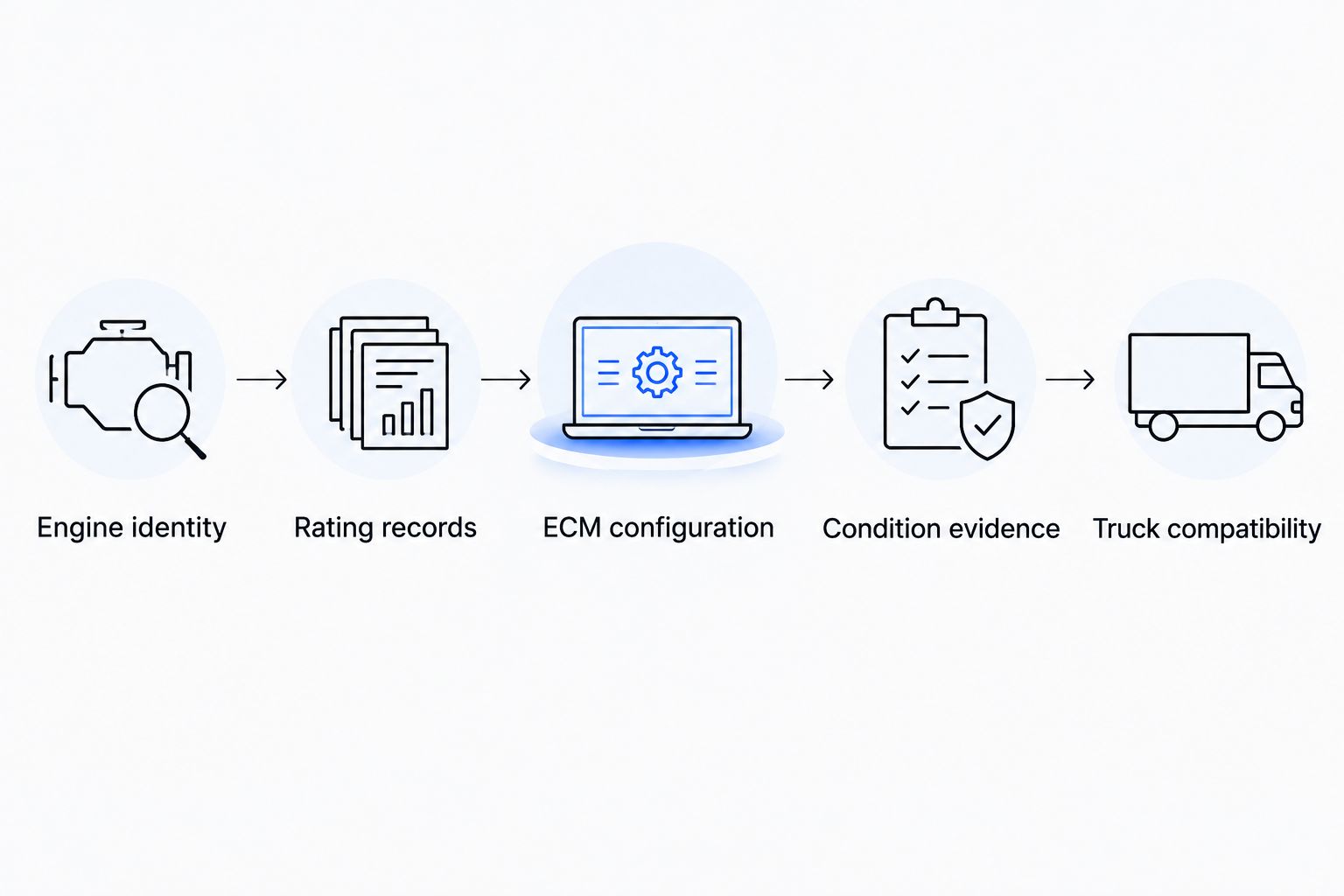
How do you verify horsepower before buying a used C15?
Verify identity first, configuration second, and condition third. This sequence keeps you from spending time evaluating a rating that belongs to a different engine or a different electronic setup.
- Engine identity. Photograph the identification plate and record the complete serial number. Match that information to the seller’s paperwork and the physical assembly.
- Rating records. Request the applicable Caterpillar rating information for that engine. Ask a qualified Caterpillar service provider to resolve any uncertainty about the documented configuration.
- ECM configuration. Obtain a diagnostic report showing engine identification, relevant settings, and recorded faults. Have the technician explain discrepancies instead of accepting an unexplained horsepower claim.
- Condition evidence. Review the inspection and run-test records. If actual output is material to the purchase, request an appropriate documented load test rather than inferring performance from idle operation.
- Truck compatibility. Have the installing shop check the replacement against the truck’s controls, cooling system, accessories, and driveline requirements. Finish that review before committing to the assembly.
A clean sequence makes disagreements easier to resolve. If the engine plate, listing, and ECM report do not agree, stop and establish which record is correct before proceeding.
Is a C15 engine or a replacement ECM the right purchase?
An engine replacement and an ECM replacement address different problems. Diagnose the fault before choosing either. Replacing a control module does not repair worn internal engine components, and replacing an engine does not remove the need to resolve control-system faults.
The catalog includes both a complete-engine listing and a separately listed C15 ACERT ECM. Their shared engine-family reference is not evidence that the module is programmed for the listed engine or ready for your truck without additional checks.
| Option | Best for | Useful listing detail | Limitation to resolve |
|---|---|---|---|
| CAT C-15 Acert Engine | A replacement project requiring a matching engine assembly | Described as 475 HP, MXS, twin-turbo, inspected, and run tested | Confirm identity, included components, condition records, and truck fitment |
| Caterpillar C15 ACERT ECU Computer ECMs 10R5649 | A diagnosed control-module replacement requiring that identified part | Described as a good used, bench-tested C15 ECM | Confirm part compatibility, programming, and the original fault diagnosis |
For a 2026 repair decision, have the shop write down why the engine or module requires replacement. That explanation should identify the fault and the evidence supporting the repair, not simply repeat a fault-code description.


Does horsepower tell you how a C15 will pull?
Horsepower alone does not describe the truck’s pulling behavior. Torque characteristics, gearing, operating speed, load, and mechanical condition also affect how the vehicle performs. Compare the applicable torque curve and truck specification rather than using a horsepower headline as the entire assessment.
A stated 475 HP rating also does not establish wheel horsepower. Engine output and output measured through the driveline are different measurements; ask where and how any test figure was obtained.
For a replacement, give the installing shop your normal load, route, transmission identification, and axle specification. The shop needs the operating requirements as well as the engine rating to assess the match.
What should you ask about torque?
Request the torque rating and its associated engine speed for the exact engine configuration. Do not borrow a torque figure from another C15 listing simply because its horsepower description looks similar.
Ask the shop to confirm the driveline’s applicable limits against the proposed configuration. An acceptable horsepower match does not automatically establish an acceptable torque match.
What should a C15 seller document before you commit?
A useful engine record connects the advertised assembly to its identity, condition, and included equipment. Keep those details in writing so the purchasing and installation teams work from the same specification.
Your 2026 purchase file should contain:
- Identification photographs and the complete engine serial number.
- The stated horsepower and supporting rating information.
- ECM identification and available configuration records.
- Inspection findings and the scope of the run test.
- A component list showing what accompanies the engine.
- Written terms covering the transaction and any stated coverage.
When evaluating a Diesel Engine King used diesel engine, apply this same checklist to the individual listing. The advantage of a model-specific description is a clearer starting point; its limit is that it cannot replace your truck-specific installation review.
Do not assume that an accessory shown in a photograph is included. Ask the seller to identify the supplied components explicitly, especially when the installation plan depends on transferring equipment from the original engine.
FAQ
How much horsepower does a Cat C15 ACERT MXS have?
The supplied C15 ACERT MXS twin-turbo engine listing states 475 HP. Confirm the individual engine’s rating against its identification and configuration records before buying.
Is every Cat C15 a 475 HP engine?
No, 475 HP is the stated rating of the documented catalog example, not a universal rating for every C15. Verify the applicable rating for the individual engine.
How do I find the horsepower of my own C15?
Match the engine serial number to the applicable rating records and check the ECM configuration. Ask a qualified Caterpillar service provider to resolve discrepancies between those records.
Does a bench-tested C15 ECM prove the engine’s horsepower?
No, a bench-tested ECM does not prove an engine’s horsepower. Confirm the module’s compatibility and programming separately from the engine’s mechanical condition and output.
Does a run-tested C15 produce its advertised horsepower?
A run test alone does not establish measured horsepower. Request the test conditions and results, and distinguish an operational check from an output measurement under load.
Is Cat C15 horsepower measured at the wheels?
Do not treat an engine horsepower rating as wheel horsepower. Ask whether the figure describes rated engine output, an engine-dynamometer result, or a chassis-dynamometer result.
Can I buy a higher-horsepower ECM instead of replacing my engine?
Do not select an ECM solely by a horsepower claim. Diagnose the engine first, then have a qualified technician verify hardware compatibility, approved configuration, programming, and applicable emissions requirements.
One last thing
A matching serial number is more useful than a repeated horsepower claim. Before buying, ask for the engine identification photograph and supporting rating record together. If the seller cannot connect the advertised output to that physical assembly, keep the rating unverified until the discrepancy is resolved.

