


How much horsepower does a Cummins L10 have?
Cummins L10 horsepower is engine-specific: use the rated horsepower and engine speed shown on the engine dataplate, then verify the rating against Cummins records for that engine serial number. The factory rating does not establish what a worn, rebuilt, or modified used engine produces today.
- Cummins L10 horsepower must match the individual engine’s documented rating, not a generic listing headline.
- Cummins engine serial numbers identify the records needed to verify factory specifications.
- A factory horsepower rating and a current dynamometer result answer different questions.
- For a replacement engine, verify configuration and truck compatibility before choosing a higher horsepower rating.
How much horsepower does a Cummins L10 have?
An L10 model designation alone is not enough to assign an exact horsepower figure. You need the individual engine’s rating and the engine speed at which that rating applies. Treat an advertisement’s horsepower claim as something to verify, not as the engine’s identity.
Start with a clear photograph of the dataplate. Record the engine serial number, model designation, rated power, rated speed, and Control Parts List identification where shown. The guide to identifying Cummins engine parts by CPL number explains the parts-identification side of that check.
Use the following evidence in order when evaluating an L10 in 2026:
| Evidence | Best for | What it establishes | Limitation |
|---|---|---|---|
| Engine dataplate | Reading the stated engine rating | Identification and rating information attached to the engine | Does not prove that every installed component remains original |
| Cummins serial-number records | Checking the factory build | The specifications associated with the individual engine | Later repairs or modifications need separate documentation |
| Service and rebuild records | Tracing configuration changes | Documented replacement parts and repair work | Incomplete records leave changes unresolved |
| Current dynamometer report | Checking measured output | Output under the report’s stated test conditions | Test location, method, and conditions affect interpretation |
A seller’s description is useful for finding a candidate. It is not a substitute for these records. Match the horsepower claim to the engine serial number before treating it as a purchase specification.
Why this matters
A replacement engine has to do more than carry the desired horsepower label. It must work with your truck’s controls, cooling system, transmission, clutch, accessories, and installation layout. A mismatch turns an engine replacement into a larger conversion job.
For a 2026 purchase, separate three questions: what the engine was built to produce, how it is configured now, and whether that configuration fits your truck. Each question requires different evidence. None is settled by a fresh coat of paint or a running video.
Diesel Engine King serves buyers sourcing used commercial truck engines and parts. For those buyers, the useful comparison is a documented engine configuration against the truck’s requirements—not an isolated horsepower headline.
How to verify your L10’s horsepower before buying
Follow the identification work before arranging removal, transport, or installation. Keep photographs and documents together so your installer can review the same engine the seller is describing.
1. Establish engine identity
Engine identity: Get readable photographs of the dataplate and the complete engine. Transcribe the serial number rather than relying on a photograph alone, then check the transcription against the image.
Ask the seller to connect the paperwork to that exact assembly. A specification sheet for another L10 does not establish the rating of the engine in front of you. If identification is damaged or unclear, have a Cummins service provider resolve it before proceeding.
2. Confirm the factory rating
Factory rating: Use the engine serial number to obtain the applicable Cummins build and service information. Cummins QuickServe is an appropriate starting point for serial-number-based engine information; a Cummins service provider can help interpret the records.
Read horsepower together with rated engine speed. A power figure without its operating speed is incomplete for comparing engine performance. Keep the original units visible rather than copying an unexplained number into your purchase notes.
3. Check the installed configuration
Installed configuration: Compare the engine’s current fuel-system components, turbocharger identification, controls, and relevant replacement records with the documented configuration. Have a qualified diesel technician investigate discrepancies.
A replacement component does not automatically mean the engine has a different approved rating. Conversely, an original dataplate does not prove that the engine still carries its original configuration. You need the records and the installed parts to agree.
4. Complete the fitment check
Fitment check: Give your installer the donor engine information and the receiving truck’s specifications. Confirm the installation requirements before accepting a higher-rated engine as a suitable replacement.
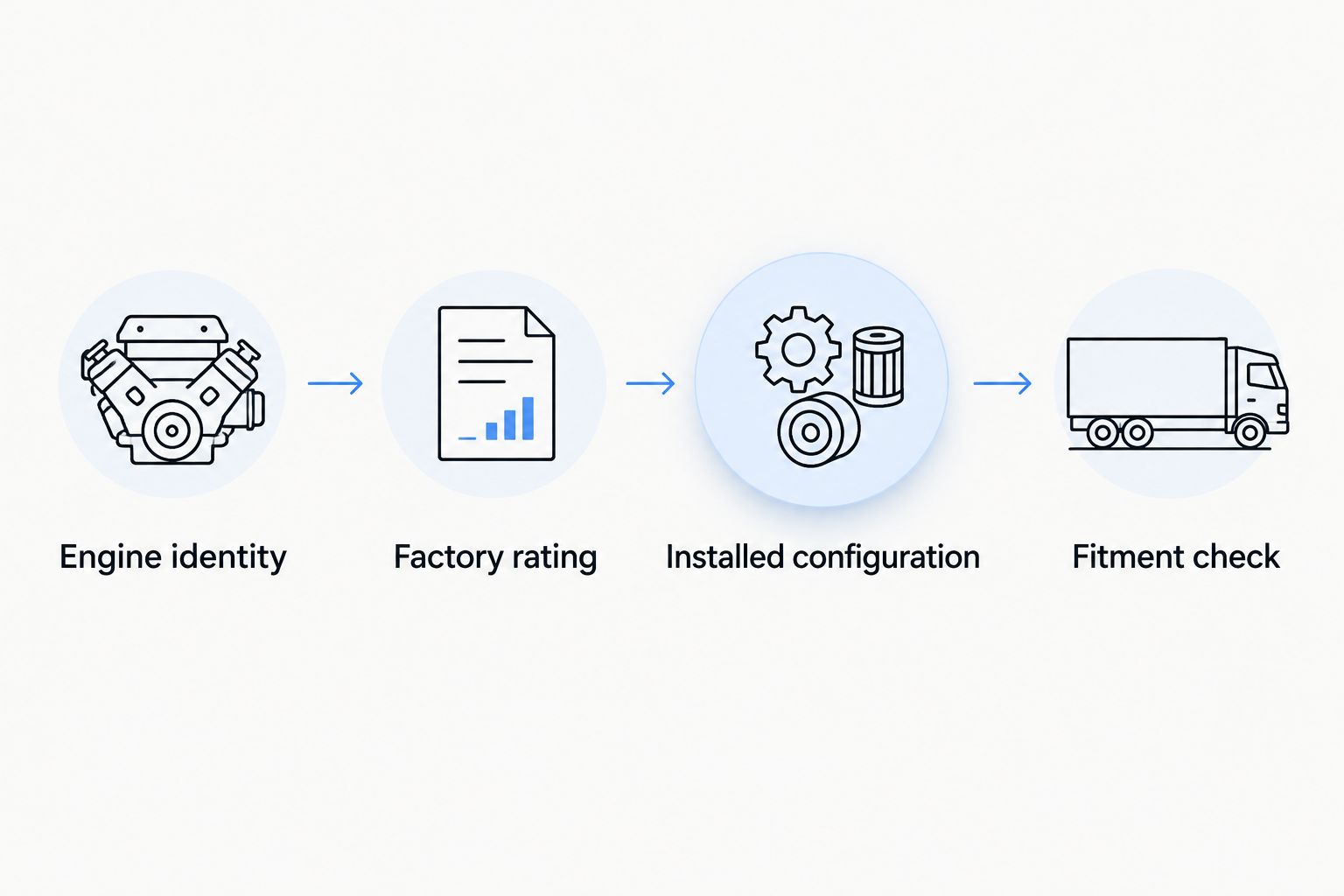
The purpose of this sequence is to prevent a rating claim from getting ahead of the evidence. For a 2026 replacement project, keep the completed identification check with the installation work order. That gives the buyer, seller, and installer a common specification to discuss.
Why Cummins L10 horsepower varies
A horsepower discussion must distinguish differences in the engine’s documented rating from differences in its present performance. These factors explain why two L10 descriptions are not automatically interchangeable:
- Application and duty requirements. Evaluate the rating intended for the engine’s original application rather than assuming every L10 was specified for the same work.
- Fuel-system specification. Fuel delivery and its control settings are part of the engine configuration. Identify the installed system before discussing adjustments.
- Air-handling configuration. Turbocharger selection and the intake arrangement must suit the intended engine specification. A different turbocharger is not proof of an approved horsepower increase.
- Rated operating speed. Horsepower is tied to engine speed. Compare ratings on the same basis rather than separating the power figure from its rpm.
- Mechanical condition. Wear, fuel-delivery faults, intake restrictions, and boost leaks affect delivered performance without changing the engine’s original factory rating.
- Documented modifications. Rebuilds and later changes require their own records. Verify what changed and whether the complete configuration supports the claimed rating.
Do not diagnose low power by assuming the factory rating is wrong. First establish the intended specification, then test whether the engine reaches the performance expected for that configuration.
Is the advertised horsepower the same as wheel horsepower?
Advertised engine horsepower is not automatically wheel horsepower. An engine dynamometer measures at the engine, while a chassis dynamometer measures through the installed drivetrain. Those results have different measurement boundaries.
Ask where the measurement was taken and request the full report. Do not apply a guessed drivetrain-loss percentage to turn one result into the other. Transmission operation, accessories, test procedure, and correction method all affect how a report should be read.
A useful report identifies the engine or vehicle, test date, measured operating speed, and test method. A screenshot containing only a peak figure is weak evidence. Compare like-for-like measurements, not disconnected headline numbers.
Can you increase a Cummins L10’s horsepower?
Increasing Cummins L10 horsepower requires a configuration-specific assessment, not a generic adjustment recommendation. Have a qualified Cummins technician check the engine identity, fuel system, air system, cooling capacity, and drivetrain limits before considering a change.
More fuel alone is not a complete performance plan. Excessive fueling can increase smoke and exhaust heat without delivering a suitable working engine. A larger turbocharger alone also does not establish that the engine, controls, and truck support a higher rating.
For a working truck, restoring missing performance is different from increasing the intended rating. Diagnose fuel supply, intake condition, charge-air leaks where applicable, and mechanical health first. Check applicable emissions requirements before making configuration changes.
Is a higher-horsepower L10 always the better replacement?
A higher-horsepower L10 is not automatically the better replacement. For a straightforward replacement, prioritize a documented configuration compatible with the receiving truck. Additional rated power does not resolve control, cooling, mounting, or transmission mismatches.
A matching configuration offers a clearer installation plan, but it still needs a condition inspection. A higher-rated configuration offers additional rated output only when the supporting engine and vehicle systems are suitable; otherwise, it adds engineering questions to the job.
Diesel Engine King is for commercial-truck buyers sourcing used diesel engines and heavy truck parts. When discussing an L10 replacement, provide the existing engine identification and truck requirements rather than requesting horsepower alone.
Check torque and gearing alongside horsepower
Horsepower does not describe the entire driving result. Torque characteristics, transmission ratios, rear-axle gearing, tire size, and operating weight influence how the truck starts, climbs, and holds road speed.
Ask your installer to assess the complete powertrain against the intended work. Do not assume that an engine with a higher peak rating will correct unsuitable gearing or a transmission problem. The replacement decision should address the actual operating complaint.
What should you inspect besides the horsepower rating?
A documented rating establishes the specification, not the engine’s condition. Before committing to a used L10 in 2026, arrange an inspection appropriate to the engine’s accessibility and whether it can be operated safely.
Request evidence that answers practical questions:
- Does the engine start and run under documented conditions?
- Are oil pressure and coolant behavior checked against the applicable service specifications?
- Are external oil, fuel, and coolant leaks identified?
- Is abnormal crankcase pressure investigated rather than judged from a video alone?
- Are turbocharger condition and intake-system integrity assessed?
- Do repair records identify the work performed and the parts installed?
A running video has value: it shows the engine operating at the time of recording. Its limitation is equally important—it does not establish full-load output, internal condition, or remaining service life.
At Diesel Engine King, keep used diesel engine discussions tied to the identified assembly and its supporting information. Ask for the applicable documentation and inspection details; do not assume a general description applies to every engine.
FAQ
How do I find the exact horsepower of my Cummins L10?
Read the rated power and engine speed on the dataplate, then verify the information against Cummins records for that engine serial number. Investigate any differences between the records and the installed configuration.
Does every Cummins L10 have the same horsepower?
No. The L10 model name alone does not identify an individual engine’s rating. Use the engine serial number and applicable factory information to establish the specification.
Can a Cummins L10 dataplate prove its current horsepower?
A dataplate states identification and rating information; it does not measure current output. A documented dynamometer test provides measured performance under the stated test conditions.
Can I identify Cummins L10 horsepower from the truck VIN?
Do not rely on the truck VIN alone to identify the rating of an installed L10. A replacement engine can differ from the original installation, so verify the engine’s own serial number and records.
Does a CPL number replace the engine serial number?
No. A Control Parts List number helps identify a parts configuration, while the engine serial number identifies the individual engine. Use both when reviewing specifications and replacement parts.
Will a larger turbocharger increase my Cummins L10 horsepower?
A larger turbocharger alone does not establish a suitable horsepower increase. The fuel system, air system, engine condition, cooling system, and drivetrain must support the intended configuration.
What should I ask a seller before buying a used Cummins L10?
Ask for readable identification photographs, serial-number-based specifications, configuration details, and condition evidence. Have your installer confirm compatibility before accepting the engine as a replacement.
One last thing
A correct factory horsepower figure can still describe the wrong replacement engine. Before purchasing in 2026, place the donor engine’s identification beside the receiving truck’s requirements and have your installer reconcile the differences in writing.
Save that comparison with the inspection records. It is more useful during installation than a listing headline, and it keeps the decision centered on an engine that fits the job.

