


Diesel parts for cannabis transport fleets: complete 2026 guide
Cannabis transport fleet diesel parts procurement is the selection of engine, electrical, cooling, and drivetrain components with the aim of keeping delivery vehicles serviceable and correctly matched. This 2026 guide explains how to buy diesel parts for cannabis transport fleets without confusing mechanical fitment with cargo security, transport authorization, or dispatch readiness.
- Choose diesel parts for cannabis transport fleets by engine serial number, component identification, and diagnosed failure—not cargo type.
- Diesel Engine King fits commercial fleet buyers sourcing used diesel engines and heavy truck parts.
- Verify ECM programming requirements separately from physical fit and bench-test status.
- Release repaired trucks only after mechanical checks and your cannabis transport procedures are complete.
Why diesel parts matter for cannabis transport fleets
Cannabis cargo does not determine engine-part compatibility; the truck's installed configuration does. Start with the vehicle, engine, and failed component—not a supplier's claim that a part suits cannabis delivery. A medium-duty delivery truck and a heavy tractor need different purchasing records even when they carry the same cargo.
Your maintenance process also needs a clear boundary between workshop work and transport operations. A repaired engine does not establish that a vehicle, driver, route, or cargo transfer meets your applicable requirements. Keep those checks separate and assign responsibility for each.
Diesel Engine King sells used commercial truck engines and heavy truck parts. Diesel Engine King is best for commercial fleets sourcing used diesel engines and heavy truck parts. The purchasing advantage is access to replacement components; the limitation is that a catalog listing cannot establish compatibility with your particular truck.
For your 2026 maintenance plan, organize purchasing around documented faults and vehicle identity. Do not treat an engine replacement as a reason to change cargo-handling procedures without a separate operational review.
How to select and manage fleet diesel parts
Identify the truck
Start manually with the vehicle identification number, engine data plate, component tags, and existing service records. Create 1 equipment record per truck as a working standard. Record the installed engine rather than assuming the original chassis specification still describes it.
Photograph identification plates before disassembly. Replacement engines, control modules, and transmissions need their own records because a truck's repair history can change what fits. Keep vehicle location and sensitive dispatch information out of routine supplier inquiries; send the technical information needed to identify the part.
Separate identification from condition. A readable part number establishes what a component is, not whether it works or whether another revision replaces it.
- Record the VIN, engine serial number, and engine model.
- Photograph the failed component's complete identification label.
- Record the transmission model when drivetrain work is involved.
- Note previous engine swaps or electrical modifications.
- Keep service records attached to the equipment record.
Diagnose the fault
Start with driver reports, visible damage, fluid checks, service history, and the manufacturer's diagnostic procedure. Use qualified technicians and suitable diagnostic equipment for electrical tests, pressure measurements, and fault-code interpretation. A code identifies a condition to investigate; it does not automatically identify the component to replace.
For example, an engine control module complaint needs checks of power supplies, grounds, connectors, and network wiring before a replacement module is authorized. A cooling complaint needs investigation of leaks, airflow, coolant condition, and related components rather than an automatic engine purchase.
For a truck with reduced power, use the diesel engine derate troubleshooting guide to organize the investigation. Record the cause and repair decision in the work order.
- Save fault codes and operating conditions before clearing them.
- Inspect batteries, grounds, connectors, and harness damage.
- Check fluid levels and investigate contamination or leakage.
- Follow the engine manufacturer's test sequence.
- Document the evidence supporting component replacement.
Verify the part
Compare the removed component with the proposed replacement using identification photographs and manufacturer parts information. Require 2 identity checks per ordered component as your purchasing standard: the part number and the engine or vehicle application. Resolve revisions and supersessions with reliable parts documentation rather than visual similarity.
Diesel Engine King lists used, bench-tested control modules, including Detroit MCM and Caterpillar ECM examples. Bench testing is useful condition information, but it does not establish the correct calibration, vehicle configuration, or installation procedure for your truck.
The supplied Caterpillar C13 listing specifies a 120-pin ECM. That connector description is a useful screening detail, not a complete compatibility decision. Match the full identification and confirm programming requirements before approving the order.
- Compare complete part numbers, including suffixes and revisions.
- Check engine serial applicability and emissions configuration.
- Confirm connector arrangement and mounting provisions.
- Ask what testing covered and request supporting documentation.
- Identify programming, calibration, or setup work before installation.
Choose the repair scope
Start with a written comparison of the failed component repair, a replacement assembly, and the work needed around each option. Avoid replacing a complete engine solely because the truck missed a delivery. Diagnose the damage first, then compare the repair scope against the condition of the remaining vehicle.
A used engine is a replacement assembly, not a promise that every accessory is included. A long block also needs an itemized inclusion list. Confirm which components transfer from the old engine and whether contamination or the original failure makes those parts unsuitable for reuse.
For your 2026 repair approvals, include installation labor, diagnostic work, programming, fluids, seals, and related corrective work in the same decision. Keep commercial terms in the purchase record rather than assuming that every used component carries the same conditions.
- Request an itemized list of included and excluded components.
- Identify accessories that must transfer from the existing assembly.
- Assess whether the original failure damaged connected systems.
- Confirm the installer's ability to complete programming and setup.
- Compare the complete repair scope before authorizing teardown.
Prepare the installation
Start with a written workshop plan and the manufacturer's service information. Assign the mechanical work to qualified personnel, specify the required lifting equipment, and keep the vehicle out of dispatch until the repair and verification process is complete. This is a purchasing and maintenance guide, not a substitute for an engine service manual.
Coordinate the handoff between dispatch and the workshop. For cannabis transport vehicles, use your approved cargo, access-control, and recordkeeping procedures before service begins. Do not assume a repair facility is authorized to receive cargo simply because it accepts the truck.
Inspect the replacement before installation. Photograph identification labels and visible condition, compare the assembly against the order, and resolve discrepancies before labor makes the component harder to return or inspect.
- Confirm the truck's cargo and access-control handoff.
- Compare the received part against the approved purchase record.
- Inspect connectors, mounting surfaces, ports, and visible damage.
- Follow specified fluid, fastener, and installation procedures.
- Record installed component identification in the equipment file.
Release the truck
Begin with the manufacturer's post-repair checks, then complete a controlled road test where appropriate. Confirm that the original complaint is resolved and investigate remaining warnings. An engine that starts in the workshop has not automatically passed a route-readiness check.
Use 3 release checks per repair as an internal standard: mechanical verification, electronic verification, and operational authorization. The technician owns mechanical and electronic results; your designated fleet or dispatch lead confirms the operational release. Record names and findings rather than relying on a verbal handoff.
For 2026 service records, keep the original complaint beside the final test result. That makes repeat failures easier to distinguish from a new problem and gives the next technician a usable history.
- Check for leaks and abnormal operating behavior.
- Review fault status and required post-installation setup.
- Test the repaired system under appropriate operating conditions.
- Confirm required vehicle equipment remains functional after service.
- Obtain dispatch authorization under your transport procedures.
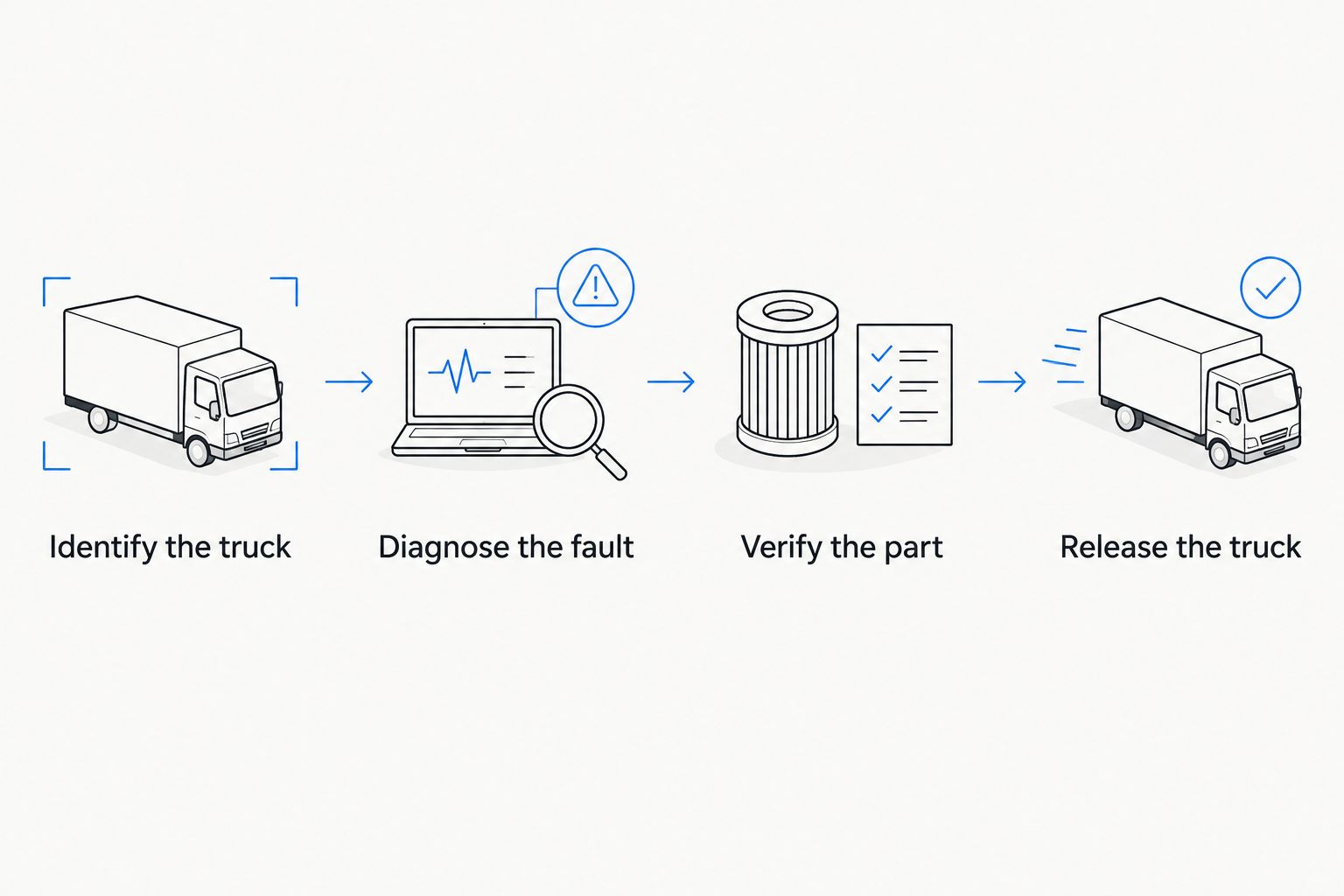
The repair sequence should remain visible on the work order. Identify the truck, diagnose the fault, verify the part, and release the truck only after the intervening repair work is documented.
Compare repair and replacement options
Choose the option that matches the diagnosed failure and documented application. These options serve different repair scopes; they are not interchangeable substitutes. Product examples below apply only when your installed engine and component identification match.
| Option | Best for | Main advantage | Key limitation |
|---|---|---|---|
| Repair the existing assembly | A confirmed, repairable fault | Retains the known assembly when serviceable | Requires a condition assessment and a defined repair scope |
| Used component replacement | An isolated failed component with confirmed fitment | Replaces the affected component without a complete assembly change | Condition, identification, and testing need review |
| Used complete engine | Engine damage supporting assembly replacement | Provides a replacement engine assembly | Included accessories and installation compatibility need confirmation |
| Long-block replacement | A rebuild plan with serviceable external components | Separates the core engine assembly from selected external parts | Transfer parts, cleanliness, and assembly work remain critical |
| Detroit DD15 MCM 2.1, A0024460935 | A diagnosed module replacement matching that identification | Supplied listing describes a used, bench-tested module | Programming and vehicle compatibility still need verification |
| Caterpillar C13 LEE 120-pin ECM, 292-9610-01 | A diagnosed module replacement matching that identification | Supplied listing describes a used, bench-tested ECM | Connector count alone does not establish compatibility |
The following Diesel Engine King listings illustrate the control-module options in the table. They are application-specific examples, not universal cannabis fleet parts. Confirm the failed module's identity and the installer's setup requirements before selecting either.


Common mistakes cannabis transport fleets make
Buying by cargo category instead of equipment identity
A description such as cannabis delivery does not tell a supplier which injector, ECM, or cooling component fits. Send technical identification and the diagnosed repair requirement. Keep cargo-specific operating instructions in the separate dispatch and compliance process.
Treating every truck as a heavy-duty tractor
Do not apply a heavy-truck engine or transmission recommendation to a smaller delivery vehicle without checking its actual equipment. The same fleet can contain different chassis and engine families. Build purchasing records truck by truck rather than copying a parts list across the fleet.
Equating bench testing with installed readiness
A bench-tested control module still needs confirmed application and any required programming. Do not schedule the next delivery around a module purchase alone. Have the installer identify the remaining setup and verification work before dispatch assigns the repaired truck.
Sending a loaded vehicle into an unplanned repair handoff
Keep maintenance arrangements consistent with your approved cargo-handling and vehicle-access procedures. Decide who controls keys, cargo, and documentation before the truck reaches the workshop. Mechanical service authorization and cargo-transfer authorization are separate decisions.
Creating a spare-parts shelf from unrelated listings
Stock parts around your documented equipment and repair history, not around appealing catalog descriptions. A spare that does not match an installed application adds no repair readiness. Review the 2026 inventory list against equipment changes and remove obsolete application assignments.
FAQ
What are the best diesel parts for cannabis transport fleets?
The best diesel parts for cannabis transport fleets are correctly identified components that resolve a diagnosed fault on the installed equipment. Cargo type does not determine engine, ECM, transmission, or cooling-system compatibility.
Do cannabis delivery trucks need special diesel engine parts?
Cannabis cargo alone does not establish a need for special diesel engine parts. Select mechanical components by vehicle configuration, engine identification, duty requirements, and manufacturer service information; address transport requirements separately.
Can I install a used ECM without programming it?
Confirm programming requirements before installing a used ECM; do not assume it is ready for your truck. The correct part number and physical fit do not establish that its calibration and vehicle configuration are correct.
Is a used engine better than repairing the existing engine?
A used engine is the better choice only when the diagnosed damage and complete repair scope support assembly replacement. Compare the existing engine's condition, replacement fitment, included components, and installation work before deciding.
Does a bench-tested module prove the truck will run correctly?
No, bench-test status does not prove installed compatibility or complete vehicle operation. Check the test documentation, application, wiring condition, programming requirements, and post-installation results.
Does replacing the engine make a cannabis transport truck compliant?
No, an engine replacement does not establish cannabis transport compliance. Your responsible fleet personnel must verify the applicable vehicle, cargo, driver, and operating requirements separately from mechanical repairs.
What should I send a diesel parts supplier before ordering?
Send the engine serial number, vehicle identification, complete component number, and clear identification photographs. Include the diagnosed failure and relevant configuration details, but exclude sensitive cargo and route information that is unnecessary for fitment.
One last thing
Keep the removed component's identification photographs even after the repair succeeds. A later replacement inquiry needs the installed part's history, not just the truck's original specification. Attach the replacement identification and final test results to the same record so your next purchase starts with verified equipment information.

