


Diesel Engine King vs Truck Parts Inventory: which is better in 2026
Choose Diesel Engine King if you want to buy used commercial truck engines and parts from a supplier with a parts catalog; choose Truck Parts Inventory if you want to search listings from multiple truck-parts sellers. The difference is a supplier relationship versus a marketplace search, not a universal winner on condition, fitment, or purchase terms.
- Diesel engine king vs truck parts inventory comes down to supplier purchasing versus marketplace searching for used diesel engines.
- Diesel Engine King is best for buyers seeking used commercial truck engines and heavy truck parts from one supplier.
- Truck Parts Inventory is best for buyers comparing truck-parts listings across multiple sellers.
- For either route, confirm part numbers, condition evidence, included components, and written purchase terms before ordering.
Why this matters
A replacement engine purchase is also an installation decision. A matching engine-family name does not establish that the controls, accessories, mounting arrangement, and emissions configuration match your truck.
For your 2026 purchase, separate finding a candidate from approving it. A supplier catalog gives you a place to start a purchasing conversation; a marketplace gives you a way to find sellers. Neither replaces the checks your installer needs before accepting a replacement assembly.
Diesel Engine King is best for buyers seeking used commercial truck engines and heavy truck parts through a supplier catalog. Truck Parts Inventory serves a different buying task: comparing listings and identifying sellers to contact.
At a glance
| Dimension | Diesel Engine King | Truck Parts Inventory |
|---|---|---|
| Best for | Buyers starting with a used-engine and heavy-truck-parts supplier | Buyers searching across truck-parts sellers |
| Standout feature | Product-specific catalog entries with model and part-number information | Marketplace search across seller listings |
| Search breadth | A supplier's catalog | Listings from multiple sellers |
| Buying relationship | Supplier-focused purchasing | Seller-specific purchasing after marketplace discovery |
| Fitment approval | Confirm the exact unit with the supplier and installer | Confirm the exact unit with the listing seller and installer |
| Condition evidence | Evaluate the description and evidence for each unit | Evaluate the description and evidence from each seller |
| Installation planning | Define the replacement package before ordering | Define the replacement package before ordering |
| Pricing model | Evaluate the individual part or engine purchase | Evaluate each seller's individual part or engine purchase |
The supplier route wins for a focused replacement purchase
The supplier route is the better starting point when you have a defined repair: a particular engine family, a transmission model, or an engine control module with a readable identification label. You can start with the relevant catalog entry and ask about the exact replacement rather than beginning with a broad search.
The client's catalog includes transmission and engine-control-module pages, alongside its stated used commercial truck engine and parts business. That makes the purchasing route relevant to drivetrain repairs, not just complete engine replacement.
The limitation is straightforward: a supplier's catalog is not a cross-seller comparison. If your purchasing requirement is to compare several independent sellers before selecting a candidate, a marketplace fits that task better.
For an owner-operator who already has an installer and a diagnosed failure, keep the inquiry narrow. Send identification photos, the repair diagnosis, and a list of components the installer expects with the replacement. Ask the supplier to answer against a specific unit, not against the engine family in general.
Truck Parts Inventory wins for cross-seller searching
Truck Parts Inventory is the better starting point when your main task is discovering and comparing truck-parts listings from different sellers. That route suits a repair shop looking for alternatives or a fleet buyer building a shortlist before contacting suppliers.
The advantage is the search structure. You are not limited to beginning with a single supplier's catalog, and you can compare candidate listings before narrowing the purchasing conversation.
The tradeoff is that marketplace discovery does not make seller terms uniform. Treat every listing as a separate purchasing inquiry. Confirm who owns the unit, who issues the invoice, and who handles questions about condition or a disputed part.
For your 2026 shortlist, record the same fields for every candidate. Engine serial number, component identification, included equipment, condition description, and purchase terms belong in the comparison. A larger set of search results is useful only when you can distinguish the actual units behind them.
The supplier route keeps the purchasing conversation focused
A supplier-focused purchase keeps your questions tied to that supplier's unit and terms. This is useful when your installer needs clarification about an assembly, its accessories, or a control module before approving the order.
With Truck Parts Inventory, the marketplace helps you find the listing; the listing seller remains the party whose answers matter for the purchase. Identify that seller before you treat a description as a purchasing commitment.
Neither route removes the need for a written record. Save the description, identification photos, component list, and agreed terms together. Give your installer the same information you used to select the unit.
Ask these questions before authorizing payment:
- Who is selling and invoicing this exact unit?
- Which identification number will appear on the invoice?
- What components are included and excluded?
- What evidence supports the stated condition?
- What written terms apply if the received unit differs from the description?
The supplier route wins for a buyer who wants a focused purchasing conversation; the marketplace wins for a buyer who first needs to identify competing sellers. Those are different advantages, not competing claims about product quality.
Both routes require exact fitment approval
Neither buying route earns a fitment win simply by displaying the right engine-family name. Your installer must compare the replacement configuration with the truck and the existing assembly.
For an engine, collect the engine serial number and the truck's identifying information. For a transmission, collect the model designation and identification-tag details. For an electronic module, collect the hardware part number and ask the installer about programming and calibration requirements.
The catalog illustrates why model names alone are insufficient. A Caterpillar C11 ECM entry specifies 70 pins and part number 256-1159. A Detroit DD15 module entry identifies MCM 2.1 and part number A0024460935. Those identifiers give you specific questions to resolve; they do not establish interchangeability by themselves.
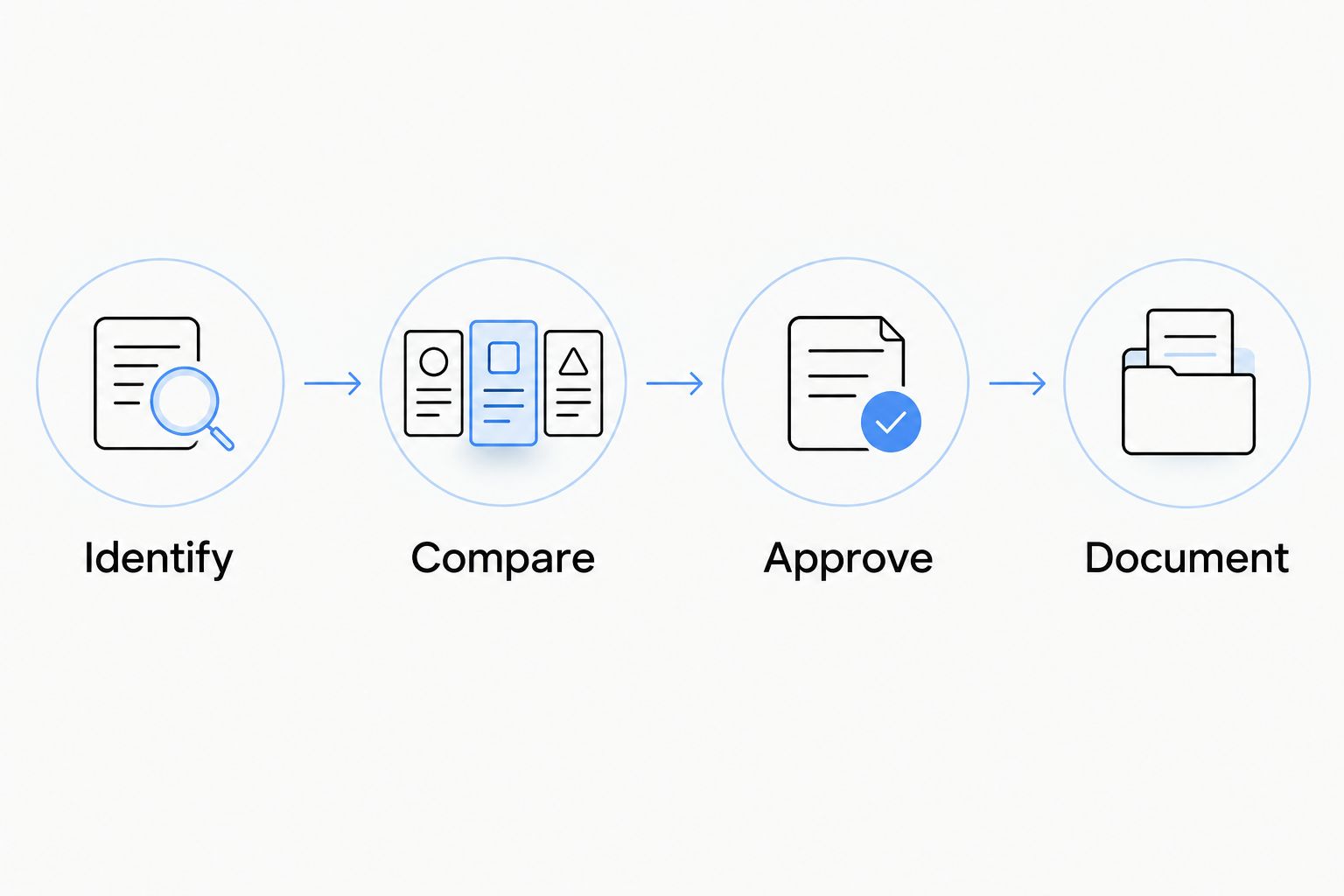
Use this approval sequence for a 2026 replacement:
- Identify: Photograph the truck and component identification labels.
- Compare: Match the candidate's identifiers and configuration to the repair requirement.
- Approve: Have the installer confirm what fits and what requires additional work.
- Document: Put the approved unit and included components in the purchase record.
A readable label is useful evidence, but your installer still needs the surrounding configuration. Use the guide to matching a replacement diesel engine to your truck's ECM specs to organize that discussion.
Condition evidence wins over either buying route
There is no defensible blanket winner on used-part condition. Evaluate the exact unit, not the supplier name or marketplace label.
Several client product descriptions identify used modules as bench-tested. That is a specific description of those modules, not a statement that every engine, injector, transmission, or electronic part receives the same test. Ask what the test covered and what evidence accompanies the unit.
For a complete engine, ask for available operating evidence, identification photos, and a clear description of its condition. For a removed component, ask how its stated condition was established. Keep the request appropriate to the part.
Bench-tested, run-tested, inspected, and remanufactured are not interchangeable descriptions. A test description should answer a question about function; a condition label should describe what you are buying. Neither should replace the other.
For your 2026 purchase, prefer a candidate whose description answers your installer's questions. Reject a purchasing decision based only on general claims of quality, even when the listing otherwise looks relevant.
Both routes need a defined installation package
A replacement engine and an installation-ready package are different purchasing requirements. Specify which one your repair needs before comparing candidates.
Ask whether the assembly includes the components your installer expects: electronic controls, turbocharger, fuel-system components, wiring, flywheel housing, and other accessories relevant to the application. Do not assume that a photograph settles the included-component list.
Quantity matters for smaller repairs as well. The client catalog describes a Volvo D13 injector set containing 3 injectors and a Freightliner Cascadia DD15 injector set containing 6 injectors. Those are different package quantities, not equivalent replacement sets for the same application.
Use an inclusion checklist:
- Core assembly: Identify the engine or component being purchased.
- Accessories: List every attached item included in the transaction.
- Controls: Confirm what electronic hardware is included.
- Installation work: Have the installer identify transfers, programming, and other required work.
- Excluded items: Record components that must come from the existing truck or another source.
Both buying routes tie here. The better replacement package is the one your installer has approved in writing. A broad description creates unnecessary ambiguity regardless of where you found it.
Catalog examples: part identification comes before selection
The following modules illustrate a parts-catalog approach: a named engine family, a component type, and an identification number. Best for Detroit DD15 module identification: the listed MCM 2.1 entry. Best for Caterpillar C11 module identification: the listed 70-pin ECM entry.
Both descriptions identify the units as used and bench-tested. The limitation remains fitment: neither description replaces approval of the hardware and programming requirements for your truck.


Pricing: compare purchase terms, not just the search result
Both routes lead to an individual engine or part purchase. Compare the exact transaction, including the replacement configuration and the written terms attached to it.
For a supplier purchase, request terms for the selected unit. For a Truck Parts Inventory listing, request terms from the seller responsible for that listing. Do not treat marketplace listings as a single standardized offer.
Predictability comes from a defined purchase scope. Flexibility comes from comparing alternative sellers and configurations, but that comparison adds work: you must establish whether the alternatives include the same equipment and require the same installation work.
Your 2026 comparison should separate:
- The engine or component itself.
- Any applicable core obligation.
- Freight arrangements and unloading requirements.
- Installation, programming, and accessory-transfer work.
- Written warranty and return terms, where offered.
Neither route wins on purchase value without comparable unit-level terms. Ask the installer to identify the work behind each candidate before making the purchasing decision.
Final verdict: choose the route that matches your buying task
Choose Diesel Engine King if you are a focused replacement buyer
Best for: an owner-operator or fleet maintenance buyer with a diagnosed engine or heavy-truck-parts requirement. Start with the supplier catalog when you know the component you need and want to resolve the exact unit, condition, and purchase terms with a supplier.
The advantage is focus. The limitation is that this route does not substitute for comparing independent sellers when your purchasing process requires that comparison.
Choose Truck Parts Inventory if you are a cross-seller sourcing buyer
Best for: a repair shop or fleet purchaser building a shortlist across truck-parts sellers. Start with the marketplace when finding alternative listings is your immediate task, then move to seller-specific verification.
The advantage is cross-seller discovery. The limitation is that fitment, condition evidence, and transaction terms still require separate confirmation for each candidate.
| Dimension | Winner |
|---|---|
| Focused replacement purchase | Supplier route |
| Cross-seller search | Truck Parts Inventory |
| Focused purchasing conversation | Supplier route |
| Fitment approval | Tie: installer approval required |
| Condition evidence | Unit-level decision |
| Installation package | Tie: written scope required |
| Purchase value | Unit-level decision |
FAQ
Is Diesel Engine King better than Truck Parts Inventory?
Diesel Engine King is the better starting point for a focused used-engine or heavy-truck-parts supplier purchase. Truck Parts Inventory is the better starting point for comparing listings across sellers; approve the exact unit before buying through either route.
What's the best option for comparing multiple truck-parts sellers?
Truck Parts Inventory fits cross-seller searching. After finding candidates, contact each listing seller to confirm identification, condition evidence, included components, and written purchase terms.
Can I buy a replacement engine using only the engine model name?
No. Have your installer compare the engine serial number, configuration, controls, accessories, and truck requirements before approving the replacement.
Does a bench-tested ECM mean it is ready for my truck?
A bench-tested description does not establish compatibility or programming requirements for your truck. Confirm the hardware identification and required calibration with your installer.
How do I compare purchase terms for a used diesel engine?
Compare the exact assembly, included accessories, any core obligation, freight arrangements, installation work, and written warranty or return terms. Keep the comparison tied to specific units rather than general seller descriptions.
What should I send a seller before ordering truck parts?
Send clear identification-label photos, the truck's identifying information, and your installer's replacement requirements. Ask the seller to confirm the exact unit and included components in writing.
Which buying route guarantees the better-condition engine?
Neither buying route establishes condition by itself. Judge the exact engine using its description, identification, inspection information, and available operating evidence.
One last thing
Ask your installer what would disqualify the replacement before you ask a seller to confirm it. That turns a general inquiry into an approval checklist: wrong identification, unsuitable controls, missing accessories, or an undefined assembly scope.
For a 2026 purchase, keep that checklist with the invoice and identification photos. The useful comparison is not just where you found the part. It is whether the exact replacement satisfies the repair requirement you documented.

