


Diesel Engine King vs Adelman's: which is better in 2026
Choose Diesel Engine King if you need used commercial truck engines or heavy truck parts and want to start with model- and part-number-specific listings; choose Adelman's if its written offer gives you a better-documented match for your truck, installation scope, and purchase terms. For 2026, the winning supplier is the one that documents the replacement you need—not the one with the strongest sales claim.
- Diesel Engine King suits used commercial truck engine and heavy truck parts buyers who shop by model and part number.
- For diesel engine king vs adelmans, choose the documented fit—not a supplier-wide quality claim.
- Adelman's wins your purchase when its written offer better covers fit, condition, included components, and purchase terms.
- Bench-tested electronics and used take-out injectors require different checks before installation.
Why this matters
A used engine purchase involves more than choosing an engine family. You need the replacement configuration, supporting components, and installation plan to agree with the truck you are repairing. A recognizable model name does not settle those questions.
For a 2026 purchase, compare actual units and written offers. Do not turn a statement about one tested component into a claim about every engine or part sold by that supplier. Your mechanic needs evidence tied to the unit being purchased.
Diesel Engine King is a starting point for used commercial truck engines and heavy truck parts identified by model and part number. That is a useful buying route, but it does not replace fitment checks or a unit-specific inspection.
At a glance
Use this table as your purchasing outline. The Adelman's column describes the evidence its offer needs to win your order, rather than assuming supplier-wide advantages.
| Dimension | Diesel Engine King | Adelman's |
|---|---|---|
| Best for | Buyers sourcing used commercial truck engines and heavy truck parts | Buyers whose written Adelman's offer better matches the specific repair |
| Standout feature | Supplied listings identify specific modules, part numbers, and component condition | A stronger offer identifies the exact unit and supplies supporting documentation |
| Fitment | Match the listed identity to your truck and mechanic's requirements | Wins when its offer documents the closer configuration match |
| Condition evidence | Some supplied ECM descriptions explicitly state bench-tested condition | Wins when its unit-specific evidence answers more of your inspection questions |
| Included components | Verify the contents of the individual engine or parts purchase | Wins when its documented package better matches your installation scope |
| Installation planning | Requires a mechanic-approved replacement plan | Requires the same mechanic-approved replacement plan |
| Freight and receiving | Agree packing, unloading, and inspection arrangements in writing | Apply the same receiving requirements |
| Pricing model and terms | Evaluate the individual component or engine purchase and its written terms | Evaluate the specific offer on the same scope and obligations |
Diesel Engine King suits model-specific used-parts sourcing
The supplied catalog includes used engine control modules, fuel injectors, and an inspected diesel particulate filter assembly. Those are distinct repair purchases. Start with the failed system and the mechanic's diagnosis rather than ordering an engine because the truck has an engine-related fault.
The catalog's useful feature is specificity. For example, a Detroit module description identifies part number A0024460935 and states that the unit is good used and bench tested. A Caterpillar C11 module description specifies part number 256-1159 and a 70-pin configuration. These details give your shop something concrete to compare against the removed component.
The limitation is equally clear: a part number and condition description do not establish the complete installation requirements. Confirm calibration, connectors, application, and any setup work with your technician before ordering an electronic module.
Best for: an independent repair shop or truck owner who already knows the required component identity. Do not use a catalog description as a substitute for diagnosing the truck.
Adelman's wins fitment when its offer documents the closer match
Choose Adelman's for a particular engine purchase when its written offer establishes a closer match to the truck than the competing offer. That is a real advantage. It is also a unit-level decision, not proof that one supplier always has better fitment.
Send both suppliers the same identification packet:
- Truck identity: VIN, make, model, and application.
- Engine identity: engine serial number, data-plate photographs, and the current configuration.
- Control requirements: existing module identification and the technician's calibration requirements.
- Installation scope: components the shop plans to retain, replace, or transfer.
Have the installing shop review the proposed replacement before you authorize the purchase. Ask the shop to identify unresolved differences explicitly, especially around controls, mounting, accessories, and emissions equipment.
For a 2026 repair, make written fitment confirmation part of the purchasing process. Adelman's earns the fitment win only when its documented replacement better satisfies those requirements. A verbal assurance without an identified unit does not earn that win.
The stronger condition record wins—not the supplier name
Used, take-out, bench-tested, and rebuilt describe different things. Keep them separate. An electronic module's bench test does not describe a complete engine's mechanical condition, and a used injector description does not establish injector test results.
The supplied parts descriptions illustrate the distinction. The Volvo D13 listing describes 3 injectors as used take-out parts. The Freightliner Cascadia DD15 listing describes 6 injectors as good used take-out parts. Neither description should be expanded into an undocumented performance claim.
For an engine, request inspection evidence tied to its identifying information. Ask what was checked, what observations were recorded, and which components the inspection covered. If a seller provides a running video, verify that the identifying details connect the video to the engine offered.
Adelman's wins condition evidence when its offer supplies clearer, unit-specific records than the alternative. The same rule works in reverse. Reject unsupported supplier-wide statements about quality, remaining service life, or testing.
A useful condition record answers a buying question. A label alone does not. Keep the records with the purchase documents so the receiving shop can compare the delivered unit against the agreed description.
Bench-tested modules still need an application check
The supplied Detroit and Caterpillar ECM descriptions explicitly identify bench-tested units. That gives you a stated condition detail for those components—not a promise that every module will work in every truck carrying the same engine-family name.
Ask your shop to separate three checks: hardware identity, electrical condition, and application setup. These checks serve different purposes. A successful electrical test does not decide whether the module has the appropriate configuration for your installation.
Use the guide to matching a replacement diesel engine to your truck's ECM specifications when preparing the questions for your mechanic. Resolve those questions before committing to either supplier.
The following examples show the kind of part-specific descriptions you can compare. They are not interchangeable recommendations; your technician must identify the correct component first.


Adelman's wins package scope when fewer requirements remain unresolved
Choose Adelman's when its documented engine package better matches what your shop needs to install. The advantage is not the word complete. It is a clear included-components list that agrees with the repair plan.
Ask both suppliers to distinguish what comes with the engine from what appears in photographs. Your checklist should cover the turbocharger, fuel-system components, wiring, control modules, mounting hardware, flywheel housing, and accessories relevant to the job. Mark each item as included, transferred from the truck, or sourced separately.
A less complete assembly is not automatically the wrong purchase. It suits a shop that has inspected the retained components and deliberately plans to reuse them. Its drawback is the additional work of documenting and coordinating those transfers.
Best for: a fleet maintenance manager who wants the purchased assembly to match an already-approved work order. Award the package-scope win to Adelman's only when its written contents actually reduce unresolved installation requirements.
Both suppliers require the same installation planning
Neither supplier name replaces a mechanic-approved installation plan. Before purchasing, settle the replacement identity, the included hardware, and the work needed to prepare the truck. Keep the job sequence visible to the person authorizing the order.
Use this sequence for a 2026 replacement:
- Identify: photograph the truck, engine, and component identification plates.
- Match: have the shop compare the proposed replacement with the existing installation.
- Document: obtain the unit identity, condition description, and included-components list.
- Receive: inspect the delivered assembly against the purchasing documents.
- Install: follow the applicable service information and agreed shop procedure.
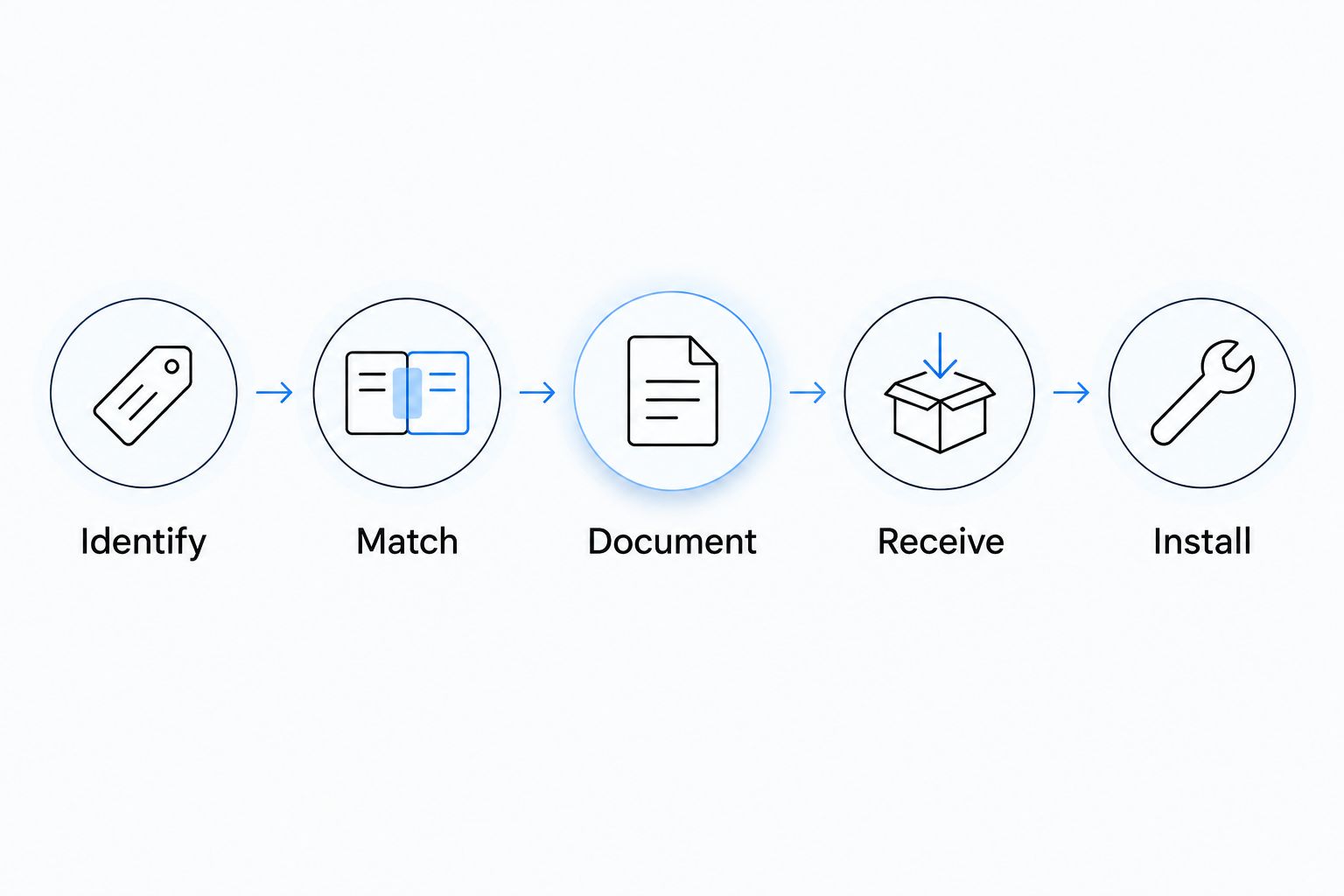
Assign responsibility for each step. The supplier identifies what it is selling; the installing shop confirms the application and performs the work. The buyer keeps the agreed scope intact between those parties.
Verdict: tie on the planning requirement. Prefer the offer that supports your process, but do not assume purchasing an engine also settles installation details.
Both suppliers need written freight and receiving arrangements
Freight is a purchasing requirement, not a supplier-quality shortcut. Agree how the assembly will be packed, where it will be delivered, and how the receiving shop will unload it. Do not infer handling arrangements from a product photograph.
Ask for the shipment's documented dimensions and weight rather than estimating them from engine-family names. Confirm the receiving address and unloading equipment with the shop. Have someone responsible for checking the unit present at delivery.
Keep the receiving inspection practical:
- Photograph the shipment before unpacking.
- Compare identification details with the order.
- Check the documented included components.
- Record visible damage or discrepancies using the agreed reporting procedure.
Verdict: tie on the receiving standard. Apply the same requirements to both suppliers. Neither earns a logistics win from an unverified assumption about delivery speed, packing quality, or damage handling.
Pricing: compare purchase scope, not a headline amount
This is an engine-and-parts purchasing decision. Compare the specific assembly or component being offered, then read the accompanying obligations. A supplier-wide pricing label does not tell you what your repair includes.
For your 2026 comparison, put these items beside each offer:
| Purchase item | Question to settle |
|---|---|
| Engine or component | Which identified unit does the offer cover? |
| Included hardware | What is included, and what must the shop transfer? |
| Core arrangement | Does the transaction require a return, and under what written conditions? |
| Freight | Which transport and receiving responsibilities belong to each party? |
| Coverage | What written coverage applies to this unit and this installation? |
| Setup work | What programming or preparation remains the shop's responsibility? |
A fixed, clearly defined scope gives you better planning predictability. Separately arranged components and services give you more purchasing flexibility but require closer coordination. These are tradeoffs in the offer you accept, not assumed differences between the suppliers.
Ask about return eligibility, exclusions, and reporting procedures before authorizing the purchase. The better terms belong to the offer that clearly assigns responsibilities and matches your repair—not automatically to either seller.
Final verdict: choose by your repair profile
Choose Diesel Engine King for an identified used-parts repair
Best for: the independent shop or owner-operator sourcing used commercial truck engines and heavy truck parts by model and part number. Start here when the supplied catalog's component descriptions align with your mechanic's requirements.
The advantage is a defined sourcing focus and specific listed component identities. The limitation is that the shop still needs to confirm application, setup, and the condition evidence relevant to the purchase. Do not extend a bench-tested ECM description to an unrelated engine assembly.
Choose Adelman's for the better-documented replacement offer
Best for: the fleet manager or repair-shop buyer holding an Adelman's offer that more clearly settles fitment, condition, package contents, and purchase obligations. Choose Adelman's when those documents establish the better match for the approved repair.
The advantage is specific to that offer. The limitation is the same purchasing discipline: an attractive supplier description does not replace a unit identity, inspection record, or included-components list.
One-glance scorecard
| Dimension | Winner |
|---|---|
| Used commercial truck sourcing focus | Client catalog for the stated buying profile |
| Part-specific listing detail | Client catalog for the supplied component examples |
| Fitment | Adelman's when its documented match is closer |
| Condition evidence | Supplier with stronger unit-specific records |
| Included components | Adelman's when its written package better matches the job |
| Installation planning | Tie: mechanic approval required |
| Freight and receiving | Tie: written arrangements required |
| Pricing model and terms | Offer with the clearer agreed scope and obligations |
FAQ
Is Diesel Engine King better than Adelman's for used truck engines?
Choose the supplier whose identified engine and written offer better match your truck. The client's stated focus is used commercial truck engines and heavy truck parts; compare the actual replacement, not a supplier-wide ranking.
What should I send a supplier before buying a replacement engine?
Send the truck VIN, engine serial number, data-plate photographs, and your mechanic's replacement requirements. Include control-module identification and a list of components the shop intends to reuse.
Does a bench-tested ECM mean it is ready for my truck?
No. A bench-tested condition description does not establish application compatibility or calibration; have your technician confirm hardware identity and setup requirements.
Is a used take-out injector the same as a tested injector?
No. Used take-out describes the component's removal history, while a test claim requires separate evidence. Ask for the inspection or testing information tied to the injectors offered.
Which supplier has better warranty terms?
Choose the offer with written coverage that fits your purchase and installation. Compare exclusions, covered components, responsibilities, and reporting procedures before ordering.
How do I compare engine purchase terms in 2026?
Compare the same replacement scope, included components, core obligations, freight responsibilities, and setup work. Keep the written terms beside the shop's installation plan.
Should I choose an engine with more accessories attached?
Choose the assembly whose documented contents match your repair plan. Additional attached components only help when they are suitable for the application and included in the purchase.
One last thing
Ask your mechanic to mark every component as included, reused, or purchased separately before you choose a supplier. This exposes unresolved work that a photograph or engine-family name does not answer. For a 2026 purchase, keep that marked list with the supplier's written offer and use it again at receiving.

