


Diesel Engine King vs 4BT Engines: which is better in 2026
Choose Diesel Engine King if you need used commercial truck engines and heavy truck parts; choose 4BT Engines for a Cummins 4BT repower only when its quoted engine matches your installation requirements. For 2026, the deciding difference is commercial truck repair versus a specific repower project—not which seller has the better name.
- Diesel engine king vs 4bt engines: choose by application, engine identity, and documented condition.
- Diesel Engine King suits buyers sourcing used commercial truck engines and heavy truck parts.
- Choose 4BT Engines for a repower only after confirming the exact engine and included components.
- Neither seller wins on fitment, testing, or purchase terms without unit-specific documentation.
Why this matters
A replacement engine and a repower engine solve different problems. Replacing a failed commercial truck engine starts with matching the existing installation; repowering starts with proving that a different engine works with the chassis, transmission, cooling system, and intended duty.
The Cummins 4BT is a 3.9-liter, four-cylinder diesel engine family. That designation identifies an engine type, not a complete installation package or a seller's service terms. A listing that says 4BT does not establish mounting compatibility, accessory placement, or suitability for your vehicle.
Diesel Engine King is a fit for buyers sourcing used commercial truck engines and heavy truck parts. For a 4BT project, judge the specific engine package rather than treating a seller comparison as an engineering decision.
At a glance
Use this 2026 comparison to decide where to start your inquiry. The purchasing checks apply to either seller; they are not claims that either business provides every item listed.
| Dimension | Diesel Engine King | 4BT Engines |
|---|---|---|
| Best for | Used commercial truck engine and parts sourcing | A 4BT project when the quoted unit meets the build requirements |
| Standout feature | Stated focus on used diesel engines and heavy truck parts | Project fit depends on the specific 4BT package quoted |
| Existing truck replacement | Start with the original engine identity and installation | Consider only an engine that matches the required application |
| Repower planning | Ask for a unit-specific component list | Require engine configuration and installation details |
| Engine condition | Evaluate evidence for the individual used unit | Evaluate evidence for the individual quoted unit |
| Fitment | Confirm serial numbers, part numbers, and interfaces | Confirm serial numbers, configuration, and interfaces |
| Pricing model | Compare the defined engine or part purchase | Compare the defined engine package and remaining project work |
| Purchase terms | Obtain written terms for the specific transaction | Obtain written terms for the specific transaction |
Commercial truck repair favors the stated truck-parts focus
For an owner-operator replacing a failed truck engine, the first task is identifying the correct replacement. Record the existing engine model, serial number, vehicle identification number, and relevant component numbers before requesting a quote.
The client's stated business covers used commercial truck engines and heavy truck parts. The supplied product descriptions also identify Detroit, Volvo, Caterpillar, and Cummins components. That supports starting a commercial truck inquiry here; it does not establish that any particular replacement engine fits your truck.
Best for: a repair shop or fleet buyer working from an existing truck specification. Keep the request narrow: identify the truck, describe the failed component, and specify whether you need an engine assembly or an individual part.
The limitation is important. A broad truck-parts business does not remove your responsibility to check fitment. A familiar engine model name still leaves questions about controls, accessories, flywheel housing, and emissions configuration.
A 4BT repower favors the seller with the matched package
Choose 4BT Engines for a 4BT build when its written offer identifies the engine configuration and supplies the components your installation plan requires. That is a genuine buying advantage—but only for the documented package, not for the name alone.
Best for: a project owner who has already selected the Cummins 4BT and defined the installation. Bring the proposed transmission, mounting arrangement, cooling layout, and operating requirements to the inquiry.
Do not confuse the 4BT with the Cummins 6BT. The commonly referenced 6BT is a 5.9-liter, six-cylinder engine family. Those are different engines, and a component intended for one is not automatically suitable for the other.
The repower route also has a clear disadvantage: you must resolve the interfaces that an original-engine replacement already has. Engine mounts, exhaust routing, accessory clearance, and driveline connections belong in the plan before you select a donor unit.
For 2026 road-use projects, confirm the applicable emissions and registration requirements before committing to a different engine configuration. Mechanical fit does not establish legal suitability.
Replacement work wins on preserving a known installation
An original-configuration replacement is the more direct starting point when your objective is returning an existing commercial truck to service. You already have a defined chassis installation, transmission arrangement, and control system to match.
That does not make every engine from the same family interchangeable. Compare the donor engine against the original unit, including its fuel system, control-module requirements, accessory mounting, and relevant emissions equipment.
Request photographs showing the identification plate and the actual engine from several sides. Then ask the installer to review the proposed replacement before you authorize the transaction.
Choose a matched replacement for repair work; choose a different engine only as a planned conversion. Treating a repower as a shortcut to replacement leaves installation questions unresolved.
If your repair uses a long block rather than a complete assembly, read the guide to installing a long-block diesel engine replacement. The component transfer plan belongs in the purchase decision, not after the engine arrives.
A defined 4BT build wins over an open-ended engine search
A 4BT project becomes easier to compare once you separate engine identity from package contents. Write down which components must arrive with the engine and which components your shop will supply or transfer.
Use these categories in the request:
- Engine identity: serial number, configuration, and application details.
- Package contents: attached accessories and separately included components.
- Transmission interface: housing, flywheel, clutch or converter arrangement, and proposed connection.
- Chassis fit: mounting points, sump clearance, and accessory clearance.
- Operating requirements: cooling, intake, exhaust, and intended load.
A seller offering the right bare engine does not automatically offer the right complete package. Conversely, extra accessories have no purchasing value if they conflict with your installation.
For a repower, the better offer is the one that satisfies the build sheet with fewer unresolved interfaces. This criterion gives 4BT Engines a fair opportunity to win without assuming unverified package contents or installation support.
Neither seller wins on condition without evidence
Used, rebuilt, and remanufactured describe different purchasing categories. Keep the quoted condition attached to the exact unit you are considering, and ask what work or testing supports that description.
The supplied store descriptions identify several control modules as used and bench-tested. That statement applies to those described modules. It is not evidence that every engine, injector, or other component receives the same testing.
For an engine, request records relevant to its condition: identification photographs, known donor information, inspection findings, and any available operating or test documentation. Ask what the test actually measured and whether it covered the complete engine or only a component.
Both sellers face the same evidence standard. A running video supports a narrower conclusion than a documented loaded test, and neither replaces a fitment review.
Do not make a seller-wide reliability judgment from one product description. In 2026, evaluate the unit you will receive, with its own identification and condition record.
Both require serial-number and interface checks
Start with engine identity, then work outward to the installation. Reversing that order encourages comparisons between engines that share a model name but differ in configuration.
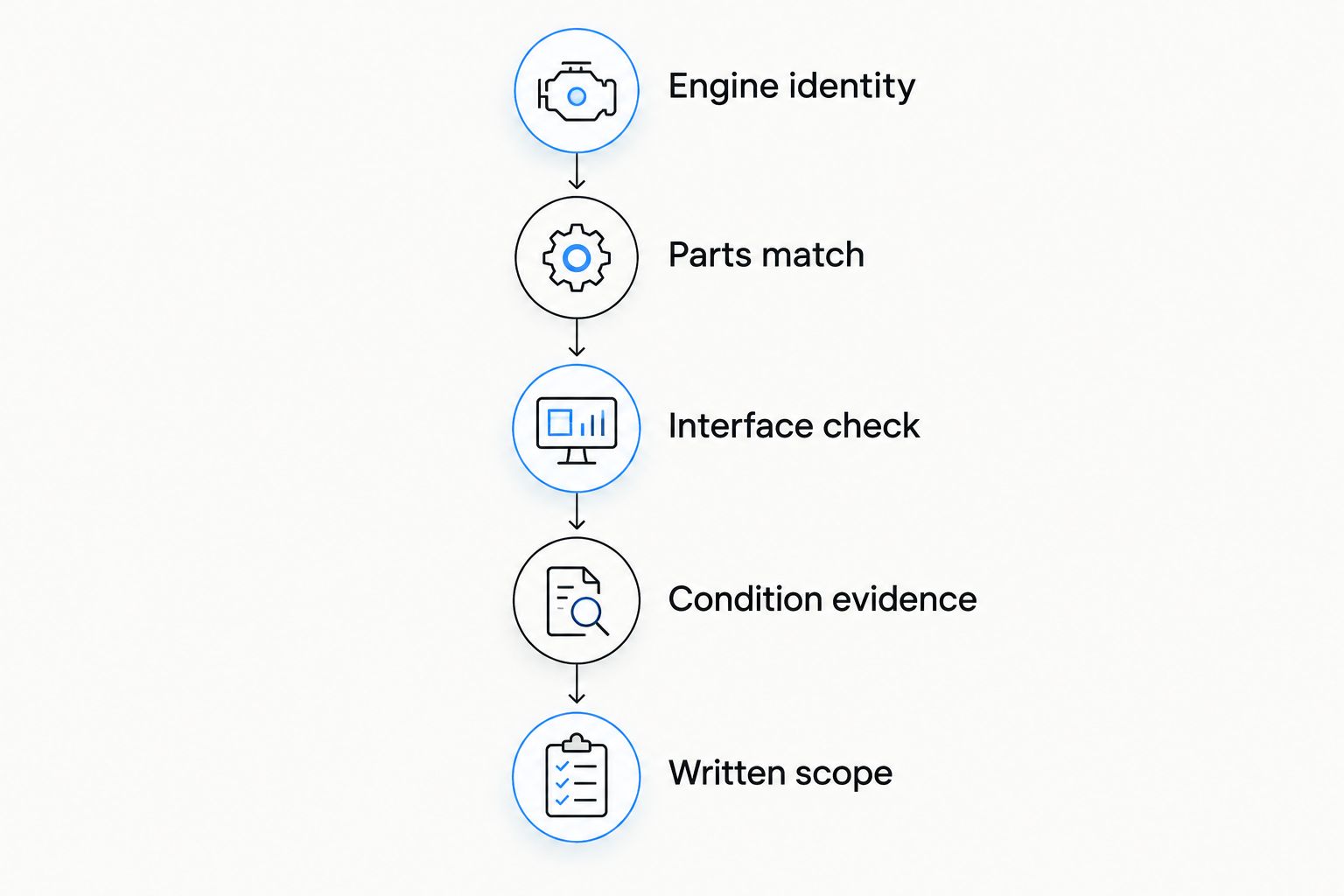
Use this sequence before approving either offer:
- Engine identity: match the identification plate to the written quote.
- Parts match: verify relevant component numbers and approved substitutions.
- Interface check: confirm the transmission, mounts, controls, and accessory connections.
- Condition evidence: review documentation for the quoted unit.
- Written scope: record included parts, exclusions, and transaction terms.
Electronic parts need the same discipline. One supplied Caterpillar C11 module title specifies a 70-pin connection and part number 256-1159. Those details provide matching information; they do not authorize substituting that module into another application.
Fitment is a tie until the exact engine and installation agree. Ask your installer to sign off on the proposed interfaces rather than relying on a listing headline.
Pricing: compare a defined purchase with a defined project
For Diesel Engine King, compare the quoted used engine or heavy truck part against the exact repair requirement. For 4BT Engines, compare the quoted engine package against the complete repower requirement. Neither comparison works if the included components remain unclear.
A narrowly defined component purchase gives you a clear scope. A larger package consolidates components, but only helps when those components match the build; otherwise, you still need separate sourcing or adaptation work.
Request a written breakdown covering:
- The engine or part identification and stated condition.
- Included accessories, controls, and connecting components.
- Items your installer must transfer, replace, or fabricate.
- Transportation and unloading responsibilities.
- Any applicable core requirements and transaction terms.
The winning quote closes the required scope—not merely the engine purchase. Compare like-for-like condition, package contents, and installation work before choosing a seller.
Keep commercial truck repair and repower budgets separate. A replacement quote addresses restoring an existing installation; a repower quote must also account for making a different installation work.
Purchase terms are a tie until they are written
Obtain the applicable return, warranty, and core terms before authorizing either purchase. Tie those terms to the quoted engine or part rather than assuming they apply across a seller's entire business.
Ask who handles a disputed fitment issue and what documentation the transaction requires. Confirm how the supplied unit will be identified on the paperwork and which included components appear on that record.
Also define responsibility for receiving and inspecting the shipment. Your shop needs a process for checking the identification, package contents, and visible condition before installation begins.
Neither seller wins on purchase protection through reputation alone. The useful comparison is the written agreement attached to your specific transaction.
Final verdict: choose for the job you actually have
Choose Diesel Engine King for an existing commercial truck repair
Named buyer profile: the fleet maintenance buyer or independent repair shop sourcing used commercial truck engines and parts. The stated business matches that purchasing task.
Start with the original engine specification and the failed-part diagnosis. Choose the quoted unit only after confirming identity, condition, interfaces, and included components. Do not turn a straightforward replacement inquiry into an unplanned conversion.
Choose 4BT Engines for a documented 4BT repower package
Named buyer profile: the project owner with a completed Cummins 4BT installation plan. Choose 4BT Engines when its written package matches that plan and resolves the required component interfaces.
The disadvantage is the extra integration work inherent in a repower. Reject an offer that leaves the transmission connection, mounting arrangement, cooling requirements, or legal application unresolved.
For a 2026 purchase, both profiles lead to the same final check: your installer must approve the specific engine, not just the seller.
One-glance scorecard
| Dimension | Winner |
|---|---|
| Used commercial truck sourcing | Client's stated truck-parts focus |
| Defined 4BT repower | 4BT Engines, when its package matches the build |
| Existing installation replacement | The exact original-configuration match |
| Repower planning | The offer that closes the build sheet |
| Engine condition | Tie until unit-specific evidence is reviewed |
| Fitment | Tie until serial numbers and interfaces match |
| Pricing structure | The offer with the complete required scope |
| Purchase terms | Tie until written terms are compared |
FAQ
Is Diesel Engine King better than 4BT Engines?
Diesel Engine King matches used commercial truck engine and heavy truck parts sourcing. Choose 4BT Engines for a 4BT repower only when its specific quoted package meets your installation requirements.
What is a Cummins 4BT engine?
The Cummins 4BT is a 3.9-liter, four-cylinder diesel engine family. The designation alone does not establish the engine's exact configuration, included accessories, or fitment.
Can I replace my truck engine with a 4BT?
A 4BT installation requires an application-specific engineering and legal review. Confirm mounting, transmission connection, controls, cooling, operating requirements, and applicable emissions rules before purchasing.
Is a 4BT the same as a 6BT?
No. The Cummins 4BT is a four-cylinder, 3.9-liter engine family; the commonly referenced 6BT is a six-cylinder, 5.9-liter engine family. Do not assume their parts or installation packages interchange.
What should I compare in an engine quote?
Compare engine identity, condition evidence, included components, installation requirements, and written transaction terms. A quote for a bare engine is not equivalent to a quote for a larger installation package.
Does bench-tested mean an engine has been run-tested?
No. A control module's bench-test description applies to that component and does not establish whole-engine operating condition. Ask for documentation relevant to the exact engine you are buying.
What should I confirm before buying a used engine in 2026?
Confirm the quoted unit's serial number, configuration, condition, interfaces, and package contents. Have your installer review those details before authorizing the purchase.
One last thing
Photograph the engine you are removing before the shop disconnects it. Capture the identification plate, accessory locations, mounting arrangement, and transmission connection. Those photographs give your installer a reference when reviewing a replacement or planning a repower.
For your 2026 purchase, add the photographs to the same job record as the quote and component list. Keep engine selection and installation approval connected.

