


4BT Engines alternatives for Cummins 4BT buyers
The Cummins 4BT gives buyers a 3.9-liter, four-cylinder diesel platform, with mechanical fuel injection on many versions. It stops being the right choice when the exact engine configuration, installation requirements, or operating duty do not fit your truck. The best 4BT engines alternatives in 2026 are Diesel Engine King for used commercial diesel engine sourcing, and rebuilding your existing Cummins 4BT when retaining the current installation is the priority.
- For 4bt engines alternatives, Diesel Engine King serves buyers sourcing used commercial diesel engines and heavy truck parts.
- Rebuild an existing Cummins 4BT when inspection supports repair and retaining the installation matters.
- Consider a Cummins 6BT only after checking space, axle loading, transmission compatibility, and cooling requirements.
- Choose an Isuzu 4HK1 for a matching application, not as an assumed bolt-in Cummins 4BT replacement.
Why this matters
A supplier alternative and an engine alternative solve different problems. You can change sellers while keeping a Cummins 4BT, or change engine families and take on a repower project. Those decisions need separate comparisons.
Diesel Engine King sells used commercial truck engines and heavy truck parts. Compare that sourcing route with repairing your existing engine before deciding that a different engine family is necessary.
For a 2026 purchase, start with the engine identification plate, the vehicle application, and the components you intend to retain. A family name alone does not establish fit. The flywheel housing, oil pan, mounts, injection system, and accessory arrangement all belong in the decision.
4BT engines alternatives at a glance
The Cummins 4BT is the benchmark below. The alternatives include a supplier route, a repair route, and different engine families; they are not interchangeable products.
| Option | Best for | Main strength | Main limitation | Difference from a Cummins 4BT purchase |
|---|---|---|---|---|
| Cummins 4BT | Retaining a compatible four-cylinder installation | 3.9-liter inline-four architecture | Exact configuration still needs verification | Baseline engine family |
| Diesel Engine King | Sourcing used commercial diesel engines and heavy truck parts | Engine and parts supplier route | Every proposed assembly needs application and condition checks | Changes sourcing, not necessarily the engine family |
| Rebuild the existing Cummins 4BT | Keeping a serviceable installation | Retains the known engine configuration | Depends on block, crankshaft, and cylinder-head condition | Repairs the engine instead of replacing it |
| Cummins 6BT | Projects designed around a larger inline-six | 5.9-liter, six-cylinder architecture | Longer engine package and repower work | Changes the engine size and installation requirements |
| Isuzu 4HK1 | Matching Isuzu commercial applications | 5.2-liter, four-cylinder architecture | Controls and application-specific integration | Changes engine family and supporting systems |
For 2026, choose the route that preserves verified compatibility—not the engine name that sounds closest. Displacement identifies engine size; it does not establish mounting compatibility, legal suitability, or the correct transmission connection.
1. Diesel Engine King: best for used commercial engine sourcing
Diesel Engine King is a used commercial diesel engine and heavy truck parts supplier. This is the first alternative to consider when your problem is finding a replacement assembly rather than redesigning the vehicle. Keep your existing engine specification as the buying reference.
Where this sourcing route shines
- You can frame the purchase around a used commercial engine and the truck parts involved in replacement.
- You can compare a proposed replacement against your current engine identification rather than choosing by displacement alone.
- You can keep supplier selection separate from the decision to retain or change the Cummins 4BT platform.
Where this sourcing route falls short
- Buying a used engine does not, by itself, establish its internal condition.
- A matching family name does not prove that the oil pan, housings, mounts, or accessories match your installation.
- A supplier choice does not replace the installer’s fitment assessment or the vehicle’s compliance checks.
Best for: Buyers who need used commercial engine sourcing and can provide the exact application details.
Ask for the engine serial number, identification-plate photos, donor application, included components, and documented condition evidence for the specific assembly. Ask what was inspected or tested rather than treating a general quality description as a test report.
Separate the engine assembly from the installation scope. Your installer needs to identify what transfers from the old engine, what needs replacement, and what requires modification before you commit.
Verdict: Hold until the exact assembly, condition evidence, and installation match are verified.
2. Rebuild your Cummins 4BT: best for retaining the installation
Rebuilding your existing Cummins 4BT keeps the engine family and known installation configuration. It is a strong alternative to replacement when an inspection confirms that the major castings and rotating components support repair. Start with diagnosis, not a rebuild-kit order.
Where rebuilding shines
- The existing mounts, accessory layout, and transmission connection remain the starting point.
- Inspection identifies which components need machining, replacement, or further testing.
- You retain the engine identity associated with the current installation.
Where rebuilding falls short
- A damaged block, crankshaft, or cylinder head changes the repair scope.
- Disassembly is necessary to establish the condition of many internal components.
- A parts kit does not correct unsuitable machining, incorrect assembly clearances, or the original cause of failure.
Best for: Owners whose existing Cummins 4BT fits the application and has repairable major components.
For a 2026 rebuild decision, require a written inspection and machining scope. It should distinguish reusable parts from rejected parts and explain how the failure cause will be corrected. Cooling-system faults, lubrication problems, and fuel-system defects need attention alongside internal engine work.
Use the engine serial number and Cummins Control Parts List, or CPL, to identify the required configuration. The guide to Cummins 4BT engine parts for repower projects is relevant when comparing retained components with replacement parts.
Verdict: Buy the rebuild route only after inspection confirms a repairable foundation.
3. Cummins 6BT: best for a larger-engine repower
The Cummins 6BT is a 5.9-liter inline-six, compared with the Cummins 4BT’s 3.9-liter inline-four. It belongs on the shortlist when the project calls for a larger engine and the chassis can accept the installation. It is not a direct replacement simply because both engines belong to the Cummins B-series family.
Where the Cummins 6BT shines
- It provides a larger-displacement alternative within the Cummins B-series family.
- It gives a repower project a six-cylinder starting point instead of retaining the four-cylinder package.
- Its suitability can be evaluated against a defined chassis, transmission, and operating requirement.
Where the Cummins 6BT falls short
- The longer inline-six package requires engine-bay clearance checks.
- Mounting, front-axle loading, cooling, exhaust routing, and driveline compatibility need separate assessment.
- Ratings and fuel-system configurations vary; the model name is not a complete specification.
Best for: A planned repower with enough space and an installation design approved for the selected engine.
Before choosing a Cummins 6BT, measure the complete package with its fan, accessories, turbocharger, and housings. Check the selected engine rating against transmission and clutch specifications. Do not infer interchangeability from a shared manufacturer name.
Verdict: Hold until the repower design confirms fit, loading, and driveline suitability.
4. Isuzu 4HK1: best for a matching commercial application
The Isuzu 4HK1 is a 5.2-liter four-cylinder diesel used in commercial applications. It is an alternative engine family, not a substitute selected solely because the Cummins 4BT also has four cylinders. The donor configuration and recipient vehicle determine the integration work.
Where the Isuzu 4HK1 shines
- It is a relevant replacement candidate for an application designed around the Isuzu 4HK1.
- Engine identification and donor information provide a basis for matching the assembly.
- A correctly matched replacement keeps the decision focused on the vehicle’s established engine system.
Where the Isuzu 4HK1 falls short
- Four-cylinder architecture does not make it compatible with Cummins mounts or transmission interfaces.
- Electronic controls, wiring, and emissions equipment require configuration-specific checks.
- An incomplete donor package leaves additional integration work to resolve.
Best for: Matching Isuzu commercial applications or engineered repowers with a complete integration plan.
Verdict: Skip as an assumed bolt-in 4BT replacement; hold for a verified matching application.
Why buyers move beyond the Cummins 4BT
The strongest reasons to consider 4BT engines alternatives are application mismatches—not unsupported claims about another seller’s service or engine quality. Decide which problem you actually need to solve.
- Engine condition: Inspection shows that the existing assembly needs replacement or major repair.
- Configuration mismatch: A proposed engine has the wrong sump, housing, accessory arrangement, or fuel-system configuration.
- Changed operating requirements: The project needs an engine rating and installation different from the existing specification.
- Incomplete replacement package: Essential components are missing from the proposed assembly.
- Installation constraints: The chosen engine does not fit the chassis, driveline, or control-system plan.
These are reasons to reassess the purchase, not automatic reasons to abandon the Cummins 4BT. A correctly configured replacement within the same family can address a failed engine without introducing a different engine platform.
Check the replacement before committing
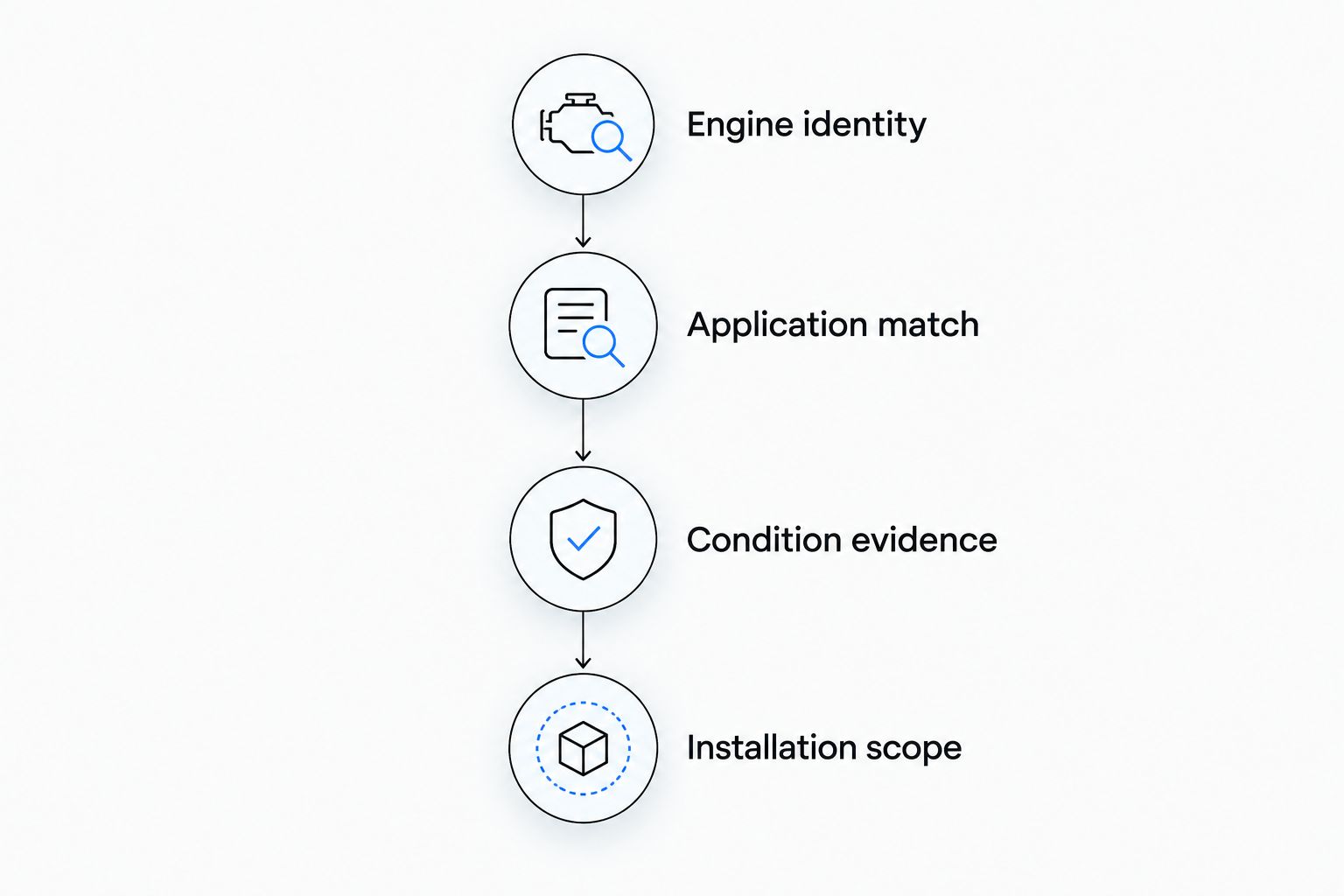
Use this sequence for a 2026 replacement decision. Resolve identity first, then fit, condition, and installation; accepting an engine before those checks reverses the process.
Engine identity
Record the existing engine serial number, CPL where applicable, and identification-plate information. Obtain the same details for the proposed replacement. Keep photographs with the written specification.
Application match
Compare the oil pan, mounting points, flywheel housing, accessory positions, intake, exhaust, and cooling connections. Have the installer identify every mismatch. Include transmission and clutch compatibility in the assessment.
Condition evidence
Request the inspection or test records associated with that specific engine. A running video shows operation during the recording; it does not establish every internal clearance or rule out every defect. Interpret the evidence according to what the test actually measures.
Installation scope
List the included components, retained components, replacement parts, and fabrication work. Check applicable emissions requirements before changing engine families. An engine that runs is not automatically suitable for installation in your vehicle.
Keep the resulting specification with the purchase documents. The receiving inspection should compare the delivered assembly with that specification before installation begins, while discrepancies are still easy to photograph and document.
When staying with the Cummins 4BT is right
Stay with the Cummins 4BT when the current installation suits the job and a matching repair or replacement is technically sound. A different engine family adds interfaces to resolve; it does not automatically solve the original failure cause.
The Cummins 4BT’s advantage is continuity in an already compatible installation. Its limitation is that continuity only helps when the engine specification still meets the application’s requirements.
For an existing conversion, review the mounting arrangement and driveline connection before deciding to keep them. Prior installation is not proof of correct installation. Correct any identified faults rather than duplicating them with the next engine.
FAQ
What are the best 4BT engines alternatives in 2026?
The best route depends on whether you need a different supplier, a repair, or a different engine family. Diesel Engine King serves used commercial diesel engine buyers; rebuilding an existing Cummins 4BT preserves a repairable installation, while Cummins 6BT and Isuzu 4HK1 choices require application-specific checks.
Is a Cummins 6BT better than a Cummins 4BT?
A Cummins 6BT is not automatically better than a Cummins 4BT. The 5.9-liter inline-six and 3.9-liter inline-four have different installation requirements, so choose against the chassis, driveline, and operating specification.
Can an Isuzu 4HK1 replace a Cummins 4BT?
An Isuzu 4HK1 is not an assumed bolt-in replacement for a Cummins 4BT. A conversion requires verification of mounts, transmission interfaces, controls, cooling, exhaust, and applicable emissions requirements.
Should I rebuild my Cummins 4BT or replace it?
Rebuild your Cummins 4BT when inspection confirms repairable major components and the installation still suits the application. Compare the documented repair scope with the condition and installation requirements of a replacement.
What information do I need before buying a used Cummins 4BT?
You need the engine serial number, CPL where applicable, donor application, included-component list, and condition evidence. Compare those details with the existing engine and have the installer verify physical and driveline compatibility.
Does a running video prove a used diesel engine is good?
A running video does not prove the complete internal condition of a used diesel engine. It documents operation during the recording; ask for additional inspection or test evidence relevant to the assembly.
Are all Cummins 4BT engines interchangeable?
Cummins 4BT engines are not automatically interchangeable across applications. Verify the exact fuel system, housings, oil pan, accessory arrangement, rating, and other installation details before buying.
One last thing
Photograph the engine you are removing before disconnecting it. Capture the identification plate, mounts, housings, oil pan, accessory layout, and wiring connections; those records give the installer a direct reference when evaluating the replacement.
For your 2026 purchase, the useful question is not simply whether an engine is a Cummins 4BT. Ask whether that exact assembly matches the installation and comes with evidence supporting its condition.

