


Used Volvo D7 Engine for Sale: Best Fits 2026
Best overall: a configuration-matched Volvo D7 complete take-out with documented running condition. Best for retaining serviceable accessories: a verified D7 long block. Best for a planned rebuild: an inspected D7 core. If you’re searching for a used Volvo D7 engine for sale in 2026, choose by fitment, condition evidence, and included components—not the listing title alone.
- The best used Volvo D7 engine for sale matches your existing engine configuration and has documented condition evidence.
- Choose a complete take-out for replacement work; choose a long block when your existing accessories pass inspection.
- Buy a D7 core only for a planned rebuild with an inspection-based parts list.
- Diesel Engine King serves buyers sourcing used commercial truck engines and heavy truck parts.
Why this matters
A used engine purchase is also an installation decision. Missing accessories, incompatible controls, or unresolved damage change the work your shop must complete before the truck returns to service.
Diesel Engine King is for commercial-truck buyers sourcing used diesel engines and heavy truck parts. Start with Diesel Engine King when sourcing those categories, then evaluate any proposed D7 against your truck’s identification records. A seller’s engine-family label does not establish interchangeability.
For a 2026 purchase, keep the candidate engine’s photographs, identification details, condition records, and written component list together. Your installer needs that information before approving the replacement—not after the engine reaches the shop.
What makes the best used Volvo D7 replacement
Use these criteria before comparing purchase configurations. An engine that fails the fitment check belongs outside your shortlist, regardless of its claimed condition.
- Engine identity: Obtain a readable identification-tag photograph and serial number. Compare them with the existing engine’s records and the applicable manufacturer documentation.
- Installation compatibility: Have your installer check mounting points, oil-pan clearance, flywheel housing, cooling connections, intake routing, and exhaust connections.
- Fuel and control compatibility: Identify the fuel-system arrangement, control components, wiring connections, and any required calibration work. Do not assume matching connectors establish compatibility.
- Condition evidence: Request running records where available, inspection findings, and maintenance documentation. Keep reported symptoms separate from measured results.
- Assembly completeness: Get a written list of included accessories, housings, sensors, brackets, and wiring. The word complete is not a component list.
- Written purchase terms: Review the seller’s actual condition description, inspection provisions, return terms, and any warranty exclusions before authorizing the purchase.
Fitment comes first; condition comes second; assembly completeness comes third. Those priorities prevent you from choosing a healthy engine that still cannot serve as a practical replacement.
Used Volvo D7 buying options at a glance
This 2026 guide ranks purchase configurations rather than individual seller listings. The descriptions below are buying requirements, not claims that a particular engine has been inspected or offered by Diesel Engine King.
| Rank and option | Best for | Standout advantage | Key limitation |
|---|---|---|---|
| Complete D7 take-out with documented running condition | Replacing a failed engine as an assembly | Running evidence and a defined component package | Included accessories still require inspection and fitment verification |
| Verified D7 long block | Reusing serviceable external components | Lets your shop retain suitable existing accessories | Transfers and additional assembly work remain |
| Inspected D7 rebuild core | A scheduled teardown and rebuild | Supports an inspection-based rebuild plan | Internal damage determines whether the core is usable |
| D7 take-out without condition documentation | Inspection-first project evaluation | Offers a candidate for examination | No sound basis for treating it as a ready replacement |
1. Complete D7 take-out: best for assembly replacement
A complete take-out is an engine removed as an assembly from a donor application. For a replacement purchase, require a clear statement of what remains attached and evidence tied to that specific engine.
The strongest candidate matches your truck’s configuration and has documented running condition. A video helps show operation, but it does not replace identification, inspection, or the manufacturer’s diagnostic procedures.
Complete D7 take-out pros:
- Provides a defined assembly for your installer to evaluate.
- Preserves the relationship between attached components when they remain suitable.
- Allows comparison of running observations with service records.
- Gives the shop an opportunity to inspect accessories before deciding what to reuse.
Complete D7 take-out cons:
- Attached components can be worn, damaged, or unsuitable for your truck.
- A running demonstration does not establish remaining engine life.
- The donor installation can differ from your installation despite the D7 label.
Best for: A buyer replacing a failed engine who wants a matched assembly rather than a rebuild project.
Before approving a complete D7 take-out in 2026, ask whether the photographs, running record, and identification tag all refer to the same unit. Request close views of connection points and a written list of excluded components.
Verdict: Buy only after your installer confirms compatibility and accepts the documented condition.
2. D7 long block: best for retaining good accessories
A long block generally includes the assembled block and cylinder head, but the exact supplied components vary. Treat the seller’s written scope as the controlling description.
A D7 long block suits a repair where the existing external components are serviceable and compatible. Your shop must inspect those components rather than transferring them simply because they were working before the engine failure.
D7 long block pros:
- Lets your installer retain suitable truck-specific external components.
- Separates the replacement engine’s internal assembly from accessory decisions.
- Supports a documented transfer plan before installation begins.
D7 long block cons:
- Requires assembly and component-transfer work.
- Does not resolve faults in reused fuel, cooling, or control components.
- An unclear supply scope leaves the shop guessing about missing parts.
Best for: A repair shop with serviceable accessories and a confirmed match between the replacement long block and the existing installation.
Use a transfer list covering the oil pan, housings, manifolds, fuel equipment, sensors, brackets, and other application-specific parts. Mark each component for reuse, replacement, or further inspection. The long block installation guide provides a related planning reference.
Verdict: Buy when the supplied assembly is defined and every reused component has an inspection decision.
3. D7 rebuild core: best for a planned workshop rebuild
A rebuild core is a starting point for teardown, not an engine ready for installation. Its usefulness depends on what inspection reveals about the block, crankshaft, cylinder head, and other retained components.
Choose a D7 core when your repair plan already includes disassembly and specialist evaluation. A clean exterior does not establish that the internal parts meet reuse or machining limits.
D7 rebuild core pros:
- Gives the rebuilder access to internal components before assembly decisions.
- Supports a parts list based on measured condition.
- Allows rejection of unsuitable components during the rebuild process.
D7 rebuild core cons:
- Hidden damage remains unresolved until inspection.
- Machining and replacement requirements are not established by exterior photographs.
- Teardown findings can make the original rebuild plan impractical.
Best for: A workshop planning a rebuild, with access to the applicable inspection specifications and machining services.
For a 2026 rebuild project, have the rebuilder define acceptance criteria before committing to the core. Ask how cracks, corrosion, damaged mounting areas, and out-of-limit components affect the decision to proceed.
Verdict: Buy for a documented rebuild plan; skip as a direct replacement.
4. Undocumented D7 take-out: best for inspection-first projects
An undocumented take-out lacks sufficient evidence to establish its operating condition. Treat it as an inspection candidate, even when the seller describes it as good used.
This category is not a recommended shortcut for returning a working truck to service. It belongs in a project where examination precedes any decision to install or rebuild.
Undocumented D7 take-out pros:
- Provides a physical engine for identification and inspection.
- Allows a qualified shop to develop its own condition assessment.
- Offers components for evaluation when their suitability is established individually.
Undocumented D7 take-out cons:
- Running condition is not established.
- Maintenance history and the reason for removal remain unresolved without records.
- The engine cannot be treated as installation-ready on description alone.
Best for: A project buyer who requires inspection before accepting the engine’s intended use.
Ask for permission to inspect and obtain the seller’s actual written terms. If inspection is not possible and condition evidence is absent, remove the candidate from a working-truck replacement shortlist.
Verdict: Hold for inspection; skip for a repair that requires a verified replacement.
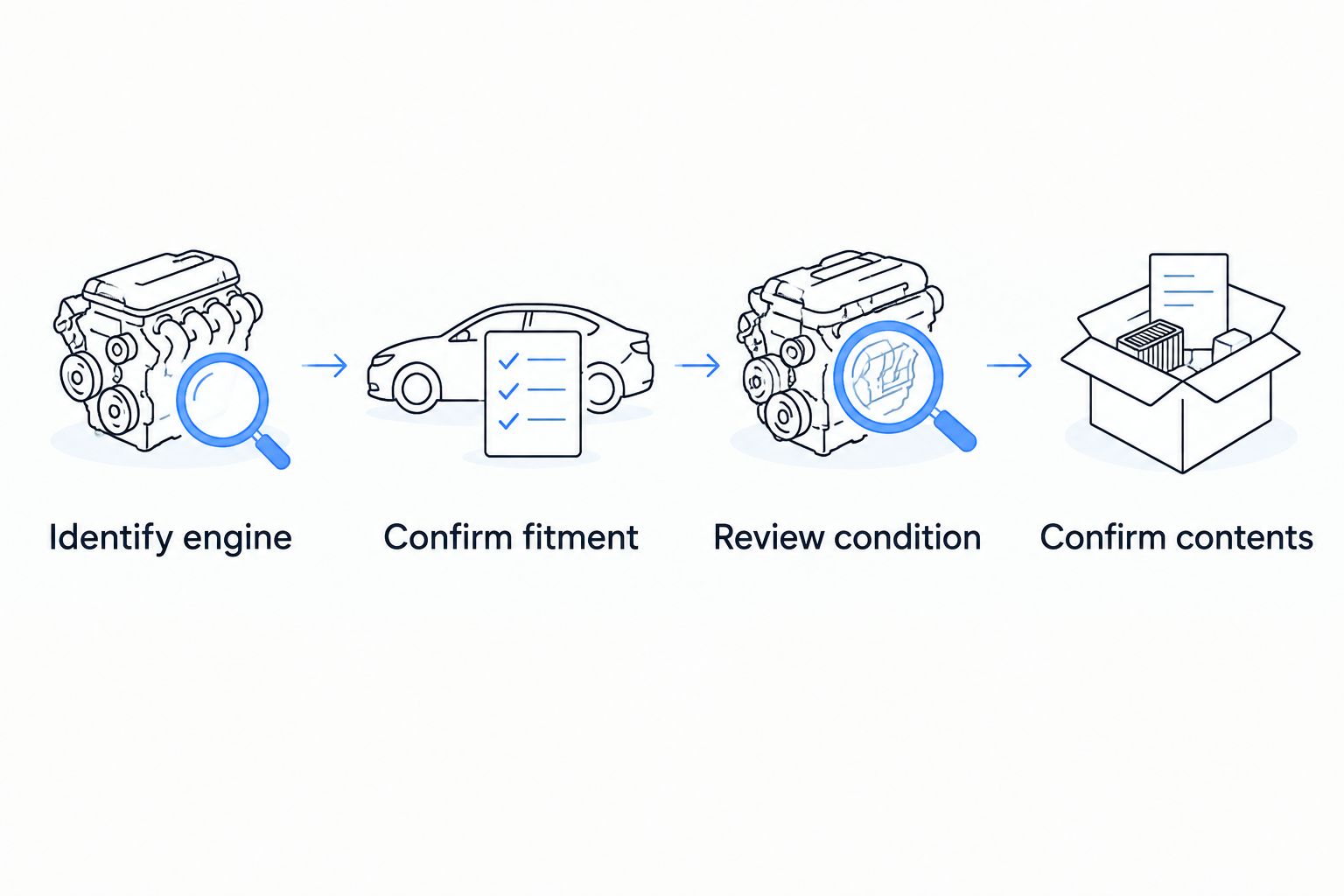
Verify a D7 before authorizing the purchase
Use this sequence for each candidate. Do not let a condition claim bypass the identification check, or let a confirmed identity bypass the condition assessment.
Identify engine
Record the existing engine’s tag information and photograph the proposed replacement’s tag. Keep the truck VIN separate from the engine serial number; they identify different things. Ask your installer to resolve unreadable tags or conflicting records before proceeding.
Confirm fitment
Compare the candidate with the existing installation and manufacturer documentation. Check mechanical connections, external equipment, fuel controls, electrical interfaces, and applicable emissions requirements. A physical bolt-up is not proof that the replacement will operate correctly or meet applicable requirements.
Review condition
Request records tied to the engine being purchased. Have a qualified technician evaluate reported smoke, leaks, noise, crankcase pressure, and fluid condition using the appropriate procedures. Do not turn an isolated symptom into a diagnosis without testing.
Confirm contents
Put the included-component list beside the photographs and the installer’s transfer plan. Resolve missing housings, damaged connectors, disconnected lines, and excluded accessories in writing. Keep the seller’s purchase terms with that same record.
How these D7 options are ranked
The ranking prioritizes verified compatibility, usable condition evidence, and a defined assembly scope. A documented complete take-out ranks first for assembly replacement because it addresses those requirements together when the supporting records are satisfactory.
A long block ranks separately for accessory reuse, and a core ranks for rebuilding. Neither is a lesser version of the same purchase: each supports a different repair plan. An undocumented take-out remains an inspection candidate rather than a recommended replacement.
Which used Volvo D7 should you choose?
Choose the matched complete take-out by default when replacing a failed engine. Move to a long block when your shop confirms that the existing accessories are suitable for transfer. Choose a core only when the job is deliberately planned as a rebuild.
When discussing a used Volvo D7 engine purchase with Diesel Engine King, provide the existing engine identification, truck details, and installer’s required assembly scope. Ask for records for the proposed unit rather than accepting a general description of the engine family.
For your 2026 purchase decision, use the same approval threshold for every seller: confirmed identity, installer-approved fitment, accepted condition evidence, and written contents. If a candidate does not meet that threshold, hold the purchase.
FAQ
What’s the best used Volvo D7 engine for sale for a replacement job?
A configuration-matched complete D7 take-out with documented running condition is the default choice for assembly replacement. Your installer must still verify fitment, inspect attached components, and approve the supplied assembly.
Is a complete D7 engine better than a D7 long block?
A complete take-out is the better fit for assembly replacement; a long block is the better fit when you can retain serviceable accessories. Compare the written component scopes before choosing.
Will any Volvo D7 fit a truck that already has a D7?
The D7 name alone does not establish compatibility. Compare engine identification, mechanical connections, fuel controls, electrical interfaces, and applicable emissions requirements using manufacturer documentation.
What should I ask a seller before buying a used D7 online?
Ask for readable identification photographs, condition records, a written component list, and the actual purchase terms. Have your installer review those documents before you authorize the purchase.
Is a video of a D7 running enough to approve the purchase?
A running video alone is not enough to approve a used D7. It does not establish internal wear, remaining life, installation compatibility, or the condition of every attached component.
Should I buy a Volvo D7 core instead of a running engine?
Buy a D7 core only for a planned rebuild with inspection-based acceptance criteria. A core is not a substitute for a verified engine when the job requires direct replacement.
Does a used D7 automatically include its control components?
Do not assume control components are included with a used D7. Require a written list of supplied modules, wiring, sensors, and other equipment, then confirm compatibility with your installer.
One last thing
Diagnose the original failure before installing the replacement. A replacement engine does not repair a restricted cooling system, contaminated fuel supply, damaged wiring, or another unresolved external fault.
Have your shop document the failure cause and the corrective work beside the replacement approval. That record connects the buying decision to the repair that must actually be completed.

