


Used Mack E-Tech Engine for Sale: Best Pick 2026
Best overall: a documented, run-tested Mack E-Tech take-out that matches your truck. Best for reusing serviceable accessories: a matched E-Tech long block. Best for a planned rebuild: an inspected E-Tech core. This 2026 guide ranks replacement configurations so you can judge a used Mack E-Tech engine for sale by fit, condition, and included components—not the listing headline.
- The best used Mack E-Tech engine for sale is a documented, run-tested take-out matched to your truck.
- Choose a Mack E-Tech long block when your existing accessories pass inspection and fit the replacement.
- Choose a Mack E-Tech core only for a rebuild with teardown and machine-shop inspection planned.
- Diesel Engine King serves buyers sourcing used commercial truck engines and heavy truck parts.
Why this matters
A replacement engine must match the truck mechanically and electronically. The Mack name on the valve cover does not establish that match, and a running video does not establish the condition of every internal component.
Diesel Engine King sells used commercial truck engines and heavy truck parts. When evaluating a replacement, separate the seller's description from the evidence attached to the individual engine: identification, operating condition, and exactly what accompanies the assembly.
For a 2026 replacement project, approve the engine and the installation scope together. An engine that needs unplanned accessory transfers, wiring repairs, or calibration work is a different job from the one described as a straightforward replacement.
What makes the best used Mack E-Tech replacement?
Use these criteria before comparing complete engines, long blocks, or rebuild cores:
- Identity: Readable engine identification, donor information, and photographs that belong to the actual assembly.
- Mechanical fit: Confirmed mounting arrangement, oil-pan clearance, flywheel housing, and accessory layout for your truck.
- Electronic fit: Compatible controls, harness connections, sensors, and a documented calibration plan.
- Condition evidence: Recorded inspection findings and, for a running engine, operating evidence tied to its identity.
- Included components: A written list distinguishing installed components, loose components, and excluded components.
- Installation scope: A shop-approved plan for transfers, repairs, commissioning, and investigation of the original failure.
Make a 3-document purchase file: an identification record, a condition record, and an included-components record. These are buyer requirements, not proof that every seller already supplies them. Keep them together so your installer evaluates the same engine you are considering.
Mack E-Tech replacement options at a glance
These rankings compare assembly types, not individual engines or sellers. A particular take-out, long block, or core earns its recommendation only after inspection and compatibility checks.
| Rank and option | Best for | Standout feature | Key limitation |
|---|---|---|---|
| 1. Documented running E-Tech take-out | Returning a truck to service with a matched replacement | Operating evidence before installation | Used internal parts retain their existing wear |
| 2. Matched E-Tech long block | Reusing inspected, compatible external components | Separates the engine assembly from accessory selection | More transfer work; package contents require confirmation |
| 3. Inspected E-Tech rebuild core | A shop-managed rebuild project | Internal condition can be evaluated during teardown | Not a ready-to-install running replacement |
Choose the assembly type your repair actually needs. A complete take-out is not automatically better than a long block when its external components are unsuitable, and a core is not a substitute for a tested replacement.
1. Running E-Tech take-out: best for a matched replacement
A take-out is an engine removed from a donor vehicle. For this recommendation, the engine must have documented operating evidence and a configuration your installer has checked against the receiving truck.
The advantage is visibility into how the engine operates before installation. Request the circumstances of the test: whether it started cold, whether it reached operating temperature, and which readings or observations were recorded. A brief idle clip answers fewer questions than a documented inspection.
Running E-Tech take-out pros
- Operating evidence helps distinguish a functioning engine from an untested assembly.
- Included compatible accessories can reduce component-transfer work.
- Donor records give your shop another way to check application details.
- An intact assembly lets your installer inspect component routing and mounting arrangements.
Running E-Tech take-out cons
- A run test does not eliminate internal wear or establish remaining service life.
- Donor accessories still need their own inspection.
- A matching engine-family name does not confirm truck-specific compatibility.
Best for: An owner-operator or fleet replacing an engine while retaining the truck's established configuration.
Before approving a take-out in 2026, ask your installer to review the identification, test evidence, and included-components list. Resolve discrepancies before arranging the installation, especially when photographs show parts that the written description excludes.
Verdict: Buy a running E-Tech take-out only after identity, fit, and operating evidence agree.
2. E-Tech long block: best for reusing inspected accessories
A long block generally comprises the assembled engine's principal internal components and cylinder head. Sellers use the term differently, so the written component list—not the label—defines the actual package.
This option fits a repair where your existing external components remain usable and compatible. Your shop must inspect those components before deciding to transfer them; retaining a failed fuel, cooling, or lubrication-related component can leave the original problem unresolved.
E-Tech long block pros
- Lets your shop retain compatible external components that pass inspection.
- Allows accessory selection around the receiving truck's configuration.
- Makes component-transfer responsibilities explicit when supported by a written scope.
E-Tech long block cons
- Requires more assembly and transfer work than a suitably equipped take-out.
- The term long block does not establish whether the unit is used, rebuilt, or remanufactured.
- External parts from the failed engine can carry defects into the replacement.
Best for: A repair shop with a confirmed internal engine failure and a usable set of matching external components.
For a 2026 long-block project, make the installer identify every transferred component. Include the injection-related equipment, manifolds, turbocharger, wiring, sensors, brackets, and housings as applicable to the specific assembly. Confirm each part's condition and compatibility rather than treating it as reusable because it remained attached to the old engine.
Verdict: Buy a matched E-Tech long block when your shop has approved the transfer parts and assembly scope.
3. E-Tech rebuild core: best for a planned shop rebuild
A rebuild core is a starting assembly for teardown, measurement, and repair. It is not a running replacement simply because its exterior appears complete or the crankshaft can be turned.
Choose this route when a qualified shop will evaluate the block, head, crankshaft, and other internal components. The rebuild plan must accommodate findings uncovered after disassembly, including damage that external photographs cannot show.
E-Tech rebuild core pros
- Teardown provides direct access to internal components for inspection.
- A shop can define replacement parts from measured condition.
- The project can be organized around a documented rebuild scope rather than unknown operating history.
E-Tech rebuild core cons
- External inspection cannot establish that major castings and rotating parts are reusable.
- Hidden damage can change the rebuild scope.
- A core does not provide operating evidence in its purchased condition.
Best for: A shop-managed overhaul where teardown and machine-shop evaluation are already part of the plan.
Ask why the engine was removed, what damage is known, and whether any components have been removed or substituted. Treat those answers as inspection leads, not guarantees. If the seller describes a seized engine, coolant contamination, or broken internal parts, have the rebuild shop assess those disclosures before accepting the core.
Verdict: Hold an E-Tech core purchase until the rebuild shop accepts the inspection plan and known damage.
Confirm the engine before confirming the purchase
Use this sequence for any used Mack E-Tech engine for sale. A good condition report cannot correct a mismatched assembly.
Engine identity
Request 2 identification photos: the donor engine's identification and your current engine's identification. Give your installer both, along with the truck identification and available service records. Do not use an exterior resemblance as the interchange decision.
Mechanical fit
Have the installer compare mounting points, sump clearance, flywheel housing, accessory drives, intake routing, and exhaust routing. Record which components stay with the replacement and which must transfer from your truck.
Electronic fit
Compare the engine controls, connectors, harness condition, sensor arrangement, and calibration requirements. Your shop should use the applicable service information to establish compatibility. The guide to matching a replacement diesel engine to your truck's ECM specs explains this part of the replacement decision.
Written scope
Create 1 written component list that follows the engine through purchase and installation. Include loose parts as well as attached parts, and identify anything pictured but excluded.
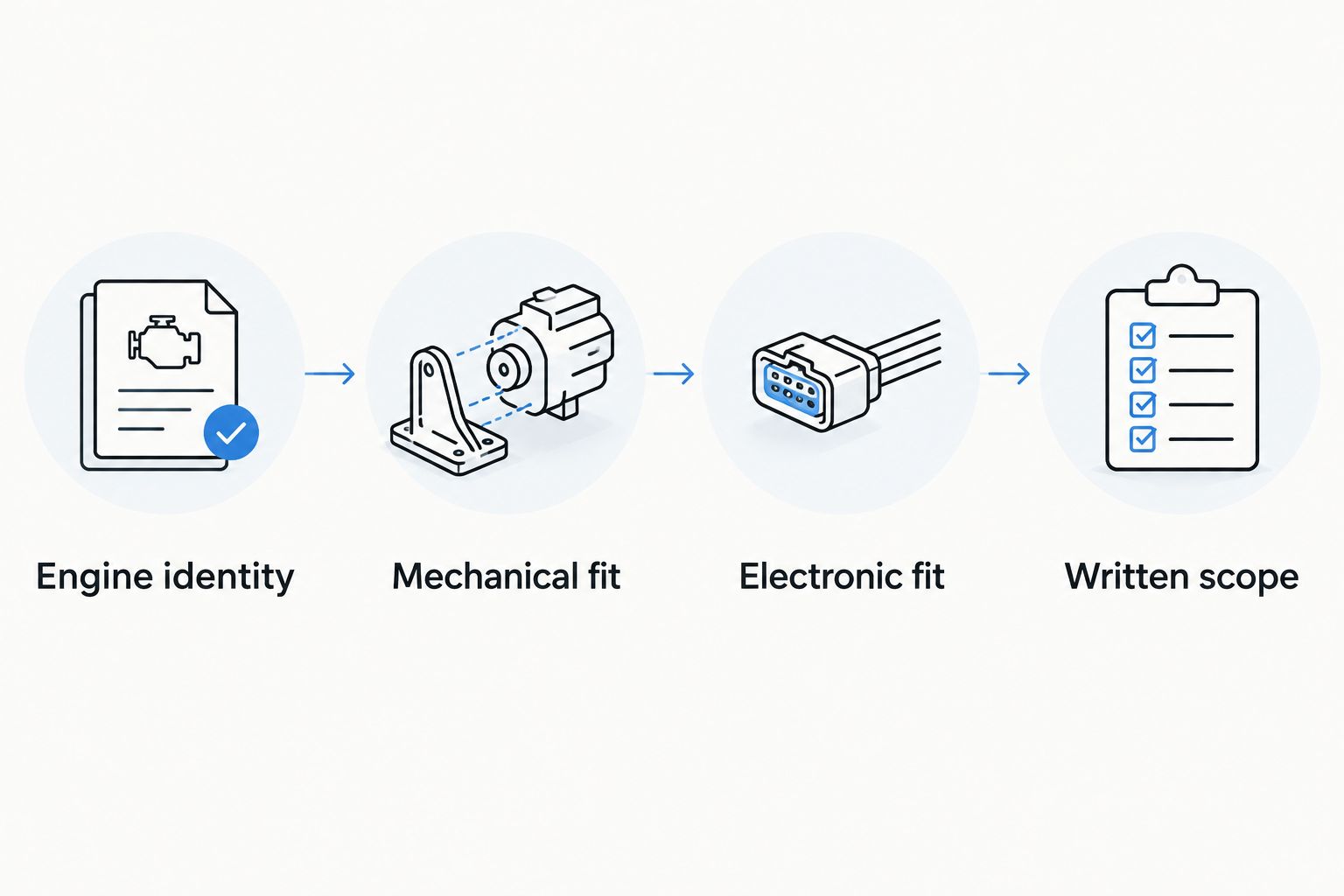
Your installer should approve this sequence before the engine arrives. It keeps fit questions separate from condition questions and establishes who is responsible for each part of the job.
Inspect condition without mistaking a video for a diagnosis
For a running take-out, request an uninterrupted record showing the engine identity and the test conditions. Ask for oil-pressure observations, coolant-temperature observations, visible leaks, exhaust behavior, and any diagnostic findings. Have your shop interpret readings against the service information for that engine and operating condition.
A cold start and a warmed-up inspection answer different questions. Neither proves remaining life, and neither replaces investigation when the engine shows abnormal noise, smoke, fluid contamination, or crankcase pressure.
For a non-running assembly, focus on disclosed damage and the checks the inspecting shop can actually perform. Do not describe the engine as run-tested when no operating test took place.
Use this evidence checklist:
- Engine identification appears in the inspection record.
- Test conditions are described rather than implied.
- Measurements identify their units and operating conditions.
- Known defects are listed separately from normal observations.
- Your installer has reviewed unresolved findings.
Skip an engine whose identity or condition evidence contradicts its description. A clean exterior is useful for seeing leaks and damage; it is not a substitute for mechanical inspection.
Questions to send with your engine inquiry
Send Diesel Engine King a specific used-engine inquiry rather than asking only for a Mack engine. Include your current identification, truck application, required assembly type, and the installer's compatibility questions.
Use this checklist with any seller:
- What identifies this particular engine and its donor application?
- Was it tested before removal, after removal, or not tested?
- What inspection findings are recorded?
- Which attached and loose components accompany the assembly?
- What known defects, repairs, or missing parts are disclosed?
- What written terms apply to this specific transaction?
Ask for answers tied to the individual engine. General statements about quality do not establish the condition of the assembly under consideration, and terms from another listing do not establish the terms of your purchase.
How the options are ranked
The order prioritizes confirmed fit, useful condition evidence, and a defined installation scope. A documented running take-out is the default because it provides operating evidence; a long block suits accessory reuse; a core belongs in a rebuild project.
This is a configuration ranking, not a claim of hands-on testing or a seller comparison. For your 2026 purchase, the individual engine's records determine whether it meets the recommendation.
Which used Mack E-Tech engine should you choose?
Choose a documented, run-tested E-Tech take-out that your installer confirms will fit. That is the default for a truck needing an engine replacement rather than a rebuild project.
Choose an E-Tech long block when the existing external components pass inspection and your shop accepts the transfer work. Choose an E-Tech core only when teardown and rebuilding are the intended repair. Do not substitute a different Mack engine family based on brand name alone.
Diesel Engine King is a source for used commercial truck engines and heavy truck parts. Your purchase specification should identify the engine, the required components, and the evidence your shop needs to approve installation.
FAQ
What's the best used Mack E-Tech engine for sale?
The best choice is a documented, run-tested Mack E-Tech take-out that your installer confirms matches your truck. Check the engine identity, mechanical configuration, controls, and included components before approving it.
Is a complete E-Tech take-out better than a long block?
A matched running take-out is better for a replacement that needs operating evidence and compatible included accessories. An E-Tech long block fits a repair where your shop has approved the existing external components for reuse.
Will any Mack E-Tech engine fit my Mack truck?
Do not assume every Mack E-Tech engine will fit your truck. Have your installer confirm the identification, mounting arrangement, housings, accessories, wiring, and calibration requirements using applicable service information.
What should I request before buying a used E-Tech engine online?
Request engine identification, condition evidence, and a written included-components list. Your installer should review those records alongside the receiving truck's identification and replacement scope.
Does a run-tested engine still need inspection?
Yes, a run-tested engine still needs inspection. Operating evidence does not establish remaining service life or confirm the condition of every accessory and internal component.
Can I reuse my old accessories on an E-Tech long block?
Reuse accessories only after your shop confirms their condition and compatibility. Investigate the original failure first so a defective transferred component does not compromise the replacement.
Should I buy an E-Tech core for an immediate replacement?
No, an E-Tech core belongs in a planned rebuild rather than an immediate running-engine replacement. Teardown and measurement are needed to establish which components can be reused.
One last thing
Diagnose why the original engine failed before installing the replacement. A replacement assembly does not repair a defective component left elsewhere in the truck.
For your 2026 job, put the failure diagnosis beside the transfer-parts list. Require the installer to explain which components are being reused, which are being replaced, and how the original cause is being addressed. That check matters more than choosing the cleanest-looking engine.

