


Used Hino J08E Engine for Sale: Best Fit 2026
Best overall: a complete used Hino J08E take-out with verified truck compatibility and documented running condition. Best for reusing serviceable external parts: a used J08E long block; best for retaining a verified cylinder head: a used J08E short block; best for a planned teardown: a J08E rebuild core. This 2026 guide ranks purchase configurations, not individual listings, so you can evaluate a used Hino J08E engine for sale without treating the model name as proof of fit.
- The best used Hino J08E engine for sale is a documented, compatible complete take-out for a direct replacement.
- Choose a J08E long block only after your shop verifies the external parts you intend to reuse.
- Choose a J08E short block only with a serviceable, compatible cylinder head.
- Diesel Engine King buyers should verify engine identity, included components, and condition before approving a replacement.
Why this matters
A used engine purchase has two separate questions: does the engine match your truck, and is its condition acceptable? A seller's J08E description answers neither question by itself. You need engine identification, donor information, inspection evidence, and a written component list.
Diesel Engine King sells used commercial truck engines and parts. For your 2026 replacement project, keep the buying decision tied to the specific engine offered and your repair shop's compatibility review—not a general description of the engine family.
Diesel Engine King buyers should choose a used Hino J08E by verified truck fit and documented condition, not the model name alone. That rule applies whether you buy a complete assembly or an engine that needs parts transferred from your truck.
What makes the best used Hino J08E engine?
Use these 5 checks before ranking any candidate:
- Engine identity: Obtain clear identification photographs, the engine serial number, and the donor vehicle VIN when available. Have your shop check the applicable Hino parts and service information.
- Truck compatibility: Compare the original engine's configuration with the candidate, including controls, emissions equipment, mounting interfaces, and transmission connection.
- Condition evidence: Request records of the actual inspection or testing performed. Separate a running observation from measurements and a visual inspection.
- Assembly contents: Get a written list of included components. Terms such as complete, long block, and short block do not replace an itemized description.
- Installation readiness: Identify everything your shop must inspect, transfer, replace, or obtain before fitting the engine.
For a 2026 purchase, the strongest candidate clears every check. An engine with an attractive description but unresolved identity or fit belongs on hold, not at the top of your shortlist.
Used Hino J08E options at a glance
These are purchase types to request and compare. They are not claims that a particular engine has been inspected, tested, or offered by a specific seller.
| Rank | Purchase configuration | Best for | Standout feature | Key limitation |
|---|---|---|---|---|
| 1 | Complete used J08E take-out | Direct replacement with fewer component transfers | An assembled engine package with documented contents | Included components still need compatibility and condition checks |
| 2 | Used J08E long block | Reusing verified external components | A base assembly for transferring compatible equipment | More transfer work and separate component inspection |
| 3 | Used J08E short block | Retaining a verified cylinder head | Replacement of the lower engine assembly | Head condition and assembly work remain your responsibility |
| 4 | J08E rebuild core | A planned teardown and rebuild | A starting assembly for inspection and machining decisions | Internal serviceability remains unresolved before teardown |
Choose the assembly around the repair you actually need. A more complete engine does not eliminate inspection, and a less complete engine does not automatically make the project simpler.
1. Complete J08E take-out: best for direct truck replacement
A complete used Hino J08E take-out is an engine removed as an assembly from a donor vehicle. The exact contents depend on the seller's description. Require that description to identify the turbocharger, fuel-system components, wiring, sensors, external accessories, and any control module supplied.
This configuration is the default for a replacement project when you want to limit component transfers. It only earns first place after your shop confirms fit and reviews evidence of the engine's condition.
Complete J08E take-out pros:
- Gives your shop an assembled candidate to compare with the original engine.
- Reduces transfer work when compatible external components are included and serviceable.
- Allows donor records and running evidence to support the purchase decision.
Complete J08E take-out cons:
- The word complete does not establish which accessories or electronics are included.
- Used external components need their own inspection.
- A running video does not establish internal wear or performance under load.
Best for: A truck owner replacing an engine while retaining the truck's established configuration.
Before approval, ask your shop to identify any differences in the oil pan, brackets, plumbing, wiring connections, and flywheel housing. Resolve those differences in writing rather than leaving them for installation day.
Verdict: Buy a complete J08E take-out only after identity, fit, contents, and condition are verified.
2. Used J08E long block: best for reusing external components
A long block generally includes the lower engine assembly and cylinder head. External equipment varies by listing, so your written component list controls the decision. Do not assume the turbocharger, injectors, manifolds, or wiring come with it.
A used J08E long block suits a repair where your shop has verified the equipment it plans to transfer. If the original failure damaged those components, transferring them without inspection carries the unresolved problem into the replacement.
Used J08E long block pros:
- Lets your shop retain verified, compatible external equipment.
- Provides a replacement base assembly without committing to every donor accessory.
- Makes the transfer scope explicit when the supplied contents are itemized.
Used J08E long block cons:
- Requires more assembly and component-transfer work than a suitable complete take-out.
- Does not establish the condition of equipment retained from your truck.
- Needs inspection evidence for the used base assembly itself.
Best for: A repair shop with serviceable external components and a defined transfer plan.
In 2026, approve a used long block only alongside a written installation scope. Specify which components stay with the replacement, which transfer from your original engine, and which require replacement or further testing.
Verdict: Buy a used J08E long block when the external-component reuse plan is verified.
3. Used J08E short block: best for retaining a verified cylinder head
A short block generally contains the block and lower rotating assembly, without the cylinder head. Confirm the exact contents before treating a listing as a replacement package. Your shop must determine whether the existing head and associated parts are suitable for reuse.
This option fits a lower-engine repair with a separately verified head. It is not the right default when overheating, contamination, or an unresolved failure leaves the upper engine's condition uncertain.
Used J08E short block pros:
- Retains a compatible cylinder head that passes inspection.
- Focuses the replacement on the lower engine assembly.
- Allows your shop to document upper-engine work during assembly.
Used J08E short block cons:
- Requires cylinder-head installation and additional assembly work.
- Leaves head, valve-train, and external-component condition to separate checks.
- Demands inspection of the used lower assembly before installation.
Best for: A repair shop that has confirmed the cylinder head's serviceability and identified the lower assembly as the replacement target.
Use the applicable Hino service procedures for inspection limits, assembly, and tightening specifications. Generic diesel instructions are not a substitute for the correct engine documentation.
Verdict: Hold a used J08E short block purchase until the cylinder head and assembly plan are approved.
4. J08E rebuild core: best for a planned teardown
A rebuild core is a starting assembly for disassembly and evaluation. Treat its internal condition as unresolved unless inspection records establish otherwise. A core is not a running replacement simply because it turns over or appears complete.
This configuration suits a shop prepared to inspect major components and make repair decisions after teardown. The decision depends on rebuild capability and a defined project—not an assumption that every removed engine is rebuildable.
J08E rebuild core pros:
- Supports a rebuild based on direct internal inspection.
- Lets your shop identify machining and component-replacement needs.
- Provides an assembly to evaluate against the intended truck application.
J08E rebuild core cons:
- Teardown can reveal unusable major components.
- Installation cannot proceed as a routine complete-engine replacement.
- The repair scope remains unsettled until inspection is complete.
Best for: An engine builder or repair shop planning a documented rebuild.
Ask why the engine was removed and what damage is already known. Have the shop define its rejection criteria before you approve the core, including how it will assess the block, crankshaft, cylinder head, and related assemblies.
Verdict: Skip a J08E rebuild core for a direct replacement; hold it for a qualified rebuild evaluation.
How these J08E options are ranked
The ranking follows the 5 checks above: identity, compatibility, condition evidence, assembly contents, and installation readiness. A verified complete take-out leads for direct replacement because it can reduce component transfers. Long blocks, short blocks, and cores serve progressively more assembly-focused repair plans.
These are configuration recommendations, not measured comparisons between individual engines. A documented long block is a better candidate than an unidentified complete assembly. Evidence outranks the label.
Match the replacement before authorizing installation
Follow this sequence with your repair shop. Keep the information attached to the specific engine under consideration, not just to a general seller conversation.
Engine identity
Record 2 identifiers separately: the original engine serial number and the candidate engine serial number. Add photographs of both identification areas and available emissions labels. Ask the shop to resolve the full engine designation through applicable documentation.
Truck configuration
Compare engine controls, wiring, emissions equipment, mounts, cooling connections, and the transmission interface. Read the guide to matching a replacement diesel engine to your truck's ECM specs before approving an electronics transfer. Matching connector shapes alone does not establish compatibility.
Included components
Put the supplied components beside the shop's required components in a written checklist. Identify omissions and incompatible items. Do not let a photograph stand in for confirmation of what accompanies the engine.
Condition evidence
Request the test date, engine identification, and method used for each test. If measurements are supplied, ask your shop to compare them with the applicable service limits. Avoid accepting unspecified claims such as checked over as a condition report.
Installation scope
Document the transfer work, inspection tasks, replacement parts, and commissioning procedure. Approve the candidate only after the shop closes unresolved fit questions.
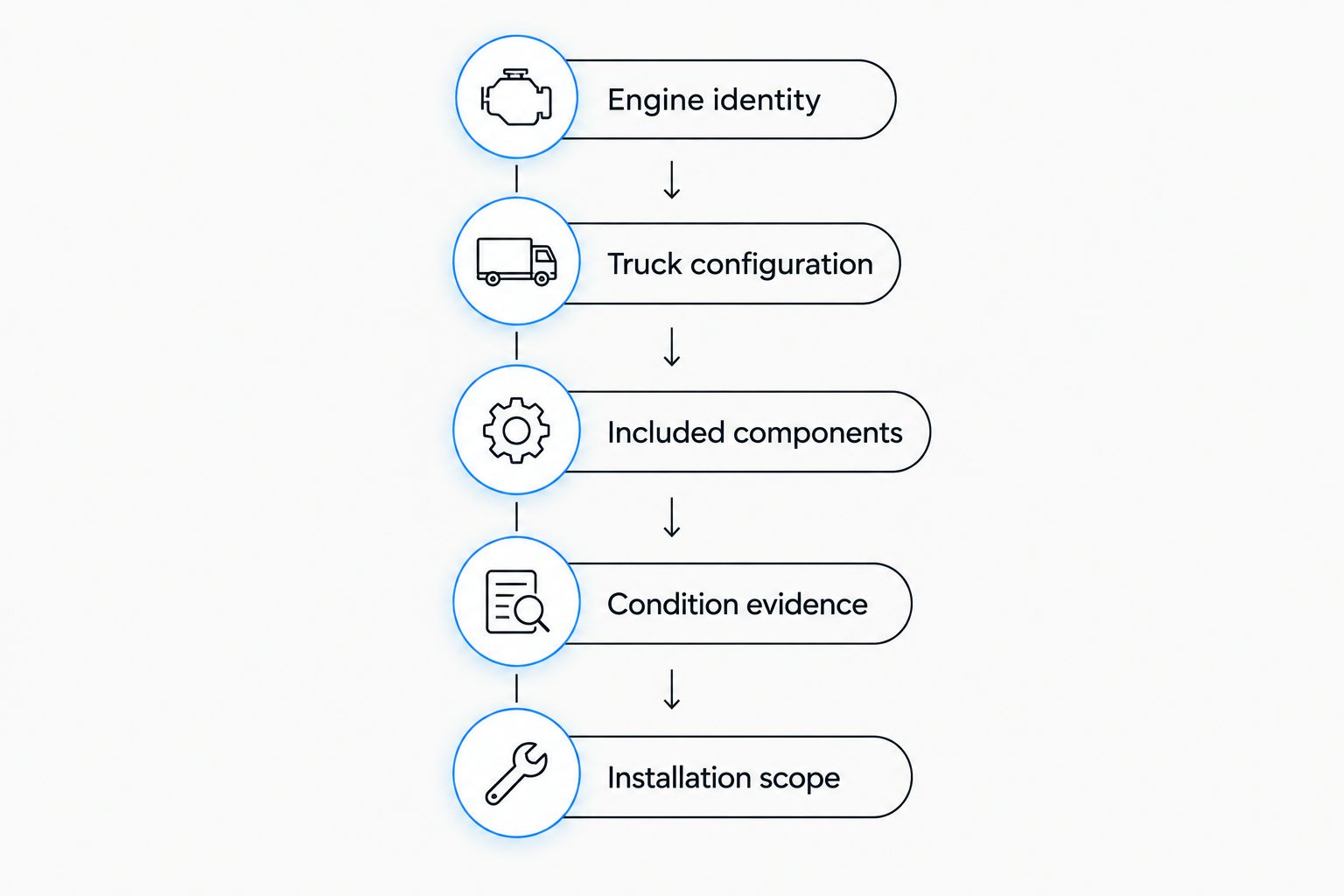
For your 2026 purchase file, retain 3 records: the identification photographs, the written component list, and the condition report. Those records give the receiving shop a clear basis for checking the delivered assembly against the agreed description.
Which used Hino J08E should you choose?
Choose a compatible complete J08E take-out with documented condition as the default for direct replacement. Choose a long block when your shop has approved external-component reuse, a short block when it has verified the cylinder head, and a core only for a planned rebuild.
Diesel Engine King buyers evaluating a used Hino J08E engine should start with the truck's original identification and the shop's required configuration. That keeps the shortlist focused on candidates that fit the repair rather than engines that merely share a family name.
FAQ
What's the best used Hino J08E engine for sale for a replacement?
A compatible complete J08E take-out with documented condition is the default choice for direct replacement. Confirm the engine identification, included components, controls, and emissions configuration before approval.
Will any Hino J08E engine fit my truck?
The J08E family name alone does not establish truck compatibility. Have your repair shop compare the original and replacement engine identification, applicable parts information, electronics, emissions equipment, and installation interfaces.
Is a complete J08E engine better than a long block?
A complete J08E take-out is better for limiting component transfers when its supplied parts are compatible and serviceable. A long block suits a shop with verified external equipment and a written transfer plan.
What should I ask for before buying a used J08E online?
Ask for engine identification photographs, donor information, a written component list, and condition evidence tied to the actual engine. Have your shop review those records before authorizing the purchase.
Does a running video prove a used J08E is good?
A running video does not establish internal wear or performance under load. It supports a running observation, but your shop still needs to review inspection evidence and any measurements provided.
Can I reuse my existing J08E ECM?
Reuse the existing ECM only after your shop confirms compatibility with the replacement engine configuration. Verify the required calibration, wiring, sensors, and emissions-system integration through applicable service information.
Should I buy a J08E rebuild core for a direct replacement?
A J08E rebuild core is not the right choice for a routine direct replacement. Choose a core only when a qualified shop has planned teardown, inspection, and rebuild evaluation.
One last thing
Find the original failure before fitting the replacement. An unresolved lubrication, cooling, fuel-system, or intake problem remains a problem after the engine changes. Ask your shop to document the cause and the corrective work as part of your 2026 installation plan.
An engine purchase is only one part of the repair. The final approval should cover a compatible assembly, acceptable condition evidence, and a truck prepared to run it correctly.

