


Best Used CAT C15 Engines for Sale in 2026
The CAT C15 engine market in 2026 is entirely a used-and-remanufactured market — Caterpillar hasn't built a new highway version since 2009, so every option on this list is a resale, a takeout, or a rebuild core. Best overall CAT C15 engine: the ACERT Twin Turbo (2004-2006) for on-highway horsepower and driveability. Best for simplicity: the pre-ACERT Single Turbo (2000-2003) for off-highway, marine, and industrial repower jobs. Best budget option: a documented high-mileage CAT C15 takeout for owner-operators stretching a rebuild budget this year.
- CAT C15 ACERT Twin Turbo (2004-2006) is the best overall used cat c15 engine for highway horsepower.
- Single Turbo C15 (2000-2003) wins on simplicity for off-highway and marine repower jobs.
- ACERT VVA (2007-2009) is the last on-highway C15 built before Caterpillar exited that market in 2009.
- Documented mileage, not sticker shine, separates a good used CAT C15 engine from an expensive gamble.
Why this matters
Caterpillar exited the North American on-highway heavy-duty engine business in 2009 ahead of tightening 2010 EPA rules, which means the newest CAT C15 engine on the road today is already 17 years old in 2026. Supply only shrinks from here — there is no new production, no factory backlog, and no fresh core count to draw from.
That scarcity is exactly why buyers overpay for the wrong generation or skip a real inspection. Diesel Engine King stocks and ships CAT C15 configurations, and this guide breaks down which generation actually fits your application before you commit.
What makes the best used CAT C15 engine
- Turbo configuration — single turbo, twin-turbo ACERT, or ACERT with variable valve actuation (VVA)
- Documented mileage or hours — an ECM pull or DOT inspection record, not a seller's word
- Emissions-era fit — whether your operation needs the 2007+ VVA generation or can run pre-2007
- Application match — highway tractor, off-highway equipment, generator, or marine repower
- Core condition — running takeout versus disassembled rebuild core
- Parts availability — turbo, injector, and ECM support for that specific arrangement
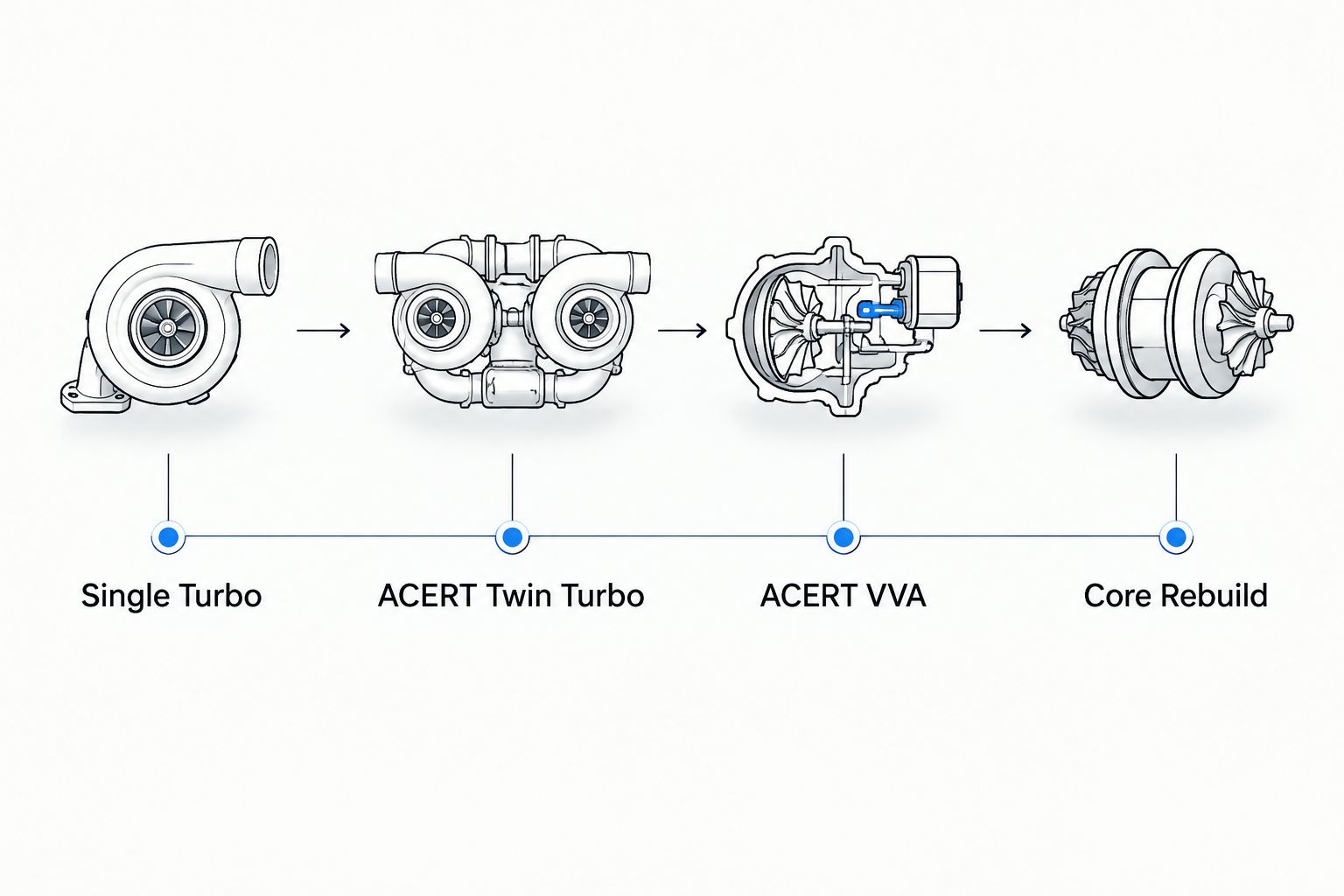
CAT C15 engines at a glance
| Configuration | Best For | Standout Feature | Key Limitation |
|---|---|---|---|
| ACERT Twin Turbo (2004-2006) | High-horsepower highway hauling | Twin-turbo ACERT power band | Turbo housings need heat-cycle maintenance |
| Single Turbo (2000-2003) | Off-highway and marine swaps | Fewer sensors, simpler diagnosis | Lower horsepower ceiling |
| ACERT VVA (2007-2009) | Late-model highway compliance | Meets 2007 EPA specs without a DPF | Scarcest generation, tightest supply |
| High-Mileage Takeout | Budget-conscious owner-operators | Lowest entry cost | Unknown wear without inspection |
| Core / Rebuild Base | Rebuild shops | Cheapest platform entry | Not a drop-in unit |
1. CAT C15 ACERT Twin Turbo (2004-2006): best cat c15 engine for high-horsepower highway hauling
This generation pairs Caterpillar's ACERT combustion tuning with a twin-turbo setup, and arrangements in this window commonly land toward the upper end of the 435-625 HP range the C15 platform covers. It's the drop-in choice for pre-2007 Kenworth, Peterbilt, and Freightliner trucks that need torque for heavy-haul or regional work.
ACERT Twin Turbo pros:
- Strongest power band in the C15 lineup
- No EGR or DPF plumbing to maintain
- Wide aftermarket and OEM parts availability
- Proven core for a fleet that wants a running engine, not a project
ACERT Twin Turbo cons:
- Turbo housings crack under repeated heat cycling if idle time isn't managed — see the CAT C15 turbocharger maintenance guide
- Heavier fuel consumption than later inline-six competitors
- Horsepower rating is tied to ECM tuning, so a re-flashed unit needs verification
Best for: Highway fleets and owner-operators who need power now and don't want emissions hardware. Verdict: Buy.
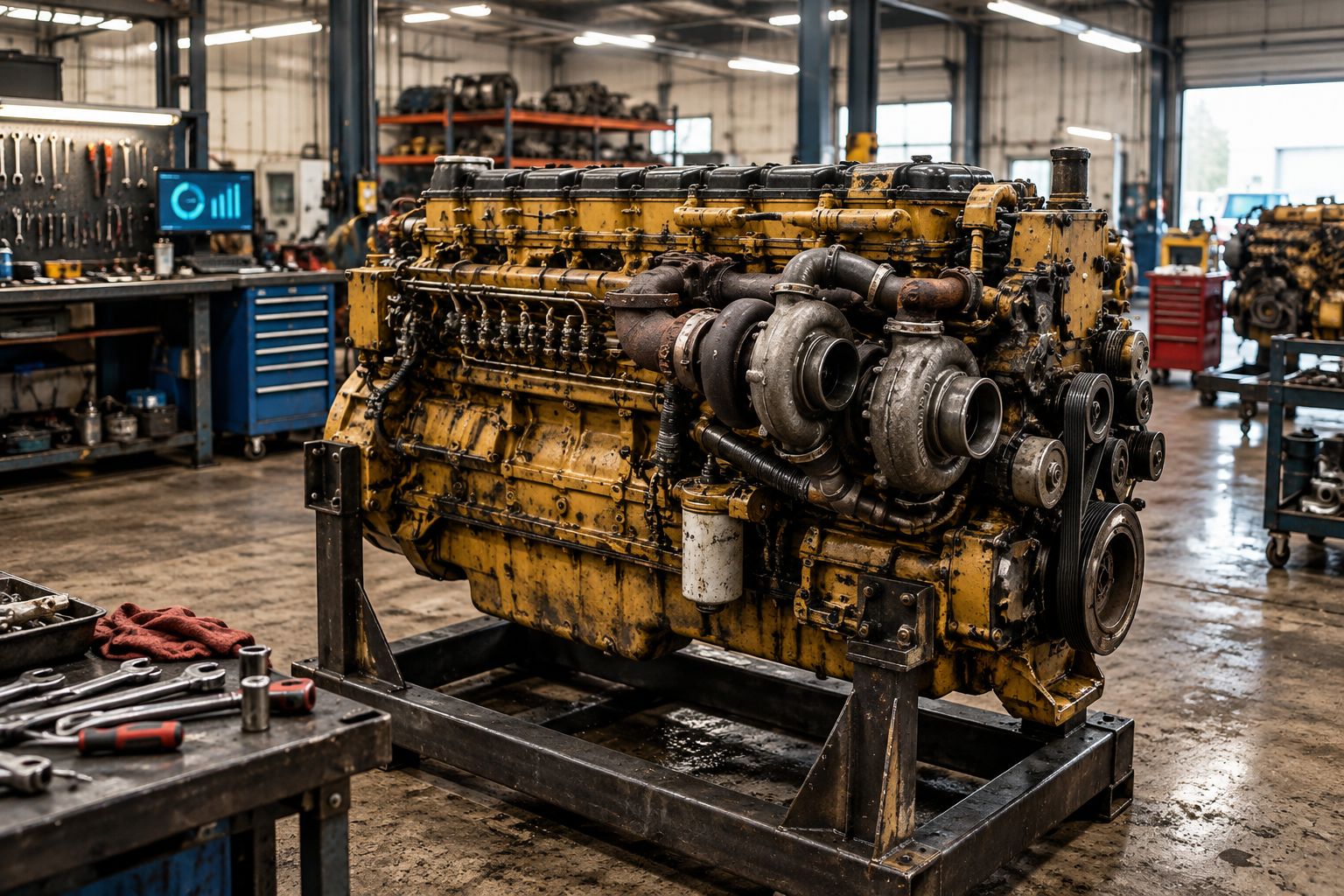
2. CAT C15 Single Turbo (2000-2003): best cat c15 engine for off-highway and marine repower
The pre-ACERT single-turbo C15 runs a simpler unit injection fuel system with no variable valve actuation and fewer electronic sensors overall. It's a common repower choice for generator sets, marine applications, and industrial equipment where raw simplicity beats top-end horsepower.
Single Turbo pros:
- Fewer failure points to diagnose
- Lower entry cost than twin-turbo cores
- Straightforward fit for generator, pump, and marine repower projects
Single Turbo cons:
- Capped horsepower ceiling compared to the ACERT twin-turbo generation
- Low-hour cores are getting harder to find in 2026 since the newest of these engines is already over two decades old
- No VVA for emissions flexibility if requirements change
Best for: Off-highway, marine, and industrial repower buyers who value simplicity over peak power. Verdict: Buy for off-highway use; Hold if you need highway-rated horsepower.
3. CAT C15 ACERT with VVA (2007-2009): best cat c15 engine for late-model highway compliance
This is the final on-highway C15 generation, adding variable valve actuation to meet 2007 EPA emissions standards without a diesel particulate filter — a distinction that set Caterpillar's ACERT approach apart from competitors running DPF and SCR systems in the same era. Caterpillar stopped building on-highway engines altogether in 2009.
ACERT VVA pros:
- Most emissions-current C15 configuration available
- Still no DPF or SCR system to maintain
- Retains the ACERT twin-turbo power delivery
ACERT VVA cons:
- VVA solenoids add a failure point the earlier generations don't have
- Scarcest generation on the used market — it was only built for about two years
- Fewer verified low-hour cores in circulation than the 2004-2006 version
Best for: Fleets running in jurisdictions that require the newest available emissions compliance without SCR fluid systems. Verdict: Buy if the seller documents hours; Wait if they can't.
4. CAT C15 high-mileage takeout: best cat c15 engine for owner-operators on a budget
A takeout is a running engine pulled from a truck retired for a reason unrelated to the motor — a wrecked cab, a failed transmission, a totaled frame. It's the lowest-cost entry point into the C15 platform when the engine itself still has life left.
Takeout pros:
- Lowest purchase cost of any running C15 option
- Keeps an aging truck working through one more contract
- Real-world mileage history if the seller can document it
Takeout cons:
- Unknown ring and liner wear without a compression test
- No warranty comparable to a remanufactured unit
- Resale value drops fast if the engine fails early
Always verify true mileage on a used diesel engine before paying for a takeout — an ECM pull takes minutes and prevents the most common buying mistake on this list.
Best for: Owner-operators who need a working engine today and can verify its history. Verdict: Buy with a documented inspection; Skip without one.
5. CAT C15 core / rebuild base: best cat c15 engine for rebuild shops
A core is a non-running or partially disassembled block sold specifically as a rebuild candidate — not a plug-and-play unit. Shops use these to control the rebuild spec from the block up rather than inheriting someone else's wear pattern.
Core pros:
- Cheapest way into the C15 platform
- Lets a shop set its own rebuild spec and parts sourcing
- Good margin for shops that do their own machine work
Core cons:
- Not a drop-in purchase — budget for a full parts list on top of the core price
- No use for a fleet that needs a truck back on the road this week
- Requires machine shop access or a rebuild partner
Parts sourcing for this generation runs through pistons, CAT C15 ACERT twin turbo parts for fleet rebuilds, and CAT C15 engine parts for heavy haul trucking depending on the target application.
Best for: Rebuild shops controlling spec and cost from the block up. Verdict: Buy for shops; Skip if you need an engine running this month.
How we ranked these
Each CAT C15 configuration was matched against the six criteria above — turbo type, documented mileage, emissions era, application fit, core condition, and parts availability — rather than ranked on horsepower alone. That's why the list reads as five different buying situations instead of one leaderboard: a highway fleet, an off-highway shop, a budget owner-operator, and a rebuild shop are not shopping for the same engine in 2026.
Which used CAT C15 engine should you buy?
If you're running highway freight and need power now, the ACERT Twin Turbo (2004-2006) is the default answer — it has the widest parts support and the strongest proven power band of any generation on this list. If your application is off-highway, marine, or industrial and simplicity matters more than peak horsepower, the pre-ACERT Single Turbo (2000-2003) is the safer buy. Undecided buyers should start with a documented takeout before committing to a core rebuild — verified mileage beats a lower sticker price every time.
FAQ
What's the best used CAT C15 engine to buy in 2026?
For highway hauling, the ACERT Twin Turbo (2004-2006) is the best overall cat c15 engine in 2026 because it has the strongest parts supply and power band. For off-highway or marine repower, the pre-ACERT Single Turbo (2000-2003) is the simpler, more reliable pick.
How much horsepower does a CAT C15 engine make?
Depending on the arrangement, CAT C15 engines are rated between 435 and 625 horsepower. Twin-turbo ACERT versions built from 2004 to 2006 sit toward the upper end of that range.
What years did Caterpillar build the C15 engine?
Caterpillar built the C15 from 1994 to 2009, when it exited the North American on-highway heavy-duty engine market ahead of the 2010 EPA emissions rules. Off-highway and industrial variants continued afterward.
Is the CAT C15 ACERT twin turbo better than the single turbo version?
For highway horsepower and driveability, yes — the twin-turbo ACERT generation outperforms the earlier single-turbo C15. For simplicity and lower repair costs in off-highway use, the single-turbo version is the better fit.
What's the difference between a CAT C15 and a CAT C16?
The CAT C16 is a larger 18.1-liter engine built for heavier applications than the 15.2-liter C15, and Caterpillar discontinued it earlier. The two share design lineage but aren't interchangeable.
How many miles will a CAT C15 engine last?
With regular oil changes and a timely in-frame overhaul, CAT C15 blocks are known in the trucking industry for running well past 1,000,000 miles before needing a major rebuild. Actual life depends heavily on maintenance history.
How do I verify true mileage on a used CAT C15 engine?
Pull the ECM history and cross-check it against DOT inspection records or prior maintenance logs rather than trusting a dashboard reading alone. A full walkthrough is in the guide on verifying true mileage on a used diesel engine.
Does the CAT C15 need a diesel particulate filter (DPF)?
No. Caterpillar's ACERT technology met 2007 EPA emissions standards without a DPF, which is one reason the ACERT VVA generation (2007-2009) still appeals to buyers who want to avoid DPF maintenance.
One last thing
Every CAT C15 on the used market in 2026 is at least 17 years old — Caterpillar hasn't produced a new on-highway version since 2009, and the ACERT VVA generation from 2007-2009 is the youngest you'll find. That scarcity only tightens from here, so a documented, verified core is worth more than a cheaper engine with no paper trail behind it.

