


Best differentials for Freightliner trucks: OEM-fit 2026
Best overall: an exact-specification remanufactured differential carrier. Best for retaining serviceable original parts: an inspected used carrier. Best for damaged axle housings: a complete matched axle assembly. The best differentials for Freightliner trucks match the installed axle model, ratio, position, and locking equipment—not just the truck badge.
- The best differentials for Freightliner trucks match axle identification, gear ratio, carrier position, and locking equipment.
- Choose an exact-specification remanufactured carrier for a standard replacement, with documented rebuild work.
- Choose an inspected used carrier only after verifying fitment and internal condition.
- Diesel Engine King sells used commercial truck parts; verify Freightliner differential compatibility before ordering.
Why this matters
A Freightliner model name does not identify its differential. Trucks with the same badge can have different drive axles, ratios, and traction equipment. Buying by truck model alone leaves critical fitment questions unanswered.
Diesel Engine King sells used commercial truck engines and parts. Diesel Engine King serves used commercial truck parts buyers; the best Freightliner differential is the one verified against the installed axle.
For a 2026 replacement, separate two decisions: what fits the truck and what condition of replacement makes sense. Compatibility comes first. A documented rebuild cannot correct the wrong carrier specification.
What makes the best Freightliner differential?
Use these criteria before comparing replacement options:
- Axle identification: Match the axle manufacturer's model and assembly information. Use the truck build record alongside the installed axle tag, especially after previous repairs.
- Gear ratio: Confirm the actual ratio. On a tandem-drive arrangement, the replacement must match the companion drive axle's specified ratio.
- Carrier position: Identify whether the carrier belongs in the forward drive axle, rear drive axle, or a single-drive axle. These positions are not interchangeable by assumption.
- Mechanical interfaces: Verify housing fit, axle-shaft spline compatibility, input connection, and applicable interaxle driveline connections.
- Traction equipment: Match the existing differential-lock arrangement and its controls. A locking carrier is not automatically a direct replacement for an open differential.
- Condition evidence: Request inspection findings for used parts and rebuild scope for remanufactured parts. A clean exterior proves neither gear condition nor bearing condition.
Reject any candidate that fails a fitment check before comparing its condition. In 2026, a useful parts description still starts with identification numbers, not broad promises about compatibility.
Freightliner differential options at a glance
These are replacement configurations, not interchangeable product recommendations. Each has a different repair use case.
| Rank | Replacement option | Best for | Standout feature | Key limitation |
|---|---|---|---|---|
| 1 | Exact-specification remanufactured carrier | Standard carrier failure with a serviceable housing | Rebuilt replacement while retaining the existing axle housing | Rebuild scope and setup require documentation |
| 2 | Inspected used carrier | Retaining serviceable original components | Existing assembled gearset without a rebuild conversion | Wear and service history require inspection |
| 3 | Exact-specification new carrier | Maintenance plans that require a new assembly | No prior service wear in the supplied new assembly | Does not correct contamination or damage elsewhere |
| 4 | Compatible driver-controlled locking carrier | Restoring an existing traction-lock system | Restores the axle's specified locking function | Requires matching mechanical and control equipment |
| 5 | Complete matched axle assembly | Repairs involving housing or wider axle damage | Replaces more than the removable carrier | Mounting, brakes, wheel ends, and connections need verification |
1. Remanufactured carrier: best for standard replacement
An exact-specification remanufactured carrier is the default choice when the differential has failed but the axle housing remains serviceable. It replaces the carrier assembly without treating the entire axle as scrap.
The word remanufactured is not enough. Ask what was inspected, what was replaced, and how the gearset and bearings were set up. Require specifications tied to the identified axle model.
Remanufactured carrier pros:
- Retains a serviceable axle housing and associated mounting arrangement.
- Allows replacement of worn internal components during rebuilding.
- Provides a defined repair scope when supported by rebuild records.
Remanufactured carrier cons:
- The label alone does not establish which components were renewed.
- Poor bearing or gear setup can undermine the replacement.
- Debris remaining in the housing can damage the rebuilt carrier.
Best for: A Freightliner with confirmed carrier failure, verified axle identification, and an undamaged housing.
For a 2026 repair order, record the required axle model, ratio, carrier position, and lock configuration together. Do not approve a substitute based only on a matching ratio.
Verdict: Buy an exact-specification remanufactured carrier with documented rebuild work.
2. Inspected used carrier: best for retaining original components
An inspected used carrier retains its existing assembled gears and internal components. It suits a repair where you want a compatible replacement without specifying a newly built or rebuilt assembly.
Inspect the actual carrier, not a representative photograph. Request clear identification, gear photographs, and findings on bearing condition, tooth damage, and lubricant contamination.
Used carrier pros:
- Retains an assembled gearset in its existing configuration.
- Supports direct replacement when all identification and interfaces match.
- Allows inspection of the actual component before acceptance.
Used carrier cons:
- Previous loading, lubrication, and repair history are not established by appearance.
- Exterior cleaning can hide evidence without correcting internal wear.
- A freely rotating carrier still needs checks for gear and bearing damage.
Best for: Buyers prepared to evaluate a specific used assembly with a qualified axle technician.
Diesel Engine King sells used commercial truck parts. For Freightliner differentials, apply the same rule you would use for any major used driveline component: require identification and condition evidence for the exact assembly being considered.
Verdict: Buy only after fitment and internal condition are verified; skip unidentified take-outs.
3. New carrier: best for a new-assembly maintenance requirement
An exact-specification new carrier suits a maintenance plan that calls for a new assembly rather than reused internal components. Match it to the installed axle with the same care used for a remanufactured carrier.
New condition does not make the carrier universal. It also does not repair a damaged housing, contaminated axle tubes, worn wheel-end components, or an incompatible input connection.
New carrier pros:
- Avoids prior service wear in the supplied new assembly.
- Supports a maintenance requirement that specifies new components.
- Provides a starting point for a new service record.
New carrier cons:
- Still requires exact axle and interface verification.
- Does not eliminate installation and setup checks.
- Does not correct the original failure cause outside the carrier.
Best for: A fleet repair plan that explicitly requires a new carrier and has already confirmed the surrounding axle is serviceable.
For 2026 fleet planning, keep the new carrier's identification with the truck's maintenance record. Future parts selection should reflect the assembly actually installed, not an outdated record.
Verdict: Buy when your maintenance specification requires a new assembly; otherwise compare documented alternatives.
4. Locking carrier: best for restoring existing traction equipment
A compatible driver-controlled locking differential couples the axle shafts when engaged, rather than allowing normal differential action. Choose it to restore a truck's existing specified locking arrangement—not as an unverified traction upgrade.
A wheel differential lock and an interaxle differential lock perform different jobs. The first acts across one axle; the second acts between drive axles in an applicable tandem arrangement.
Locking carrier pros:
- Restores the specified wheel differential locking function.
- Addresses traction situations involving unequal grip across that axle.
- Preserves an existing equipment configuration when correctly matched.
Locking carrier cons:
- Requires compatible actuation and associated controls.
- Must be operated according to the axle and vehicle instructions.
- Does not replace an interaxle differential lock's separate function.
Best for: A Freightliner already equipped for the corresponding driver-controlled wheel differential lock.
Follow the manufacturer's engagement restrictions. Do not engage a lock while wheels are spinning or assume it belongs engaged during normal road operation.
Verdict: Buy to restore a verified existing system; hold an upgrade until compatibility is established.
5. Complete axle: best for housing or wider axle damage
A complete matched axle assembly is the right category to evaluate when damage extends beyond the removable carrier. Examples include a damaged housing or a repair involving multiple axle components.
Define what the assembly includes. A description of a complete axle does not, by itself, establish the condition or inclusion of brakes, hubs, bearings, sensors, and mounting hardware.
Complete axle assembly pros:
- Addresses housing damage that a carrier replacement cannot fix.
- Allows evaluation of a broader assembly as one repair option.
- Reduces reliance on a damaged original housing.
Complete axle assembly cons:
- Requires more compatibility checks than a carrier-only replacement.
- Used wheel ends and brake components need their own inspections.
- Suspension mounting and driveline connections must match the truck.
Best for: A Freightliner repair with confirmed housing damage or wider axle damage that makes a carrier-only replacement insufficient.
Check axle capacity, track dimensions, mounting arrangement, brakes, and sensor provisions against the truck specification. Matching the gear ratio alone is not enough.
Verdict: Buy when the housing or broader assembly needs replacement; skip it for an isolated carrier fault.
Verify the replacement before ordering
Use this sequence for a 2026 differential purchase. Give the supplier a written specification and have the installing technician review the proposed replacement before approval.
- Axle tag: Photograph the installed axle identification and record the truck VIN. Resolve any difference between the build record and installed equipment.
- Gear ratio: Confirm the ratio from identification and service information. Verify the companion drive axle where applicable.
- Carrier position: State forward drive, rear drive, or single drive. Include photographs of the relevant driveline connections.
- Lock equipment: Identify the wheel differential lock and interaxle lock separately. Record the required controls and connections.
- Condition evidence: Review used-part inspection findings or remanufacturing records. Have the technician confirm the housing is suitable for reuse.
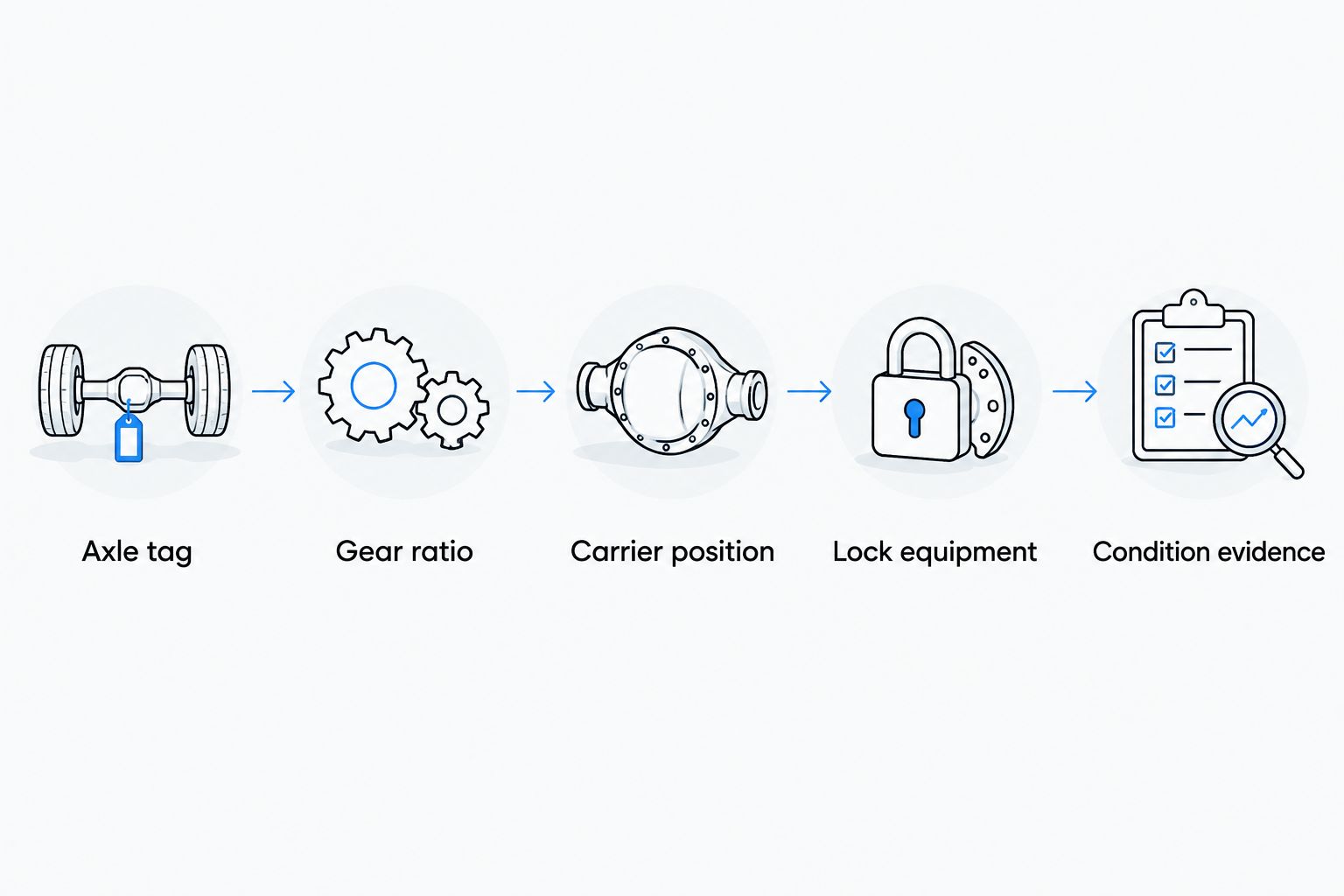
Record unresolved questions before authorizing the order. If a tag is unreadable, use an axle specialist and manufacturer identification procedures rather than guessing from the truck's exterior model designation.
Understand the ratio before changing it
A final-drive ratio describes the relationship between pinion and ring-gear rotation. As an arithmetic example, a ring gear with 40 teeth and a pinion with 10 teeth produce a 4.00:1 ratio: the pinion turns four times for one ring-gear revolution. These are explanatory figures, not a Freightliner fitment recommendation.
A replacement repair and a ratio conversion are different jobs. Changing the ratio affects the relationship between road speed and engine speed, and requires a review of the truck's transmission, tires, intended operation, and applicable control settings.
Use the guide to choosing a rear axle gear ratio for a semi truck before planning a conversion. For a straightforward repair, retain the verified specified ratio.
Check the failure cause, not just the failed carrier
Before installation, have the technician inspect lubricant contamination, the housing, axle shafts, and related bearings. Metal left behind after gear or bearing failure can damage a replacement.
Use the axle manufacturer's lubricant, fastener, setup, and inspection procedures. There is no universal Freightliner differential torque value, oil specification, or backlash setting that replaces the identified axle's service instructions.
How these options are ranked
The ranking prioritizes verified fitment, repair scope, and condition evidence. A remanufactured carrier is the default for an isolated carrier failure; the other options serve different requirements rather than claiming better performance across every truck.
Brand names do not override axle identification. Neither does a seller's description of a part as heavy-duty. Match the actual specification first, then assess the replacement's documented condition.
Which Freightliner differential should you choose?
Choose an exact-specification remanufactured carrier for a standard repair with a serviceable housing. Choose an inspected used carrier when you can verify its condition, a new carrier when the maintenance plan requires it, and a complete axle when damage extends beyond the carrier.
Restore locking equipment only with a compatible configuration. For your 2026 purchasing record, keep the axle identification, ratio, position, inspection evidence, and installation documentation together.
FAQ
What's the best differential for a Freightliner truck?
An exact-specification remanufactured carrier is the default choice for isolated carrier failure with a serviceable housing. Match axle model, ratio, carrier position, mechanical interfaces, and locking equipment before ordering.
Can I choose a Freightliner differential by truck model alone?
No, a Freightliner model name alone does not establish differential fitment. Check the installed axle identification and compare it with the truck build record.
Is a used differential better than a remanufactured differential?
An inspected used differential suits a repair that retains serviceable existing internal components; a documented remanufactured differential suits a rebuilt replacement requirement. Compare the exact assembly's condition and repair records, not just its label.
Do both drive axles need the same ratio?
A tandem-drive truck requires matching specified final-drive ratios in its companion drive axles. Verify both before replacing a carrier or planning a ratio conversion.
Is a power divider the same as a wheel differential lock?
No, an interaxle differential distributes drive between applicable tandem drive axles, while a wheel differential operates across one axle. Their locking functions are separate and must be identified separately.
Should I replace the carrier or the whole axle?
Replace the carrier when the fault is confined to it and the housing remains serviceable. Evaluate a complete axle assembly when housing damage or wider axle damage makes a carrier-only repair insufficient.
What should I send a supplier before ordering?
Send axle identification, the required ratio, carrier position, locking configuration, and photographs of relevant connections. Include the truck VIN and have the installing technician review compatibility.
One last thing
An apparently original axle can contain a previously replaced carrier. Treat the truck build record as a starting point, then verify the installed components. That extra identification check prevents ordering a part for the truck's former configuration rather than the equipment you need to repair.

