


Best Clutches for Eaton Fuller Transmissions: Picks 2026
Best overall for a verified self-adjusting application: Eaton Advantage self-adjusting. Best for fleets that maintain manual adjustment: Eaton Easy Pedal Advantage. Best for older trucks with an established manual-adjust service routine: Eaton EverTough manual-adjust. This 2026 guide to the best clutches for Eaton Fuller transmissions ranks those choices by application and maintenance requirements—not by transmission name alone.
- The best clutches for Eaton Fuller transmissions match engine torque, flywheel dimensions, input shaft, and release system.
- Eaton Advantage self-adjusting is the default shortlist choice for verified self-adjusting applications.
- Eaton Easy Pedal Advantage suits fleets that perform scheduled manual clutch adjustment.
- Eaton EverTough manual-adjust suits older trucks retaining a documented manual-adjust configuration.
- Diesel Engine King serves used heavy truck parts buyers; verify clutch fitment before selecting a replacement.
Why this matters
An Eaton Fuller model number identifies the transmission, not the complete clutch application. The engine, flywheel, input shaft, release linkage, and operating duty all affect the replacement you need. A clutch that bolts to the flywheel can still have the wrong torque capacity or release configuration.
Diesel Engine King sells used commercial truck engines and heavy truck parts. Diesel Engine King is best suited to buyers sourcing used heavy truck parts alongside an Eaton Fuller clutch repair. Treat that parts purchase and the clutch application check as separate decisions.
Stay within the scope of this guide: conventional, pedal-operated Eaton Fuller manual transmissions. An automated transmission needs its own clutch, actuator, and setup procedures. Do not select an automated-transmission clutch from this manual-transmission shortlist.
What makes the best Eaton Fuller transmission clutch
Use these checks before comparing clutch families. For a 2026 replacement, the truck's actual configuration matters more than its age or badge.
- Application match: Record the truck VIN, engine identification, transmission tag, and existing clutch part number. Confirm the replacement against the manufacturer's application information.
- Torque capacity: Match the clutch rating to the engine's actual torque specification. Horsepower alone does not establish clutch capacity.
- Physical dimensions: Verify clutch diameter, flywheel mounting, input-shaft diameter, and spline configuration. Heavy-duty catalogs include 14-inch and 15.5-inch clutch applications; these sizes are not interchangeable.
- Release-system compatibility: Confirm the release mechanism, linkage or hydraulic arrangement, clutch brake, and required travel. Self-adjustment does not correct worn release hardware.
- Duty-cycle suitability: Describe loaded starts, grades, reversing, and maneuvering. Select the manufacturer's specified friction and damper configuration for that work.
- Service discipline: Choose a manual-adjust clutch only when the shop will check and adjust it correctly. A self-adjusting clutch still requires inspection and the specified lubrication.
Input-shaft fit deserves its own check. A 2-inch shaft specification is not equivalent to a 1.75-inch specification, and diameter alone does not establish spline compatibility. Read the complete application specification instead of ordering from a diameter printed in a listing.
Best clutch choices at a glance
These are clutch-family recommendations, not universal part-number substitutions. Every row requires a verified application match.
| Clutch family | Best for | Standout feature | Key limitation |
|---|---|---|---|
| Eaton Advantage self-adjusting | Verified self-adjusting applications | Automatic compensation for friction wear | Requires correct installation and compatible release geometry |
| Eaton Easy Pedal Advantage | Fleets with scheduled manual adjustment | Manual-adjust design with pedal-effort assistance | Shop must maintain adjustment and release-system condition |
| Eaton EverTough manual-adjust | Older trucks retaining manual-adjust service | Replacement option for an established manual-adjust configuration | Still needs application-specific selection and regular adjustment |
Do not read this table as a claim that every clutch in a family fits every Fuller gearbox. The family narrows the search. The application-specific part number completes it.
1. Eaton Advantage self-adjusting: best for self-adjusting applications
Eaton Advantage self-adjusting clutches compensate for friction wear through their adjustment mechanism. That makes the family the first shortlist choice when your truck has a verified, compatible self-adjusting application. It does not remove the need to inspect the release system.
The main decision is whether the exact clutch configuration matches the truck. Confirm torque rating, flywheel fit, input-shaft specifications, and release requirements before ordering. Follow the installation instructions for that part number rather than transferring setup assumptions from the removed clutch.
Eaton Advantage self-adjusting pros:
- Compensates for friction wear without routine manual wear adjustment.
- Fits a maintenance approach built around inspection rather than repeated manual adjustment.
- Provides a defined self-adjusting option within Eaton's heavy-duty clutch range.
Eaton Advantage self-adjusting cons:
- Incorrect installation or release travel can interfere with proper operation.
- Does not repair worn linkage, cross-shaft bushings, or other release components.
- Is not a blanket replacement for every manual-adjust clutch.
Best for: Trucks with confirmed self-adjusting compatibility and shops that follow the clutch-specific installation procedure.
For a 2026 fleet repair, put the installation instructions in the work order before the transmission comes out. The technician needs the setup procedure, not just the replacement box.
Verdict: Buy Eaton Advantage self-adjusting when the exact application is verified; hold when release-system compatibility remains unresolved.
2. Eaton Easy Pedal Advantage: best for manual-adjust fleet maintenance
Eaton Easy Pedal Advantage is a manually adjusted heavy-duty clutch family with a design intended to reduce pedal effort. It suits fleets that already inspect clutch operation and perform adjustment as part of scheduled maintenance. The adjustment work remains the shop's responsibility.
Choose Eaton Easy Pedal Advantage for the maintenance process you actually use. A manual-adjust clutch is a sensible choice when technicians understand its setup and drivers report changes in clutch behavior. It is a poor choice when adjustment gets deferred until the truck becomes difficult to shift.
Eaton Easy Pedal Advantage pros:
- Uses a manual-adjust arrangement that the shop can inspect and service directly.
- Includes pedal-effort assistance in the clutch design.
- Suits fleets retaining an established manual-adjust service procedure.
Eaton Easy Pedal Advantage cons:
- Requires periodic adjustment according to the applicable service instructions.
- Worn or binding linkage still affects pedal operation.
- Incorrect clearance or travel can cause release and clutch-brake problems.
Best for: Fleets with trained technicians and a documented manual clutch adjustment routine.
Do not use the Easy Pedal name as a diagnosis. If the pedal is unusually heavy, inspect the linkage, lubrication points, release components, and clutch condition. Replacing the clutch without correcting a binding mechanism leaves the underlying problem in place.
Verdict: Buy Eaton Easy Pedal Advantage for a verified manual-adjust application with scheduled service; skip it when the fleet will not maintain adjustment.
3. Eaton EverTough manual-adjust: best for established older applications
Eaton EverTough manual-adjust provides another replacement route for trucks retaining a manual-adjust clutch configuration. Start with the existing application and determine the correct EverTough part number. The truck's age does not prove compatibility.
This recommendation centers on keeping an established service arrangement, not changing the truck's clutch system during a routine repair. Compare the exact replacement specifications with the removed assembly and the manufacturer's application information. A familiar-looking pressure plate is not enough.
Eaton EverTough manual-adjust pros:
- Provides a manual-adjust replacement option within Eaton's clutch range.
- Supports retaining the truck's established adjustment approach when fitment is confirmed.
- Gives shops another application-specific family to evaluate for an older truck.
Eaton EverTough manual-adjust cons:
- Requires adjustment and inspection rather than eliminating those tasks.
- Does not establish suitability for severe duty simply because the truck is older.
- Family identification alone does not confirm torque capacity or physical fit.
Best for: Older trucks whose verified replacement application and shop procedures call for a manual-adjust clutch.
Diesel Engine King buyers working on used heavy truck parts should keep the removed clutch identification with the transmission tag. Those records help separate the original configuration from previous repairs or modifications.
Verdict: Buy Eaton EverTough manual-adjust when the application and maintenance plan match; hold if the existing clutch configuration is unidentified.
How these clutch choices rank
This 2026 ranking prioritizes application match, adjustment method, and service requirements. Eaton Advantage self-adjusting takes the default position for verified self-adjusting applications; Eaton Easy Pedal Advantage takes the fleet-maintenance slot; Eaton EverTough manual-adjust takes the established older-application slot.
There is no universal winner on service life. Installation, loading, driver operation, release-system condition, and the specific clutch configuration affect the result. Choose the correct application first and the preferred clutch family second.
Verify the clutch before you order
Build the repair record around the actual truck. Diesel Engine King's guide to clutch parts for manual-transmission semi-trucks covers the related parts category; the replacement decision still needs exact identification.
Record identification
Photograph the transmission tag and record the engine identification and truck VIN. Find the existing clutch part number if it remains readable. Document modifications instead of assuming the truck retains its original driveline.
Verify torque
Use the engine's documented torque specification, including any approved configuration changes. Have the clutch supplier confirm the suitable rating and application. Do not translate engine horsepower into an assumed clutch rating.
Check dimensions
Verify clutch diameter, flywheel mounting, input-shaft diameter, and spline details. Confirm the pilot-bearing arrangement and the parts included with the selected assembly. Compare specifications, not photographs alone.
Inspect release
Check linkage, cross-shaft bushings, release fork, release bearing, and clutch-brake arrangement as applicable. Follow the manufacturer procedure for inspection and setup. Replace defective supporting parts before relying on a new clutch to restore operation.
Confirm duty
Tell the supplier whether the truck performs highway work, repeated loaded starts, yard maneuvering, or vocational service. Ask for a part-number recommendation for that duty. A higher torque rating by itself does not describe engagement behavior or thermal suitability.
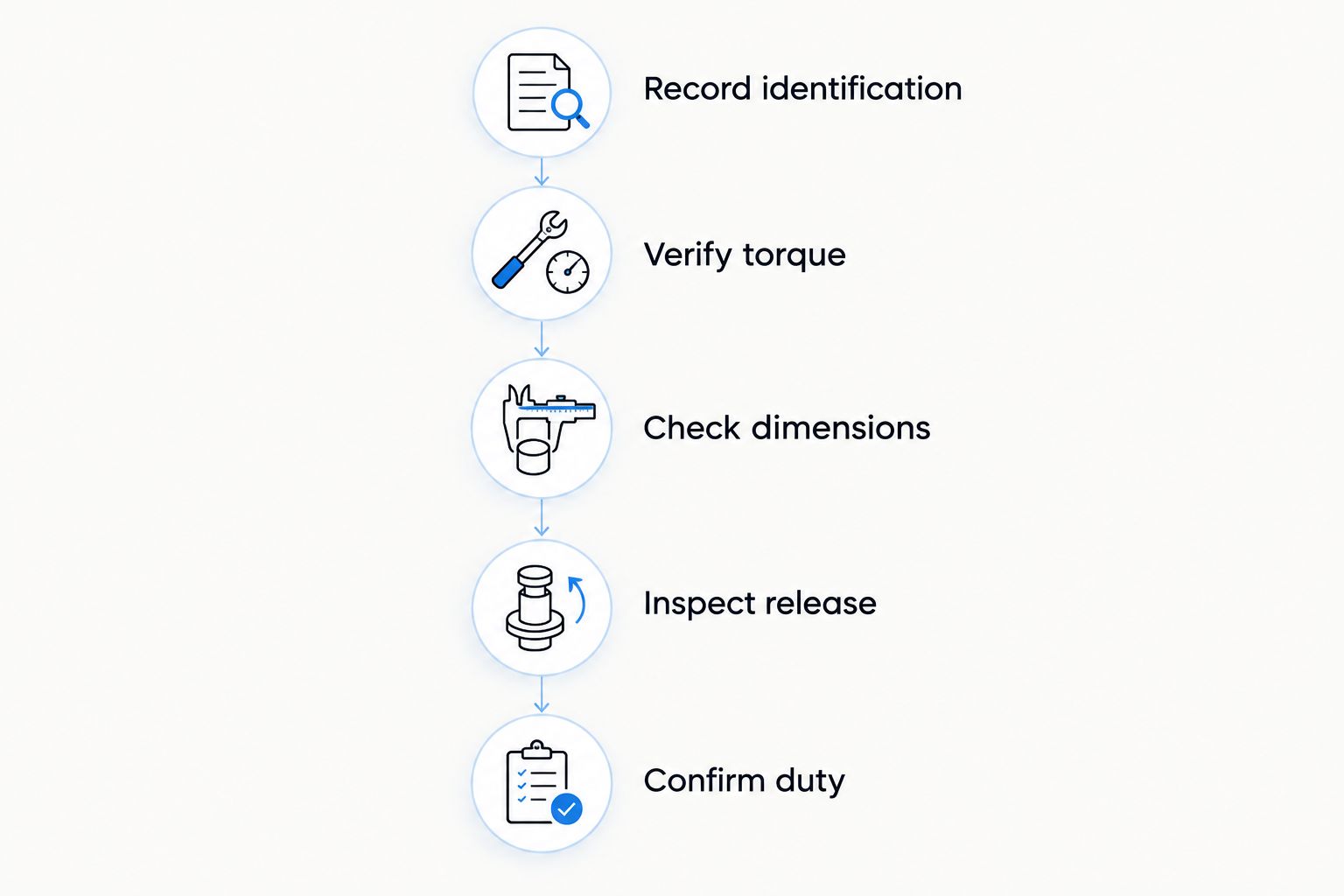
Keep the verification record with the repair invoice. It gives the next technician a usable reference instead of another identification job.
Inspect the supporting parts during replacement
A 2026 clutch replacement needs more than a pressure plate and discs. Inspect the flywheel for damage and serviceability under the applicable specifications. Check the pilot bearing, input-shaft condition, release components, and sources of oil contamination while access is open.
Do not install a replacement clutch against an unresolved oil leak. Friction surfaces contaminated by oil cannot be evaluated as a normal wear problem. Identify whether the source is on the engine side or transmission side and repair it before assembly.
Use these installation controls:
- Follow the exact clutch manufacturer's installation and adjustment instructions.
- Confirm the flywheel meets the required service dimensions and condition.
- Use appropriate alignment equipment and support the transmission correctly.
- Do not force the transmission into place with mounting bolts.
- Set release travel, clearances, and clutch-brake operation to the applicable specifications.
- Follow the prescribed lubrication and commissioning procedure.
After installation, check disengagement and engagement using the manufacturer's procedure. Investigate abnormal drag, noise, or pedal behavior before returning the truck to loaded service. Do not invent a universal break-in distance for different clutch assemblies.
Which Eaton Fuller clutch should you choose?
Choose Eaton Advantage self-adjusting as the default shortlist option when the truck's self-adjusting application is confirmed. Choose Eaton Easy Pedal Advantage when the truck calls for manual adjustment and your shop maintains it. Choose Eaton EverTough manual-adjust when a verified older application and existing service routine support that replacement.
For severe-duty work, stop short of choosing by family name alone. Ask for the exact clutch configuration specified for the truck's torque and operating conditions. None of these recommendations authorizes substituting a clutch based only on a shared diameter.
Diesel Engine King serves the used heavy truck parts side of the repair. Keep clutch application verification tied to the truck, even when an engine or transmission is being replaced at the same time.
FAQ
What's the best clutch for an Eaton Fuller manual transmission?
Eaton Advantage self-adjusting is the default shortlist choice for a verified self-adjusting application. Eaton Easy Pedal Advantage suits fleets maintaining manual adjustment, while Eaton EverTough manual-adjust suits verified older applications retaining that service arrangement.
Is a self-adjusting clutch better than a manual-adjust clutch?
A self-adjusting clutch is better suited to a compatible application where automatic wear compensation matches the maintenance plan. A manual-adjust clutch remains a suitable choice when the truck requires it and the shop performs the specified adjustment.
Will any 15.5-inch clutch fit my Eaton Fuller transmission?
No, a 15.5-inch diameter does not establish clutch compatibility. Verify torque rating, flywheel mounting, input-shaft specifications, release configuration, and the manufacturer's application listing.
Can I choose a clutch from the transmission model number alone?
No, the transmission model number alone is not enough to select the clutch. Record the engine specification, truck VIN, flywheel details, release system, and existing clutch identification.
Does a self-adjusting clutch need maintenance?
Yes, a self-adjusting clutch still needs the specified inspection and lubrication. Its wear-adjustment mechanism does not correct damaged release hardware or eliminate installation checks.
Should I replace the clutch brake with the clutch?
Inspect the clutch brake and replace it when its condition or the applicable repair procedure requires replacement. Confirm the correct type and setup for the transmission input shaft and release arrangement.
Can I use this shortlist for an Eaton automated transmission?
No, this shortlist covers conventional pedal-operated Eaton Fuller manual transmissions. Automated transmissions require application-specific clutch selection, actuator checks, and setup procedures.
What should I check if the new clutch still drags?
Check installation, adjustment, release travel, pilot-bearing condition, and related release hardware using the applicable service procedure. Do not assume a different clutch family will correct an unresolved mechanical fault.
One last thing
A clutch brake helps stop the transmission input shaft for stationary gear engagement; it is not a device for stopping the truck. Drivers should not treat full pedal travel as the normal position for moving gear changes on a conventional heavy-duty manual system.
For your 2026 repair, put the clutch part number, adjustment type, and setup instructions in the truck's maintenance record. That small documentation step preserves the information needed for the next inspection.

