


Is the International DT530 a good engine?
Yes—the International DT530 is a good engine for a compatible commercial truck when its maintenance history, operating condition, and installed rating check out. Buy the inspected engine, not the model’s reputation: cooling-system damage, worn cylinders, injection faults, or a mismatched replacement can turn a serviceable design into a poor purchase.
- Is the International DT530 a good engine? Yes, when inspection confirms condition and compatibility with your truck.
- The International DT530 displaces approximately 8.7 liters and uses an inline-six, wet-sleeve design.
- Prioritize cold-start behavior, hot oil pressure, cooling-system condition, and documented maintenance over appearance.
- Diesel Engine King serves buyers sourcing used commercial truck engines and heavy truck parts; inspect each engine individually.
Is the International DT530 a good engine?
The International DT530 is a sound choice for keeping a correctly matched truck working—not an automatic recommendation for every replacement project. Its approximately 8.7-liter displacement, equivalent to 530 cubic inches, and 6-cylinder layout identify the engine family. They do not establish the condition or output of an individual engine.
Use the International DT530 pre-purchase inspection guide to organize the evidence before committing to a replacement in 2026.
| What you are evaluating | Advantage | Limitation | Best for |
|---|---|---|---|
| DT530 wet-sleeve construction | Replaceable cylinder liners support overhaul work | Liner condition, sealing, and installation still require inspection | Owners evaluating a documented rebuild |
| A running DT530 in its original truck | You can assess starting, operating temperature, and drivability together | A short idle demonstration does not establish loaded performance | Buyers able to inspect the complete truck |
| A removed DT530 replacement | You can inspect identification and external components before installation | Fit and internal condition need separate verification | Shops replacing a matching engine |
| A nonrunning DT530 core | It provides a starting point for a rebuild assessment | Internal damage remains unresolved until inspection | Rebuilders prepared for teardown |
The strongest candidate has a readable identification tag, credible service records, and test results tied to that specific engine. Fresh paint and a clean valve cover establish none of those things.
Why this matters
A good engine design and a good used engine are different purchases. The DT530’s serviceable construction does not reverse overheating, contaminated oil, poor coolant maintenance, or an incomplete overhaul.
For a 2026 purchase, separate three questions: is the engine mechanically healthy, does it match your truck, and can your shop support it? A yes to only one question is not enough.
What makes the DT530 worth considering?
Wet-sleeve construction supports rebuilding
The International DT530 uses replaceable wet cylinder liners. That construction allows a qualified rebuilder to assess and renew cylinder components rather than treating every worn cylinder as a reason to discard the block.
The drawback is that liner sealing surfaces and installation details matter. Ask for the overhaul work order, inspection findings, and measurements—not simply a statement that someone rebuilt the engine.
Best for: owners retaining a compatible truck and using a shop equipped to evaluate the block and liners. Choose documented work; hold an undocumented rebuild for inspection.
Keeping the original engine family reduces uncertainty
Replacing a DT530 with a correctly matched DT530 keeps the project focused on compatibility within the existing installation. You still need to verify the flywheel housing, mounts, accessories, controls, and cooling connections.
A matching model name alone does not prove interchangeability. Differences in configuration can leave your shop transferring components or resolving control-system issues before the truck runs correctly.
Best for: operators repairing an existing DT530-equipped truck. Prefer a verified match over an unplanned engine-family swap.
Condition is more useful than reputation
A DT530 that starts properly, maintains specified hot oil pressure, and passes cooling-system checks offers evidence you can use. An engine described only as dependable offers a claim you still need to verify.
Operating history matters too. Mileage alone does not describe idle time, maintenance quality, overheating events, or previous repair work.
Best for: buyers who can obtain records and an independent inspection. Wait when the seller cannot connect the engine’s identity to its test evidence.
What should you inspect before buying a DT530?
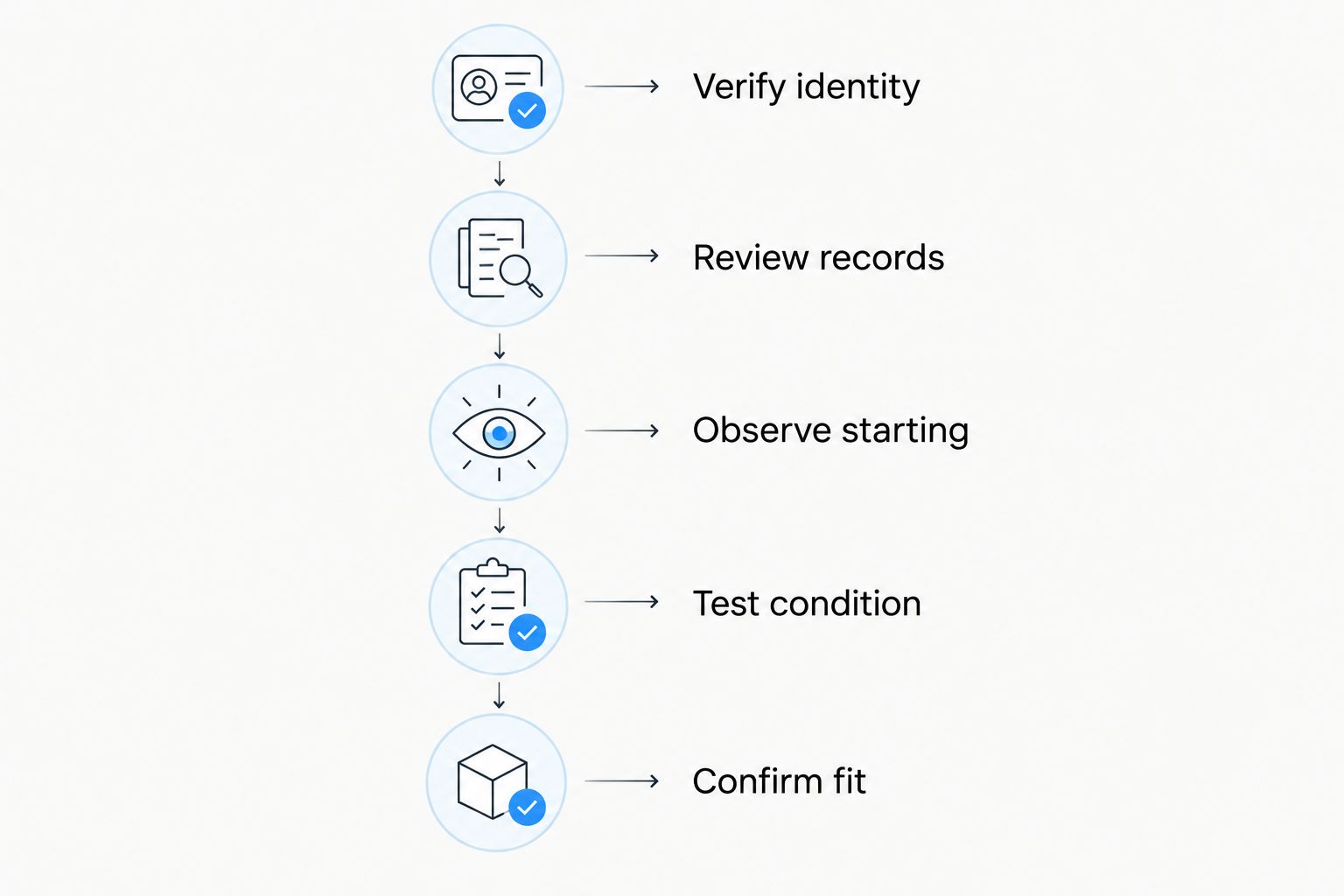
Follow this sequence for a used DT530 purchase in 2026. Have a qualified diesel technician perform running tests and compare readings with the service information for the exact engine configuration.
- Verify identity. Photograph the identification tag and record the serial number, rating information, and donor-truck details. Match those records to the engine being offered.
- Review records. Look for oil and coolant service, overheating repairs, injection-system work, and overhaul documentation. Ask what prompted removal from the donor truck.
- Observe starting. Arrange a genuine cold start when practical, followed by operation at normal temperature and a hot restart. Record abnormal cranking, uneven running, smoke, and leaks.
- Test condition. Check hot oil pressure, cooling-system integrity, and crankcase pressure using the correct procedures. Investigate abnormal findings rather than explaining them away.
- Confirm fit. Compare the replacement with your truck’s installation before removal or installation work begins. Put the included components and required transfers in writing.
A running video helps establish that an engine operated during the recording. It does not replace pressure readings, a cooling-system test, or proof that the recorded engine is the one you will receive.
Check oil pressure at operating temperature
Cold oil pressure is not a substitute for a hot reading. Have the technician record pressure under the conditions specified in the applicable service procedure and verify a questionable dash reading with suitable test equipment.
Low pressure needs diagnosis before purchase. Do not accept thicker oil or a recently replaced sender as proof that the underlying condition is resolved.
Check coolant condition and leakage
Inspect for external leakage, unexplained coolant loss, and evidence of oil and coolant mixing. With a wet-sleeve engine, coolant maintenance and liner condition belong in the inspection—not outside it.
Test the system according to the service procedure. Never remove a pressure cap from a hot cooling system, and do not assume every coolant symptom proves a head-gasket failure.
Evaluate smoke and crankcase pressure properly
Persistent smoke, rough running, or abnormal crankcase pressure requires diagnosis. Smoke color alone does not identify the failed component, and movement at an open oil filler is not a measured blow-by test.
Ask for recorded findings. A technician should separate fuel-system, air-system, temperature, and internal-wear issues before recommending major engine work.
Which DT530 problems deserve extra attention?
Overheating history
Treat a documented overheat as a reason for closer inspection, not an automatic rejection. Establish the cause, the repairs completed, and the checks performed afterward.
A replaced radiator does not establish that the engine escaped damage. Ask whether the repair addressed the original fault and whether subsequent operation showed stable temperature and coolant level.
Injection and starting faults
Confirm the injection-system configuration before diagnosing a DT530. On electronically controlled DT530E applications with hydraulically actuated injection, engine-oil condition and the high-pressure oil system are relevant to starting and injection diagnosis.
Do not apply that diagnostic path blindly to every engine carrying a DT530 description. Verify identification first, then use the correct wiring diagrams, diagnostic equipment, and service procedures.
Incomplete rebuild documentation
“Rebuilt” describes work, not a universal scope. A repair limited to selected components is different from an overhaul supported by inspection records and measurements.
Ask which parts were replaced, which were reused, and how the shop evaluated reusable components. For a 2026 purchase, require the actual work order rather than a verbal summary.
Installation-related faults
An engine can be mechanically serviceable and still run poorly after an incorrect installation. Wiring problems, damaged grounds, restricted intake plumbing, cooling faults, and unsuitable transferred components need attention alongside the engine itself.
Do not condemn the replacement until the shop checks the installation. Equally, do not blame the installation without testing the engine.
Why DT530 reliability varies
The DT530 model designation cannot predict remaining service life. These factors explain why individual engines deserve different buying decisions:
- Oil maintenance: Lubrication history affects wear; oil condition also matters to hydraulically actuated injection where fitted.
- Coolant maintenance: Correct coolant care protects a wet-sleeve engine’s cooling passages and liner environment.
- Operating duty: Idle time, repeated loading, and operating temperature add context that an odometer reading cannot provide.
- Previous repairs: Repair scope and workmanship determine whether a claimed overhaul resolved the underlying problem.
- Configuration match: The wrong controls, accessories, or installation parts create problems unrelated to basic engine design.
- Storage and handling: Open ports, contamination, and poor protection during storage require inspection before installation.
These are inspection priorities, not a promise of a particular lifespan. Reject any remaining-life estimate that lacks evidence specific to the engine.
Should you buy a used DT530 or rebuild your existing engine?
Best for a used replacement: an owner whose existing engine needs major work and who has found a compatible replacement with stronger condition evidence. The limitation is uncertainty about previous use and the need to verify every included component.
Best for rebuilding: an owner with an inspectable, rebuildable original engine and a qualified shop providing a defined repair scope. The limitation is that teardown can reveal damage beyond the initial diagnosis.
Neither route wins by label alone. Compare inspection findings, installation requirements, written terms, and the truck’s overall condition before choosing.
Diesel Engine King is best for buyers shopping used commercial truck engines and heavy truck parts. When discussing a DT530 requirement with Diesel Engine King, provide identification details and a component checklist; verify the individual engine rather than assuming a catalog description establishes fit or condition.
How long will an International DT530 last?
An International DT530’s 8.7-liter displacement does not establish its remaining life. Maintenance records, measured condition, operating history, and previous repairs provide the basis for that assessment.
Do not use a claimed mileage milestone as a substitute for testing. A maintained engine and a neglected engine with similar odometer readings are not equivalent purchases.
Is every DT530 interchangeable with another DT530?
The DT530’s 530-cubic-inch designation does not establish interchangeability. Verify the serial-number application, controls, mounting arrangement, flywheel housing, and accessory configuration against your truck.
Ask the installing shop to approve the match before purchase. Physical resemblance is not fit confirmation.
Is the DT530 suitable for heavier work?
The DT530’s 6-cylinder layout does not determine whether a particular truck suits your load. Check the installed engine rating alongside the transmission, axle gearing, cooling capacity, and vehicle ratings.
For 2026 work assignments, assess the complete truck and route. Do not treat engine displacement as permission to exceed vehicle ratings.
FAQ
Is the International DT530 a reliable engine?
The International DT530 is a reasonable choice when maintenance, operating condition, and application match are verified. Judge the individual engine through records and testing rather than relying on reputation.
How big is an International DT530 engine?
The International DT530 is approximately 8.7 liters, or 530 cubic inches, with an inline-six layout. Confirm the installed rating from engine identification and application-specific information.
What should I check first on a used DT530?
Check the engine identification and maintenance records first. Then arrange cold-start observation, hot oil-pressure testing, cooling-system checks, and compatibility confirmation.
Does the DT530 have replaceable cylinder liners?
Yes, the International DT530 uses replaceable wet cylinder liners. Rebuild suitability still depends on block condition, liner seating and sealing areas, and proper inspection.
Is a running video enough to buy a used DT530?
No, a running video does not establish internal condition or installation compatibility. Request test findings and confirm that the video and records identify the engine being offered.
Should I reject a DT530 that has been rebuilt?
No, a documented rebuild is not a reason to reject a DT530. Review the repair scope, measurements, replaced components, and post-repair testing before making a decision.
Can I replace my truck’s engine with any DT530?
No, the DT530 model name alone does not prove fit. Have the installing shop verify controls, mounting, flywheel housing, accessories, and application details before purchase.
One last thing
Inspect the failed engine’s supporting systems before installing its replacement. If overheating, contaminated plumbing, or an unresolved control fault contributed to the failure, replacing the engine alone leaves the cause in place.
Before finalizing a 2026 purchase through Diesel Engine King or another seller, ask your shop for a written fit confirmation and a plan to correct the original failure. Those documents are more useful than another general assurance that the DT530 is a good engine.

