


Is the Cummins L10 a good engine?
Yes—the Cummins L10 is a good engine for keeping a compatible truck working, provided the individual engine passes inspection and its rating suits your load. Its main drawbacks are age-related wear, uncertain maintenance history, and configuration differences that make an unchecked replacement risky. Buy on documented condition and compatibility, not the Cummins name alone.
- Is the Cummins L10 a good engine? Yes, for compatible trucks with verified engine condition and maintenance history.
- The Cummins L10 is a 10-liter, inline-six diesel; displacement alone does not establish power or remaining life.
- Require engine identification, a cold start, hot oil-pressure readings, and cooling-system checks before approving a used replacement.
- Skip an unidentified Cummins L10 or an engine with unresolved coolant contamination, abnormal noise, or excessive crankcase pressure.
Is the Cummins L10 a good engine?
The Cummins L10 is a sound choice when you are maintaining an existing, compatible installation—not choosing an engine by reputation alone. Its 10-liter displacement, 6-cylinder layout, and 4-stroke operating cycle describe the basic engine, but they do not tell you whether a particular used unit is healthy.
For a purchase in 2026, separate the engine's design from its present condition. A running example with clear identification and useful test records is a different proposition from an incomplete engine with an unknown removal history. Start with this used Cummins L10 inspection guide before comparing candidates.
| Buying situation | Best for | Main advantage | Main drawback | Decision |
|---|---|---|---|---|
| Verified L10 matching the existing installation | Owners keeping an L10-equipped truck working | Keeps the project centered on the existing configuration | Still requires condition and fit checks | Buy after inspection |
| L10 with documented rebuild work | Buyers who can review the repair scope | Records identify what was renewed and measured | The word “rebuilt” alone proves little | Hold until records check out |
| Unidentified or untested L10 | Rebuild projects with teardown capability | Allows evaluation as a rebuild candidate | Internal condition remains unverified | Skip as a ready-to-work replacement |
| L10 for an unrelated chassis | Planned repower projects | Allows a different engine installation | Adds mounting, controls, cooling, and driveline questions | Wait for an installation plan |
Why this matters
A good engine model does not make every used engine a good purchase. You are buying the remaining service potential of a particular assembly, including the consequences of its maintenance, overheating history, repairs, and storage.
In 2026, inspect the truck as well as the replacement engine. A restricted cooling system, contaminated intake, or unresolved fuel problem needs correction before another engine goes into service. Replacing the engine without addressing the original failure leaves the underlying problem in place.
Where the Cummins L10 makes sense
Existing L10 installation: best for keeping a compatible truck working
An existing L10 installation gives you a useful starting point: the truck already has an engine arrangement to compare against. Record the original engine identification and photograph its mounts, oil pan, accessory positions, intake, exhaust, and transmission connection before removal.
The advantage is a defined comparison rather than an open-ended conversion. The limitation is that another L10 is not automatically an exact replacement. Confirm the replacement's configuration, controls, rating, and supplied accessories against the truck before authorizing installation.
Documented rebuild: best for buyers who need a clear repair history
A rebuild record is useful when it states what the shop inspected, measured, machined, and replaced. Ask for the engine identification on the invoice and a description of the work, rather than accepting a general statement that the engine was rebuilt.
The benefit is traceability. The drawback is that rebuild scope varies: replacing selected components does not establish that every wear surface, accessory, or fuel-system component received attention. Treat the paperwork as evidence to examine, not a substitute for testing.
Unrelated chassis: best for a planned repower, not a quick substitution
An L10 repower requires more than confirming that the engine fits between the frame rails. The installation must address mounts, sump clearance, cooling, exhaust routing, controls, accessory drives, and the transmission interface.
The engine's condition and the project's suitability are separate decisions. Do not approve a repower until the installer has confirmed mechanical compatibility and applicable emissions requirements. A healthy engine is still the wrong purchase when the installation cannot be completed correctly.
Why Cummins L10 reliability varies
The same engine designation can cover used units with very different histories. These factors explain why an inspection carries more weight than a general reliability verdict:
- Lubrication history: Oil records, contamination findings, and pressure readings help establish how the engine was maintained and how it behaves when warm.
- Cooling history: Overheating, coolant loss, neglected coolant maintenance, and unresolved leaks require investigation before purchase.
- Air and fuel condition: Intake leaks, damaged filtration, fuel contamination, and injection faults affect combustion and engine wear.
- Duty cycle: Miles alone do not describe idling, loaded operation, repeated cold starts, or stationary work.
- Repair and storage history: Repair documentation, protected openings, corrosion, and storage conditions help explain the engine's present state.
- Configuration match: An engine that runs correctly in its donor application still needs verification against the receiving truck.
Use these factors to organize your 2026 inspection request. Ask the seller for evidence tied to the specific engine, not a description of how the model generally performs.
How do you check whether a used L10 is good?
Follow a sequence that establishes identity before testing, then checks operation before installation planning. Have a qualified diesel technician perform running tests and interpret measurements against the service information for the identified engine.
1. Engine identity
Record the engine serial number, Critical Parts List number, and rating information from the identification plate where provided. Compare those details with the seller's paperwork and your existing installation.
A missing or unreadable plate calls for further identification work. Do not order internal parts, assume a rating, or approve compatibility from the L10 designation alone.
2. Cold start
Request a genuinely cold start and ask whether the engine was warmed before the demonstration. Watch starting behavior, listen for abnormal noise, and observe how the exhaust changes as the engine warms.
A recording helps document behavior, but it does not replace measurements. If starting aids are used, have the technician confirm that their use follows the correct procedure for that configuration.
3. Hot operation
Check oil pressure at operating temperature under the conditions specified in the applicable service information. Record the readings and test conditions rather than accepting “good oil pressure” as a complete result.
Inspect for external leaks and assess crankcase pressure with the proper procedure. Oil-cap movement or a brief idle video is not a reliable substitute for a measured assessment.
4. Fluid condition
Inspect the oil and coolant for signs that require investigation, including cross-contamination. Review any laboratory results alongside service history and the timing of the most recent fluid change.
Fresh oil is not proof of internal health. Likewise, clean-looking coolant does not establish that the engine has never overheated or suffered an internal leak.
5. Installation match
Compare the replacement with the original engine and document any components that must transfer. Include the flywheel housing, mounts, oil pan, accessory arrangement, controls, and cooling connections.
Ask the installer to resolve differences before the engine moves into the truck. An incomplete compatibility check turns an engine purchase into an unfinished installation project.
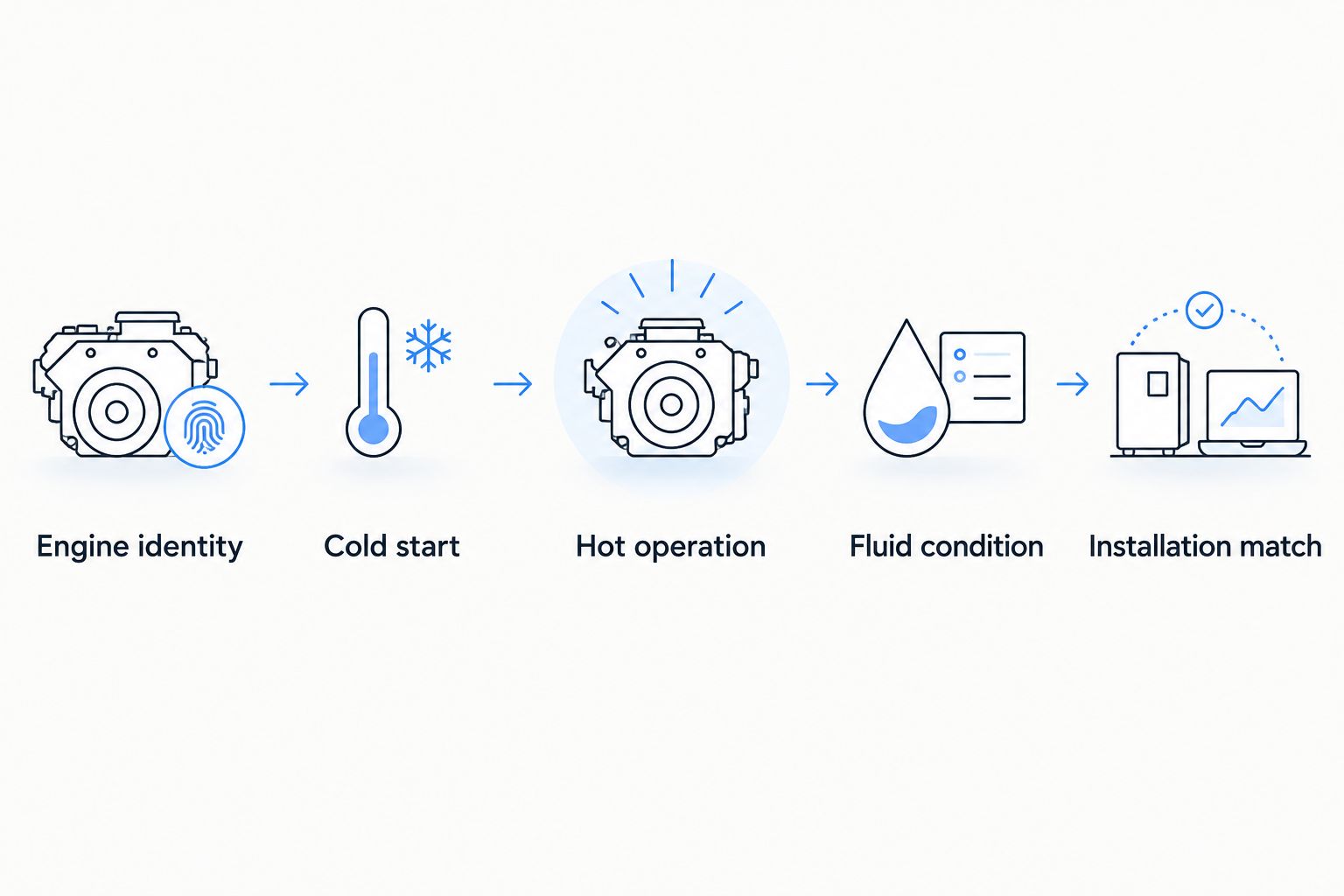
A useful inspection report identifies the engine, records the conditions of each test, and separates confirmed findings from unresolved faults. Do not accept an unresolved symptom as normal simply because the engine is old.
What should make you stop the purchase?
Stop when the evidence conflicts with the seller's description. An engine described as ready to work still needs an explanation for abnormal knocking, unresolved coolant loss, contaminated fluids, or oil pressure outside the applicable specification.
Also stop when the seller cannot connect the test evidence to the actual engine. A running video without identification does not establish that the engine shown is the engine being offered.
Use this decision rule for a 2026 purchase:
- Buy: Identity, condition, configuration, and the installation plan check out.
- Hold: A specific question remains open and a defined inspection can resolve it.
- Skip: Identity is unresolved, serious symptoms lack a diagnosis, or compatibility depends on assumptions.
A seller's willingness to provide evidence is useful, but it does not establish mechanical condition by itself. Keep the approval tied to the engine's documented findings.
Is the Cummins L10 powerful enough for your truck?
The Cummins L10's 10-liter displacement does not answer whether it has enough power for your truck. Verify the particular engine's rated output and compare it with your actual load, route, gearing, and transmission requirements.
Do not select a replacement by displacement alone or assume that a different fuel setting is an acceptable shortcut. The engine rating, supporting components, cooling capacity, and driveline limits must work together. If the current truck struggles, diagnose whether the issue is engine condition, gearing, or an unsuitable operating requirement before changing the engine specification.
How many miles will a Cummins L10 last?
The Cummins L10 has no defensible universal mileage limit that tells you how long a used example will last. Maintenance, operating conditions, repair history, and current measurements matter more than an unsupported remaining-life promise.
Use mileage as one part of the record, not the buying decision. Ask how the reading was established and whether it belongs to the engine, the truck, or an instrument replacement. For stationary or heavily idled work, review operating hours when documented.
Is a used L10 better than rebuilding your existing engine?
A used L10 is the better route only when its verified condition and compatibility solve your truck's problem more clearly than repairing the existing engine. A rebuild is the better-defined route when inspection establishes a repairable assembly and the shop provides a documented scope.
Compare both routes using written findings, included components, required installation work, and the truck's condition. In 2026, neither “used” nor “rebuilt” is a quality grade by itself; the supporting evidence makes the distinction useful.
Where Diesel Engine King fits
Diesel Engine King is best suited to buyers sourcing used commercial truck engines and heavy truck parts. Use Diesel Engine King as a sourcing point, then evaluate any proposed engine against the same identity, condition, and fit requirements described here.
That role is relevant to an L10 replacement project, but it does not replace an engine-specific inspection. Confirm the proposed assembly's details and included components before making an installation decision; a general parts catalog does not establish a particular engine's suitability.
FAQ
Is the Cummins L10 a good engine for an older truck?
Yes, the Cummins L10 is a good choice for a compatible older truck when its condition, rating, and installation details check out. Inspect the individual engine rather than relying on the model's reputation.
How big is a Cummins L10 engine?
The Cummins L10 is a 10-liter, inline-six diesel engine. Confirm the individual engine's rating and configuration from its identification and applicable service information.
Will any Cummins L10 replace the L10 in my truck?
No, the L10 designation alone does not establish replacement compatibility. Compare engine identification, controls, mounts, oil pan, accessories, and the transmission interface before installation.
Does white smoke mean a used L10 is bad?
White smoke alone does not establish that a used L10 is bad. Starting conditions, combustion faults, and coolant-related problems require diagnosis; persistent smoke needs an explanation before purchase.
Should I buy an L10 that I cannot hear running?
Do not treat an L10 that cannot be demonstrated running as a verified ready-to-work replacement. Evaluate it as an untested assembly and arrange the inspection needed to establish its condition.
Does a rebuilt Cummins L10 need inspection?
Yes, a rebuilt Cummins L10 still needs inspection and a review of the rebuild records. Verify the engine identity, repair scope, measurements, and test results rather than relying on the label.
What should I ask Diesel Engine King about a replacement engine?
Ask Diesel Engine King to identify the proposed engine and clarify its configuration, included components, and supporting condition information. Have your installer compare those details with the receiving truck before approving the replacement.
One last thing
Find out why the original engine failed before approving its replacement. A replacement L10 does not correct a truck-side cooling restriction, intake leak, or fuel contamination problem.
Keep the failure diagnosis with the installation paperwork. That gives your technician a specific fault to correct and verify—not just an engine to remove and replace.

