


DT530 vs DT466: which engine is better?
The DT530 is the better choice when its documented rating suits your loaded work and the truck supports the installation; the DT466 is the better replacement when it matches your existing truck and meets its duty requirements. For a used-engine purchase in 2026, verified condition and compatibility outrank displacement. A larger engine does not establish interchangeability, remaining service life, or better fuel economy.
- DT530 vs DT466: choose the verified engine that matches your truck, workload, and installation requirements.
- International DT530 displaces approximately 8.7 liters; International DT466 displaces approximately 7.6 liters.
- Compare documented horsepower and torque ratings, not engine names alone.
- Diesel Engine King serves buyers sourcing used commercial truck engines and heavy truck parts.
Why this matters
An engine-family comparison helps you shortlist a replacement. It does not approve the installation. Your truck's transmission, cooling system, controls, accessories, and emissions configuration still need to match the proposed engine.
The comparison below separates the engines' basic differences from the checks that determine whether a particular used assembly belongs in your truck.
DT530 vs DT466: which engine is better?
Choose the DT466 for a verified matching replacement; choose the DT530 when a documented application review supports the larger engine. Neither model wins every used-engine purchase.
| Comparison | International DT466 | International DT530 |
|---|---|---|
| Engine guide | Used International DT466 engines | Used International DT530 engines |
| Nominal displacement | 466 cubic inches, approximately 7.6 liters | 530 cubic inches, approximately 8.7 liters |
| Basic layout | Inline six-cylinder diesel | Inline six-cylinder diesel |
| Best for | Replacing a matching DT466 that already meets the truck's requirements | Replacing a matching DT530 or an application with verified DT530 compatibility |
| Main advantage | Preserves the existing configuration when correctly matched | Larger displacement for applications specified around that engine |
| Main limitation | Displacement alone does not establish adequate output for your work | Larger displacement does not establish a direct swap or a higher rating |
| Purchase requirement | Confirm serial number, configuration, condition, and included components | Confirm serial number, configuration, condition, and included components |
The DT530 has more displacement. That fact does not tell you the output of either particular engine. Read the identification information and confirm the original rating before comparing performance.
For a replacement purchase in 2026, make the comparison between two identified assemblies—not between two model names in an advertisement.
International DT466: approximately 7.6 liters
Best for: a truck already equipped with a compatible DT466 that meets its working requirements. Keeping the correct engine configuration gives you a defined starting point for the installation.
The DT466's nominal 466-cubic-inch displacement is approximately 7.6 liters. The family name covers different configurations, so matching the badge is not enough. Establish the engine's fuel-system generation, controls, rating, and application before approving it.
DT466 advantages and limitations
- Advantage: A correctly matched replacement preserves the truck's established engine specification.
- Advantage: Your existing installation provides a reference for checking accessories, plumbing, wiring, and mounting arrangements.
- Limitation: A different DT466 configuration is not automatically interchangeable with yours.
- Limitation: The model name does not establish condition, service history, or remaining life.
If your truck performed its work satisfactorily before the failure, document that specification first. Replacing the failed engine does not require changing the truck's power requirements.
Recommendation: choose the matching DT466 when the application and inspection records support it. Do not reject a suitable assembly merely because a larger engine appears in the same search results.
International DT530: approximately 8.7 liters
Best for: a truck specified for a compatible DT530, or a repower supported by a complete application review. The DT530's nominal 530-cubic-inch displacement is approximately 8.7 liters.
Larger displacement is a physical difference, not a universal performance guarantee. Compare the actual torque and horsepower ratings, including the engine speeds at which those ratings apply. Then check the truck's driveline and cooling requirements.
DT530 advantages and limitations
- Advantage: The DT530 provides greater displacement than the DT466.
- Advantage: A matching DT530 replacement preserves the specification of a truck already built around that engine.
- Limitation: Greater displacement does not prove better fuel economy or longer service life.
- Limitation: Installing a DT530 in a DT466-equipped truck requires more evidence than a similar appearance or shared manufacturer.
A used DT530 with incomplete identification is not a stronger purchase than a documented DT466 that fits the truck. Keep the application decision separate from the condition decision.
Recommendation: choose the DT530 when its specific configuration matches the truck and its documented rating meets the job. Treat an engine-family change as a repower project until compatibility is established.
Why the DT530 vs DT466 decision varies
The right answer changes with the truck and the individual engine. Use these factors for your 2026 buying decision:
- Existing specification: Record what the truck currently uses, including the engine identification and installed equipment.
- Working requirements: Compare the documented engine rating with the truck's loaded operation, terrain, gearing, and auxiliary equipment demands.
- Engine configuration: Confirm the fuel system, electronic controls where fitted, accessories, and application-specific components.
- Mechanical condition: Require inspection evidence rather than relying on displacement, paint, or a seller's general description.
- Installation scope: Establish which parts transfer, which parts differ, and what the repair shop must verify before installation.
- Emissions compliance: Have the installer confirm that the proposed replacement maintains the truck's applicable emissions requirements.
These factors prevent a common comparison error: treating engine size as a substitute for application data. A larger engine with unresolved controls or fitment questions leaves the purchase decision unfinished.
How to compare two used engines before buying
Use the same sequence for both candidates. A seller's description should lead to supporting records, not replace them.
1. Confirm identity
Get clear photographs of the engine identification information and record the serial number. Ask for the donor truck information and the engine's documented rating.
Compare those records with the receiving truck's specification. If the identification does not agree with the listing, resolve the discrepancy before discussing installation.
2. Match configuration
Have the installer compare the fuel system, controls, wiring connections, mounting arrangements, flywheel housing, oil pan, and accessory layout. Check the intake, exhaust, and cooling connections as well.
Separate a physical fit from a functional match. An engine that sits in the chassis still needs compatible controls, driveline interfaces, and supporting systems.
3. Review condition
Ask for service records and the circumstances of removal. Request available cold-start, warm-running, diagnostic, oil-pressure, and cooling-system evidence, interpreted against the correct service information.
A running video documents a particular operating event. It does not establish internal wear, performance under load, or the absence of intermittent faults.
4. Define scope
Get a written list of what comes with the engine. Clarify the status of the turbocharger, injectors, fuel-system components, electronic modules where applicable, harness, starter, alternator, and air compressor.
Do not assume that a complete-looking photograph defines the assembly supplied. Match the written scope to the installer's parts list before committing.
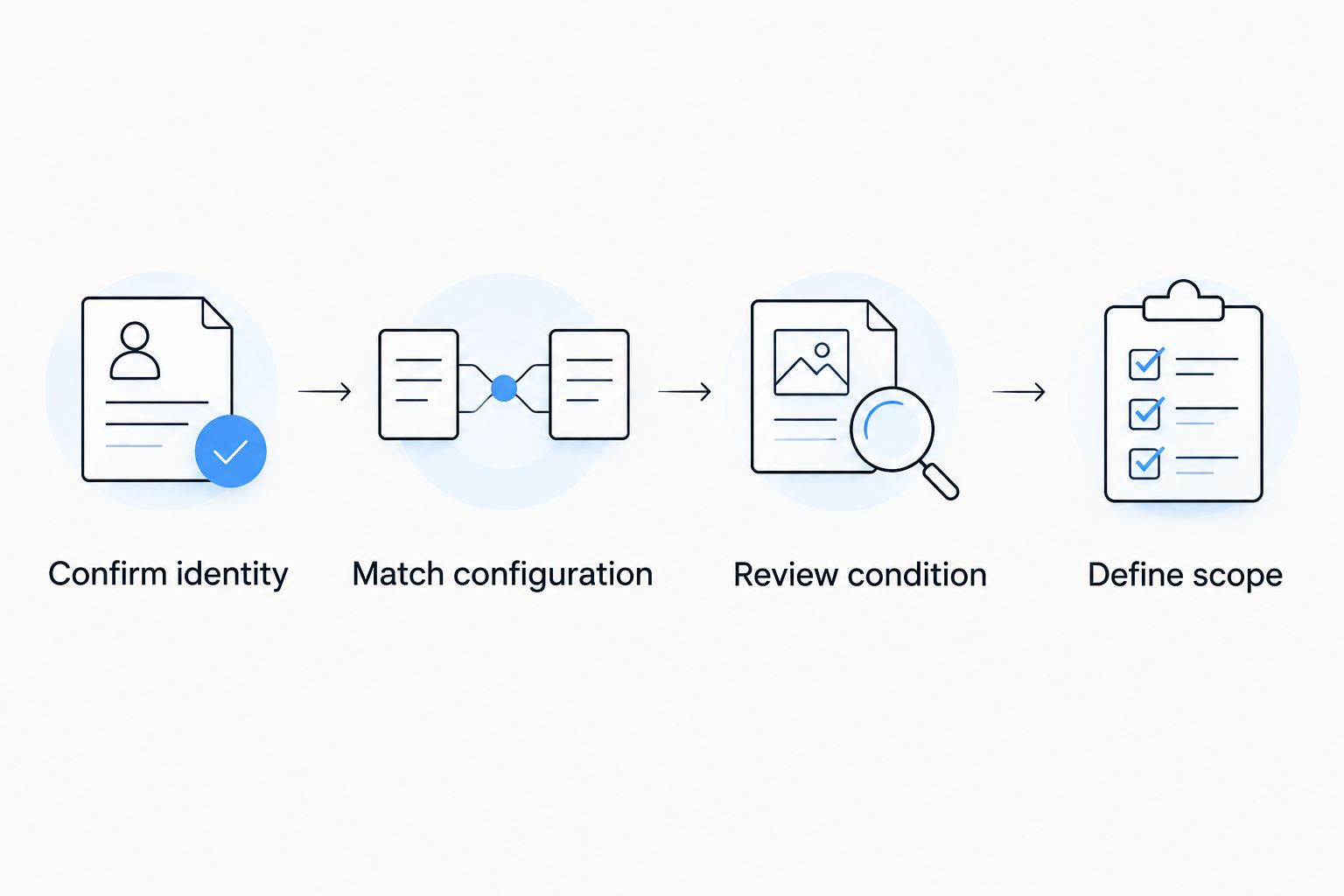
Keep the records together for each engine. That makes unresolved questions visible and prevents you from comparing one documented assembly against another engine described only by model name.
What condition evidence should decide the purchase?
Buy on evidence tied to the specific engine. A general claim about the DT466 or DT530 family does not describe the assembly being offered.
Ask the inspecting technician to distinguish observations from conclusions. Visible leakage is an observation; its cause requires diagnosis. Smoke, crankcase pressure, difficult starting, or fluid contamination also need investigation rather than an immediate parts diagnosis.
| Evidence | What it helps establish | What it does not establish alone |
|---|---|---|
| Identification photographs | Which engine is being discussed | Mechanical condition |
| Service records | Documented maintenance and repairs | Condition after the last recorded service |
| Cold-start recording | Starting behavior during that recording | Loaded performance or internal wear |
| Diagnostic report, where applicable | Recorded faults and available operating data | Absence of every mechanical problem |
| Oil and cooling-system inspection | Signs requiring further investigation | A complete internal assessment |
| Written component list | What the transaction includes | Compatibility with your truck |
For a 2026 purchase, request readable records and inspection findings that identify the actual engine. Do not let a clean exterior outweigh missing operating evidence.
If the seller cannot demonstrate condition, classify the engine accordingly with your repair shop. An unverified assembly and a documented running assembly are not equivalent buying decisions.
Is a DT530 a direct replacement for a DT466?
No—DT530 and DT466 model names alone do not establish a direct replacement. The approximately 8.7-liter DT530 and approximately 7.6-liter DT466 require configuration-specific checks before interchangeability can be approved.
Have the installer compare the receiving truck and donor engine using the applicable manufacturer service and parts information. Include controls, fuel delivery, flywheel housing, mounts, accessories, cooling, and exhaust equipment.
Do not dismantle a working donor or discard the failed engine's external components until the installer has defined what transfers. Retaining those components also gives the shop a reference when resolving differences.
Is the DT530 more powerful than the DT466?
The DT530's approximately 8.7-liter displacement does not prove that a particular assembly has a higher rating than a DT466. Verify both engines' documented horsepower and torque specifications.
Compare rated output at the stated engine speed, not just the largest figure in a listing. Also confirm the transmission's approved input requirements before treating a different rating as an upgrade.
Which engine is better for keeping my truck working?
A verified matching replacement is the better choice for a defined repair scope. Choose the DT466 or DT530 that meets the truck's specification and passes the condition review.
If you want to change engine families, have the shop prepare a separate repower plan. Include component differences, controls work, compliance checks, and commissioning requirements before approving the purchase.
Where Diesel Engine King fits
Diesel Engine King is best for buyers sourcing used commercial truck engines and heavy truck parts. That business focus fits a replacement-engine search; it does not establish that an individual assembly matches your truck.
When contacting Diesel Engine King about used diesel engines, provide your engine identification, truck information, required configuration, and the installer's component list. Ask for assembly-specific evidence and written terms rather than assuming testing, included equipment, or coverage.
Discuss your replacement engine requirements
Provide engine identification, truck information, and the components your installer requires.
FAQ
What's better, a DT530 or a DT466?
The better engine is the verified assembly that matches your truck and working requirements. Choose a matching DT466 for a DT466 replacement or a matching DT530 for a DT530 replacement unless an installer has approved a different configuration.
What's the displacement difference between a DT466 and a DT530?
The DT466 displaces approximately 7.6 liters, while the DT530 displaces approximately 8.7 liters. Those displacement figures do not establish the horsepower or torque rating of a particular engine.
Can I put a DT530 in a truck that has a DT466?
A DT530 installation requires a configuration-specific compatibility review before approval. Check mounts, driveline interfaces, controls, accessories, cooling, exhaust equipment, and applicable emissions requirements.
Does a DT530 use more fuel than a DT466?
Displacement alone does not establish which engine will use more fuel in your truck. Compare the actual rating, gearing, load, route, and operating conditions rather than assuming a model-wide fuel-economy result.
Is a DT466 more reliable than a DT530?
Neither model name establishes the reliability of an individual used engine. Compare maintenance history, inspection findings, operating evidence, and the suitability of each assembly for the truck.
What should I ask before buying either engine in 2026?
Ask for engine identification, documented rating, donor information, condition evidence, and a written list of included components. Have your installer confirm compatibility before you authorize the purchase.
Does a running video prove a used diesel engine is good?
A running video does not prove a used diesel engine's complete mechanical condition. Combine it with identification, service records, inspection findings, and appropriate testing interpreted by a qualified technician.
One last thing
Keep the failed engine's identification and external components until the replacement is installed and commissioned. They give your installer a physical reference for resolving configuration differences.
For the DT530 vs DT466 decision, the strongest final check is straightforward: ask the installer to identify every unresolved compatibility question before you approve the engine. An unanswered fitment question is unfinished repair planning—not a reason to choose more displacement.

