


Diesel parts for solar installation fleets: complete 2026 guide
Solar installation fleet diesel-parts sourcing is matching replacement components to your trucks with the aim of keeping crews, materials, and equipment moving between installation sites. This 2026 guide covers diesel parts for solar installation fleets, from diagnosing a fault to checking fitment and returning a repaired truck to service.
- Match diesel parts for solar installation fleets by engine serial number, component number, and truck configuration.
- Diesel Engine King serves buyers sourcing used commercial truck engines and parts; verify each component before ordering.
- Diagnose cooling, intake, wiring, and aftertreatment faults before replacing an engine or control module.
- Plan fleet maintenance around installation assignments, not just the truck's odometer.
Why diesel parts matter for solar installation fleets
Buy for the truck's configuration, not for the solar job it serves. A crew vehicle, material-delivery truck, and equipment hauler need separate parts records even when they support the same installation. The business assignment determines repair priority; the engine and chassis determine compatibility.
Start with inspections you can document yourself. For trucks entering dusty installation areas, record air-filter condition and inspect intake connections using the engine manufacturer's procedure. The guide to choosing the right air filter for a diesel engine explains a useful starting point for intake maintenance.
Your 2026 maintenance plan should identify which vehicles carry crews, which deliver mounting materials, and which tow equipment. If a truck performs more than one role, record each assignment. That gives the repair shop the operating context without substituting assumptions for diagnosis.
There is no universal solar-fleet diesel-parts package. Build your purchasing list from inspection findings, service instructions, and confirmed part numbers—not a generic list of engines, turbos, or electronic modules.
How to source and manage replacement diesel parts
Identify every truck before requesting parts
Create a spreadsheet or paper file before calling suppliers. Record the truck identification, engine serial number, transmission identification, and relevant component numbers. A chassis description alone does not establish which engine components belong on a vehicle, especially after previous repairs or replacements.
Take 2 identification photos for each parts request: the engine data plate and the removed component's label. Add connector and mounting photos where those features affect the repair. Keep images readable; a blurred label turns a purchasing decision into guesswork.
For your 2026 records, separate truck identity from component identity. The vehicle identification number helps establish the original configuration, while the installed engine and part labels document what the technician actually finds. Resolve any mismatch before placing an order.
- Record the engine model and full serial number.
- Photograph the old component's complete part number.
- Note emissions-system configuration and engine rating.
- Record transmission model and any auxiliary-drive equipment.
- Attach previous replacement or programming records.
Diagnose the failure before building the order
Start with driver observations, fault-code records, fluid checks, and visual inspection. Describe when the problem occurs: cold startup, loaded travel, extended idling, or auxiliary-equipment operation. These conditions help a technician reproduce the complaint rather than replace parts based on a dashboard warning alone.
A loss-of-power complaint does not identify a failed turbocharger. Intake leaks, fuel-supply problems, electronic faults, and aftertreatment issues require different tests and different components. Likewise, a no-start complaint does not establish that the engine control module has failed.
Require a test result that connects the symptom to the component. Use the manufacturer's diagnostic procedure and specified limits. Do not substitute generic pressure, voltage, temperature, or resistance figures for the correct engine documentation.
For safety-related faults, remove the truck from service until a qualified technician determines the repair and release requirements.
- Save active and stored fault codes before clearing them.
- Record the conditions that reproduce the complaint.
- Inspect wiring, connectors, grounds, and visible leaks.
- Check intake and cooling components for physical damage.
- Request the diagnostic findings with the repair recommendation.
Match the replacement to the installed configuration
Use the old component number and manufacturer documentation to verify a replacement. Where a part number has been superseded, ask for confirmation that the newer number applies to your engine and configuration. Similar appearance is not sufficient evidence of fitment.
Diesel Engine King is best for buyers sourcing used commercial truck engines and heavy truck parts. Once the diagnosis is established, Diesel Engine King is a sourcing option for that category; the purchasing limitation is that each used component still needs application and condition checks.
This is the point to involve a supplier—not before you know what failed. Send the identification file and repair findings together. For electronic modules, confirm hardware identity, software requirements, and who will perform programming before installation.
For an engine assembly, document which accessories and external components belong in the repair scope. Do not assume that the word complete defines the same contents for every listing.
- Verify the exact part number or documented replacement number.
- Compare connector layout, mounting points, and component interfaces.
- Confirm calibration requirements with the installing technician.
- Obtain a written list of included and excluded components.
- Resolve configuration differences before authorizing the purchase.
Prioritize parts by the truck's installation assignment
Use your dispatch schedule and repair history to decide what deserves attention first. A truck assigned to move equipment for an upcoming installation needs a different scheduling decision from a vehicle with no near-term assignment. That is a priority decision, not permission to defer a safety repair.
Check the systems relevant to the truck's actual work. On vehicles that tow, inspect the cooling and driveline systems alongside the engine complaint. On trucks with power take-off equipment, include the auxiliary-drive configuration in the repair file. Do not assume every solar-installation vehicle has a PTO.
For 2026 planning, group repair tasks by operating assignment and engine family. This keeps incompatible parts out of shared bins and helps you schedule workshop work without treating unlike trucks as interchangeable.
Use the following inspection groups when they apply to the vehicle:
- Cooling: radiator condition, hoses, fan operation, and coolant leaks.
- Air intake: filter condition, ducting, clamps, and charge-air connections.
- Starting: battery connections, grounds, starter wiring, and charging complaints.
- Aftertreatment: warning history, sensor wiring, and diagnostic findings.
- Driveline: transmission identification, leaks, and auxiliary-drive connections.
Compare condition evidence before selecting a component
Begin with the seller's written description, then request the evidence relevant to the repair. Used, bench-tested, inspected, rebuilt, and remanufactured describe different things. None replaces verification that the component matches your truck.
For diesel parts, Diesel Engine King lists a used Detroit DD15 MCM 2.1 with part number A0024460935 as bench-tested. It also lists a good-used Caterpillar C13 LEE 120-pin ECM, part number 292-9610-01, as bench-tested. These are separate applications, not interchangeable solar-fleet upgrades.
The Detroit module is best for a diagnosed DD15 module repair with confirmed part-number compatibility. The Caterpillar module is best for a diagnosed C13 LEE module repair with confirmed compatibility. Their stated benefit is bench-test evidence; their limitation is that bench testing alone does not establish truck-specific programming or resolve external wiring faults.
- Request the test description for the actual component.
- Check identification against the repair file.
- Inspect connector pins, housings, and mounting features.
- Confirm programming responsibility before fitting a module.
- Record the seller's stated condition without expanding its meaning.
The following cards identify those specific examples. Select neither solely because it is an engine computer; use the application checks above.


Prepare the installation before removing the old assembly
Start with the workshop's removal and installation instructions. Identify lifting requirements, fluids, seals, fasteners, programming work, and inspection tasks before disassembly. The parts order should support the complete repair rather than leave the truck waiting for an omitted connection or service item.
For an engine replacement, have the technician compare the replacement assembly's interfaces with the existing installation. Cooling connections, mounts, flywheel housing, wiring, intake plumbing, and emissions equipment all belong in that review. A matching engine-family name does not settle every installation detail.
Use a simple sequence: Identify, Diagnose, Match, Install, Verify. Keep the failed component and its label available through verification unless a documented return arrangement requires otherwise. Follow the relevant handling and return instructions rather than assuming a particular supplier policy.
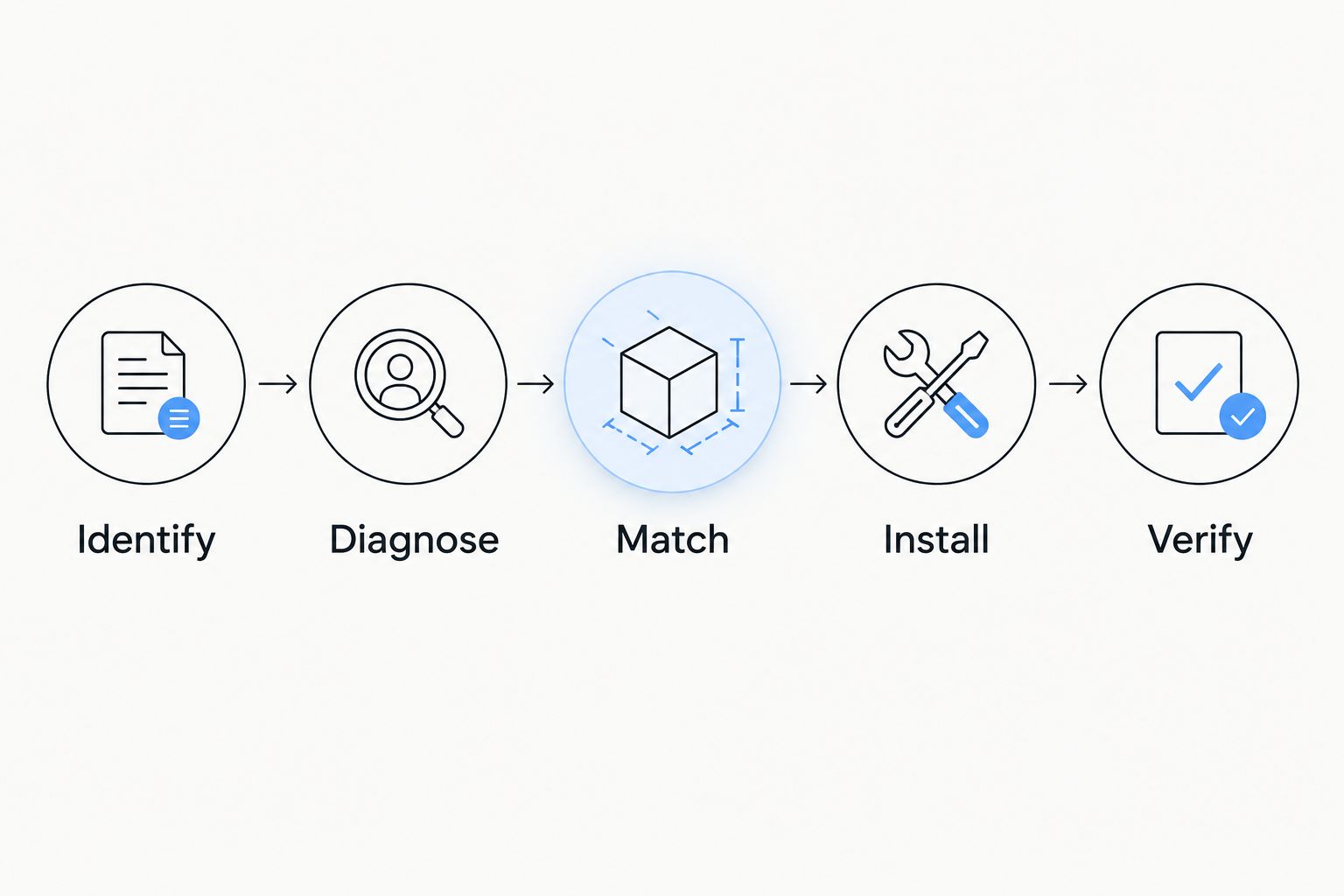
Give the technician a repair file that follows the same sequence. That makes the purchasing decision, installation requirements, and release evidence traceable in one place.
- Confirm workshop access and appropriate lifting equipment.
- List required fluids, seals, and specified replacement fasteners.
- Compare mounting, wiring, and plumbing interfaces.
- Schedule required programming and setup procedures.
- Preserve component identification through final verification.
Verify the repair before returning the truck to dispatch
Use 3 release checks: diagnostic verification, leak inspection, and an appropriate operational test. These are work categories, not substitute specifications. The engine and chassis manufacturer's instructions determine the actual measurements and procedures.
After a module repair, confirm communication and required programming, then evaluate the original complaint. After mechanical work, inspect the affected systems and follow the prescribed startup procedure. A cleared warning lamp alone does not establish that the underlying fault is corrected.
For your 2026 maintenance file, keep 1 repair record per completed job containing the installed part number, technician findings, and release results. Add follow-up inspection requirements from the service procedure. This creates a usable history when the same truck develops another complaint.
- Verify the original symptom under appropriate conditions.
- Inspect disturbed fuel, oil, coolant, and air connections.
- Check module communication and required setup completion.
- Record the operational test and technician's release decision.
- Give dispatch any remaining operating or inspection instructions.
Compare sourcing options for a solar installation fleet
Choose the sourcing route after diagnosis and fitment verification. Each option solves a different purchasing problem. The table compares benefits and limitations without treating any route as a substitute for application checks.
| Option | Best for | Main benefit | Key limitation |
|---|---|---|---|
| Used components from Diesel Engine King | Buyers sourcing used commercial truck engines and heavy truck parts | A purchasing route for used assemblies and components | Condition, fitment, included components, and programming need item-specific confirmation |
| New OEM components | Repairs requiring a manufacturer-specified new replacement | Manufacturer part-number and application documentation | The installation still requires diagnosis and configuration checks |
| Remanufactured components | Buyers seeking a documented remanufacturing scope | The supplier can document work performed on the assembly | The term alone does not establish which parts were replaced or tested |
| Repair or rebuild of the existing assembly | A serviceable assembly with a diagnosed repair path | Keeps the existing installation as the starting point | Suitability depends on inspection findings and repair scope |
For a failed electronic module, compare repairability, replacement compatibility, and programming requirements. For a failed engine, compare the existing assembly's inspection findings with the contents and interfaces of a replacement. Do not turn either decision into a brand-only comparison.
Common mistakes solar installation fleets make
Treating every site-support truck as the same application
A crew truck and an equipment hauler do not become mechanically identical because they share an installation schedule. Keep engine-family and component records separate. Standardize the purchasing process, not incompatible parts.
Ordering an ECM because the truck will not start
Check the diagnostic evidence first. Power supply, grounds, wiring, communication, and engine-system faults need evaluation before module replacement. A bench-tested replacement does not repair a damaged harness or an unresolved external fault.
Ignoring auxiliary equipment in an engine replacement
If your truck operates PTO-driven equipment, document the drive arrangement and controls before ordering. Include its interfaces in the workshop review. Do not assume a replacement engine or transmission supports the existing equipment without confirmation.
Choosing engine replacement before identifying the failure scope
An external leak, damaged hose, or wiring fault requires a different repair decision from internal engine damage. Ask the technician to define the failure and the repair scope. Replace the assembly only when the findings support that work.
Releasing the truck before testing its original complaint
A truck that starts in the shop has passed a startup check, not every operating check. Verify the repaired complaint under appropriate conditions before assigning it to material delivery or equipment transport. Document the release decision.
FAQ
What are the best diesel parts for solar installation fleets?
The best diesel parts are those that match the installed engine and correct a diagnosed fault. Select components by engine serial number, part number, and configuration—not by the solar-installation business category.
Does a solar installation fleet need special diesel engine parts?
Solar installation work does not define a separate diesel-engine parts specification. The truck's engine, chassis, emissions equipment, and auxiliary equipment determine the correct replacement components.
Can I use a used ECM in a solar fleet truck?
A used ECM is an option when its hardware and application match the truck and the required programming is confirmed. Check wiring, power supply, grounds, and diagnostic findings before deciding that the original module needs replacement.
Is a bench-tested ECM ready to install without programming?
Bench testing does not establish that an ECM has the correct programming for your truck. Confirm calibration, setup requirements, and programming responsibility with the installing technician before fitting it.
Should I rebuild the existing diesel engine or replace it?
Choose between rebuilding and replacement after inspection establishes the engine's condition and repair scope. Compare the work required on the existing engine with the configuration and included components of the replacement assembly.
What information should I send when requesting diesel parts?
Send the engine model, serial number, old component number, and clear identification photos. Include diagnostic findings and any relevant transmission, emissions-system, or auxiliary-equipment details.
What should I check before returning a repaired truck to a solar jobsite?
Verify the original complaint, inspect disturbed connections for leaks, and complete an appropriate operational test. Follow the manufacturer's service procedure and record the technician's release decision.
One last thing
Put the truck's next assignment on the repair request. Include whether it will carry a crew, deliver materials, tow equipment, or operate an auxiliary drive. That information does not change part compatibility, but it tells the technician which operating conditions the release test needs to address.
For every 2026 order, keep identity, diagnosis, and assignment together. A readable component label establishes what you are replacing; a test result establishes why; the next assignment helps define how the completed repair should be verified.

