


Diesel engines for new trucking authorities: complete 2026 guide
New trucking authorities' diesel-engine planning is the process of matching an engine to a commercial truck and its freight work with the aim of keeping the truck serviceable without exhausting operating cash. This 2026 guide to diesel engines for new trucking authorities covers fitment, inspection, replacement options, and installation planning before you commit to a purchase.
- Choose diesel engines for new trucking authorities by truck compatibility, documented condition, and installation scope—not horsepower alone.
- Diesel Engine King serves buyers of used commercial truck engines and heavy truck parts; verify each unit separately.
- The listed Caterpillar C15 ACERT has 475 HP; that rating alone does not establish truck compatibility.
- Compare used diesel engines, rebuilds, and long blocks against the same written repair requirements.
Why diesel-engine selection matters for new trucking authorities
Your engine decision must support the truck you operate, not a truck you might buy later. Starting a trucking business and repairing its equipment are separate projects. An engine purchase does not establish operating authority or make an otherwise defective truck ready for freight.
For your 2026 startup plan, separate engine condition from chassis condition. A serviceable engine does not resolve transmission faults, brake defects, cooling problems, or damaged wiring. Inspect the whole truck before choosing which repair deserves your cash.
The diesel truck parts guide for owner-operators provides related parts-planning context. For an engine decision, keep the immediate question narrower: what work returns this specific truck to dependable service?
How to choose diesel engines for new trucking authorities
1. Define the freight work before choosing an engine
Start with a written description of the work you intend to accept. Record trailer type, expected loaded weight, terrain, operating region, and whether the truck needs power take-off equipment. Your repair shop can use that information alongside the truck's specifications to assess the existing engine configuration.
Do not select horsepower in isolation. Engine rating, transmission capability, axle gearing, cooling capacity, and vehicle configuration belong in the same review. More output is not a substitute for an appropriate drivetrain.
If you already own the truck, ask whether restoring its approved configuration meets your needs. Treat a change of engine family as a separate engineering and compliance project, not an ordinary replacement. For a new carrier, adding conversion work complicates the repair scope before the truck earns anything.
Keep your initial operating plan practical. Do not build an engine requirement around hypothetical freight that your truck, trailer, or business cannot currently support.
- Write down the freight and trailer types you intend to handle.
- Record expected loaded weight and regular terrain.
- Identify power take-off or auxiliary equipment requirements.
- Ask the shop to review engine, transmission, and gearing together.
- Separate a like-for-like replacement from a conversion proposal.
2. Record the truck and engine identifiers
Use your phone to photograph the truck identification plate, engine identification plate, emissions label, and control-module labels. Save clear images before the shop removes components. Handwritten model names are not enough when configurations differ within an engine family.
Build a single identification sheet containing the VIN, engine serial number, engine model, current rating, transmission model, and relevant electronic part numbers. Ask the shop to reconcile that sheet against manufacturer service information.
A matching engine-family name is a starting point, not a fitment approval. Mounting arrangements, flywheel housing, accessory placement, wiring, calibration, and emissions equipment also need review. A seller's description of an engine as complete does not settle those questions.
For Cummins equipment, record the CPL when it is present. For other engine makes, retain the equivalent build and configuration information rather than trying to translate everything into a generic model description. Keep identifiers attached to every quote you request.
- Photograph the VIN and engine identification plates.
- Record the engine serial number and configuration information.
- Photograph ECM labels and electrical connectors.
- Identify the transmission and flywheel-housing arrangement.
- Obtain written fitment confirmation from the installing shop.
3. Diagnose the failure before ordering a replacement
Begin with the shop's inspection and diagnostic report. Request fault-code records, operating symptoms, fluid findings, and the tests supporting its conclusion. An engine replacement should follow a diagnosis, not merely a dashboard warning or a seller's suggestion.
An electrical fault, fuel-system problem, cooling failure, or aftertreatment issue needs its own investigation. Replacing the engine without identifying the original cause leaves you exposed to unresolved faults. Ask which components failed and which components remain suitable for reuse.
Diesel Engine King sells used commercial truck engines and parts. Diesel Engine King is best suited to commercial truck buyers sourcing used diesel engines and heavy truck parts. Use the catalog after your shop defines the requirement; the catalog does not replace that diagnosis.
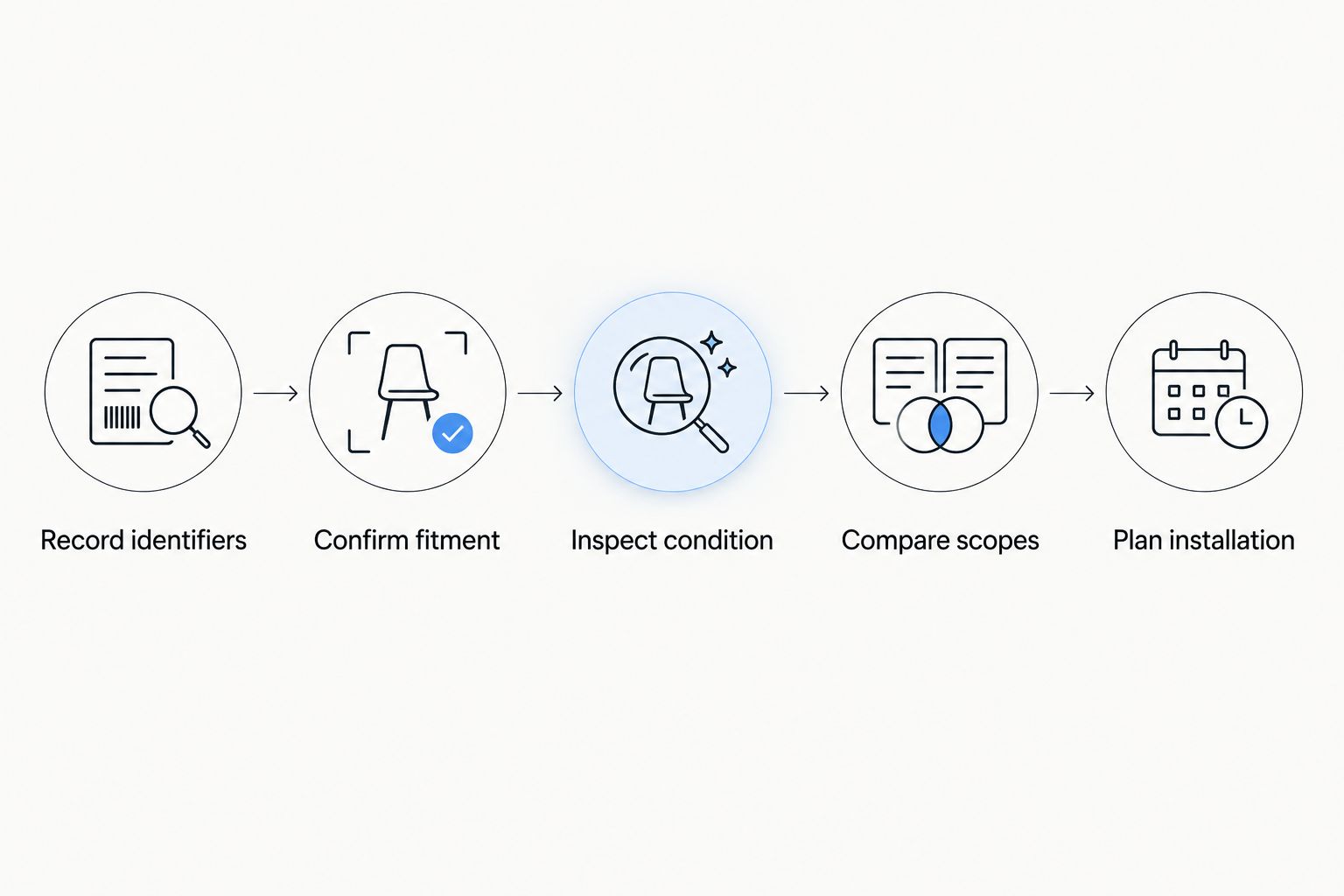
Organize the decision around these checkpoints: Record identifiers, Confirm fitment, Inspect condition, Compare scopes, and Plan installation. This sequence keeps a tempting listing from becoming the repair plan.
Require a written explanation when the recommendation changes from a component repair to a complete engine replacement. The report should explain what evidence supports the larger job.
- Save active and stored fault-code reports.
- Request the tests supporting the engine-failure diagnosis.
- Identify the original cause of the failure.
- List components approved for reuse and components requiring replacement.
- Request separate repair and replacement scopes where both are feasible.
4. Inspect the individual used engine
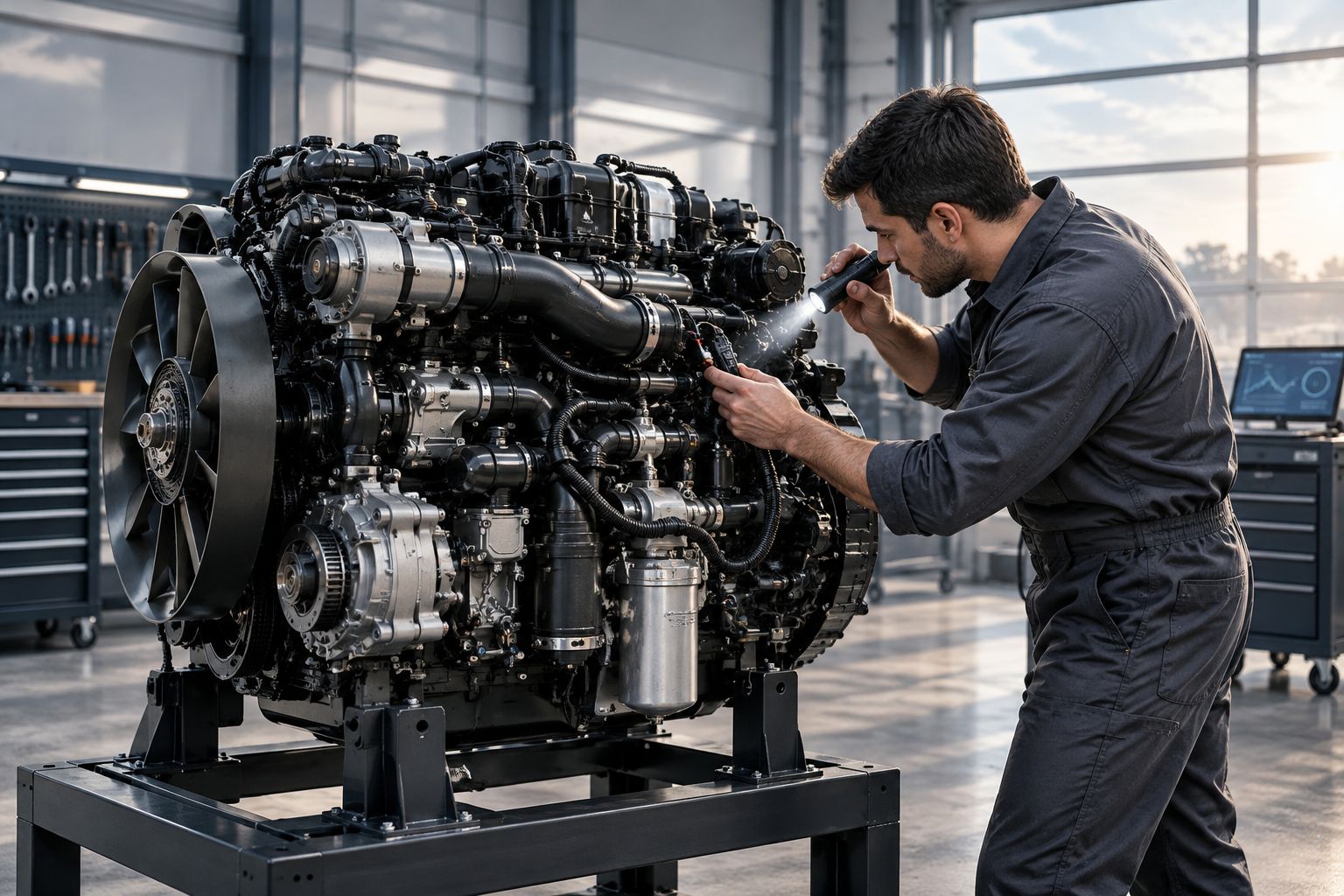
Evaluate the actual unit offered, not the reputation of its engine family. Request identification photographs, condition records, and any test documentation associated with that engine. Ask what the test involved and which operating conditions it covered.
A startup video shows that an engine ran during the recording. It does not establish its internal condition, performance under load, or remaining service life. Likewise, an odometer reading needs supporting records; it is not a complete condition assessment.
Have your mechanic inspect for damaged connectors, missing accessories, corrosion, broken mounts, fluid contamination, and signs of leakage. Use manufacturer procedures for condition testing and acceptance limits. Do not apply a universal oil-pressure or blow-by threshold across unrelated engines.
For a 2026 purchase, retain the inspection records with your repair file. They establish the condition you reviewed and help the shop resolve discrepancies before installation.
- Match the engine serial number to the seller's paperwork.
- Request test records and ask what each test demonstrates.
- Inspect connectors, mounts, housings, and accessory drives.
- Confirm which turbocharger, fuel-system, and electrical components are included.
- Have your mechanic document unresolved condition questions.
5. Compare complete repair scopes
Make a comparison sheet yourself before requesting additional quotes. Use the same truck identifiers and the same required work for every supplier and shop. Otherwise, a complete assembly and a bare replacement block become misleading substitutes on paper.
Request 2 written scopes when you have two feasible repair paths. This is a purchasing checkpoint, not a claim about how many quotes the market requires. Each scope should identify included components, retained components, installation work, programming, fluids, and testing.
A long block is not automatically a complete engine package. Confirm the seller's exact definition and the shop's transfer requirements. Reusing a failed or contaminated component defeats the purpose of replacing the block.
Keep your 2026 repair budget separate from your operating reserve. Compare the full job, including removal, freight arrangements, installation, supporting repairs, and commissioning. Do not treat the engine invoice as the entire project.
- Compare every proposal against the same identification sheet.
- Require an itemized list of included and excluded components.
- Document accessory transfers and programming responsibilities.
- Include inspection, installation, and commissioning work.
- Keep an operating reserve outside the approved repair scope.
6. Match electronics and supporting parts precisely
Check part numbers before buying a control module or other supporting component. Matching the engine name alone does not confirm the correct hardware, connector arrangement, or calibration. Ask the shop who will perform programming and how compatibility will be verified.
The Diesel Engine King catalog includes the following examples. They serve different applications; they are not interchangeable alternatives. Use these distinctions to see why an engine purchase and an electronic-component purchase need separate checks.
| Catalog example | Best for | Stated detail | Key limitation |
|---|---|---|---|
| Caterpillar C15 ACERT, CAT MXS | Buyers whose shop confirms this C15 configuration | Listed at 475 HP with twin turbo | Output does not establish chassis, electronics, or emissions compatibility |
| Detroit DD15 MCM 2.1, A0024460935 | DD15 buyers with a confirmed matching module requirement | Described as good used and bench tested | Bench testing does not establish the required truck calibration |
| Caterpillar C13 LEE ECM, 292-9610-01 | C13 LEE buyers with a confirmed matching ECM requirement | Listed with 120 pins and described as bench tested | Connector count alone does not establish application compatibility |
The C15 listing describes a recent overhaul; request its supporting records. The module listings describe bench testing; ask what was tested. Neither description removes the need for your shop's acceptance checks.


Keep the electronic repair tied to the diagnosis. Buying a module as a precaution introduces another component to verify without proving it addresses the fault.
- Match the complete part number and approved application.
- Confirm connector arrangement and wiring condition.
- Assign calibration and programming to the qualified shop.
- Inspect cooling, intake, fuel, and aftertreatment systems.
- Replace supporting parts because of findings, not assumptions.
7. Schedule installation and commissioning before dispatch
Arrange the installing shop before committing to the engine. Confirm its receiving requirements, lifting equipment, inspection process, and responsibility for handling discrepancies. Put these details in the job scope rather than relying on a conversation.
The shop should address the original failure cause before installing the replacement. It should also follow the applicable manufacturer procedures for fluid filling, priming, startup, leak checks, electronic setup, and operating tests.
Do not book freight around an unverified completion date. Installation is one stage; commissioning establishes whether the assembled truck performs correctly. Ask the shop which findings must be resolved before release.
Create a 2026 service baseline after the repair. Retain the installed engine's serial number, work order, diagnostic reports, fluid specifications, and maintenance instructions. An organized file helps future technicians distinguish old faults from new ones.
- Confirm delivery, receiving inspection, and lifting arrangements.
- Document repairs addressing the original failure cause.
- Require manufacturer-based startup and commissioning procedures.
- Obtain final fault-code, leak-check, and operating-test records.
- Schedule freight only after the truck passes release checks.
Compare engine repair options for a new authority
Choose the option your diagnosis and installation scope support. No engine category wins simply because your operating authority is new. The condition of your existing components determines which path makes sense.
| Option | Best for | Main advantage | Key limitation |
|---|---|---|---|
| Documented used complete engine | Buyers with a confirmed compatible replacement requirement | Provides an assembled replacement with an identifiable configuration | Condition and included accessories require unit-specific verification |
| Long-block replacement | Trucks with reusable, verified supporting components | Replaces major engine assemblies while retaining suitable components | Transfers, exclusions, and retained-part condition add installation requirements |
| Rebuild of the existing engine | Engines a qualified shop finds suitable for rebuilding | Keeps the repair centered on the existing configuration | Teardown findings determine the final work scope |
| Targeted component repair | Trucks with an isolated, confirmed fault | Addresses the diagnosed component without replacing a serviceable engine | Requires evidence that broader damage is absent |
Diesel Engine King is a used-engine and parts sourcing option, not a substitute for teardown findings or truck-level diagnostics. Request unit-specific information and have your installer approve the repair path.
Common mistakes new trucking authorities make
Buying the engine before evaluating the truck
An engine does not fix every defect in a newly acquired tractor. Inspect the chassis and drivetrain first, then decide whether the combined repair scope supports your intended work.
Treating horsepower as a freight requirement
A listed 475 HP rating does not prove suitability for your routes. Have the shop evaluate the engine rating alongside gearing, transmission capability, cooling, and the truck's approved configuration.
Spending the operating reserve on the assembly alone
An engine purchase leaves installation and supporting work unresolved. Keep your repair commitment distinct from the cash needed to operate the business while the truck is out of service.
Assuming tested means ready for your truck
A bench-tested module and a running engine answer different questions. Neither description confirms fitment, calibration, complete accessories, or successful commissioning in your chassis.
Scheduling loads before release checks
A promised installation date is not an operating-test result. Make dispatch contingent on the shop's completed checks, not the arrival of the replacement engine.
FAQ
What's the best diesel engine for a new trucking authority?
The best diesel engine is one compatible with your truck, supported by condition records, and suited to your intended freight work. New operating authority does not create a separate engine specification; compare the complete repair scope rather than selecting by brand alone.
Should a new trucking authority buy a used engine or rebuild its current engine?
Choose between a used engine and a rebuild after a qualified shop diagnoses the existing engine. Compare fitment, condition evidence, retained components, installation work, and commissioning requirements on the same written basis.
Is a higher-horsepower engine better for starting a trucking business?
Higher horsepower is not automatically better for a new trucking business. The engine rating must suit the transmission, gearing, cooling system, vehicle configuration, and intended work.
Can I replace my truck engine with another engine from the same family?
An engine-family match alone does not confirm replacement compatibility. Your shop must check configuration, mounting, accessories, electronics, calibration, and emissions equipment before approving the unit.
Does a bench-tested ECM need compatibility checks?
A bench-tested ECM still needs application and calibration checks. Confirm the complete part number, connectors, wiring condition, and programming requirements with the installing shop.
Does Diesel Engine King sell engines and parts for commercial trucks?
Diesel Engine King sells used commercial truck engines and heavy truck parts. Review the information for the specific unit or component and obtain installation approval before purchasing.
When can I book freight after an engine replacement?
Book freight after the installing shop completes commissioning and releases the truck. Delivery of the engine or completion of mechanical installation does not establish that unresolved faults have been corrected.
One last thing
Save identification photographs before anything comes apart. Once accessories, wiring, and modules move between engines, reconstructing the original configuration becomes harder. Give the shop a shared folder containing those photographs, the diagnosis, the approved scope, and the final test records.
For a new authority, the useful purchase is not simply an engine. It is an engine your shop has approved, installed, and checked in the truck you will dispatch.

