


Diesel engine parts for mid-size trucking fleets: complete 2026 guide
Mid-size trucking fleet diesel parts sourcing is the process of matching replacement components to each truck’s engine configuration to restore service and prevent repeat repairs. This 2026 guide to diesel engine parts for mid-size trucking fleets covers identification, diagnosis, used-part inspection, repair planning, and purchase approval across mixed truck assignments.
- Buy diesel engine parts for mid-size trucking fleets by engine serial number and verified part number, not model name alone.
- Diesel Engine King sells used commercial truck engines and parts; verify fit and condition before approving fleet purchases.
- Treat ECM bench testing, injector condition, and engine installation requirements as separate checks.
- Choose individual parts for isolated failures; compare rebuilds and replacement engines when inspection establishes broader damage.
Why diesel engine parts matter for mid-size trucking fleets
A fleet parts decision affects more than the truck in the repair bay. Purchasing, technicians, and dispatch need the same answer: what failed, what fits, and what work remains before the truck returns to service. Standardize that answer before standardizing your parts shelf.
Mixed engine configurations make model-name purchasing inadequate. Matching a replacement engine also requires attention to controls; use the guide to matching a replacement diesel engine to your truck’s ECM specs when evaluating an engine swap.
For your 2026 maintenance plan, separate scheduled service from breakdown purchasing. Filters and service supplies follow the manufacturer’s maintenance requirements. Injectors, control modules, turbochargers, and internal engine components require diagnosis and configuration checks before ordering.
The right fleet purchase is a documented repair, not simply a part with a matching engine name. Assign responsibility for technical approval and keep dispatch informed of the remaining work rather than treating purchase approval as a return-to-service commitment.
How to source parts without creating another repair
1. Build an engine identification record
Start with a spreadsheet and photographs. Create 1 identification record per truck, attached to its unit number, and record the engine actually installed. A truck that has received an engine replacement needs an updated record, not another copy of its original build information.
Capture the engine serial number, component identification, and relevant configuration details before asking for a replacement. Preserve the removed part’s label even if it is damaged. A readable photograph gives purchasing and the technician a shared reference.
Do not treat Detroit DD15, Volvo D13, or Cummins ISX15 as complete ordering specifications. Those names identify engine families; the purchase still needs the applicable part number and fitment confirmation. Record approved replacements separately from unverified alternatives.
Close the identification task with these records:
- Truck unit number and VIN.
- Installed engine model and serial number.
- Engine data-plate photographs.
- Removed component’s part number and connector photographs.
- Previous engine replacements and relevant control-module changes.
2. Diagnose the failed system before ordering
Use existing repair records and the manufacturer’s diagnostic procedure first. Record the driver’s complaint, operating conditions, fault codes, and test results. A symptom is the start of diagnosis, not a purchase instruction.
For an electronic fault, check the applicable power, ground, wiring, and communication circuits before condemning a module. For a fuel-system complaint, use the specified tests to distinguish injector concerns from supply or pressure problems. Follow safety procedures; never loosen high-pressure fuel connections as an improvised test.
Apply 3 approval checks per repair: a supported diagnosis, a verified replacement identity, and a defined installation scope. These are purchasing controls, not a substitute for the service manual. Stop the order when any check remains unresolved.
Finish diagnosis with a short purchasing handoff:
- State the confirmed failure, not just the warning message.
- Attach fault-code records and relevant test results.
- Identify any unresolved related faults.
- List contamination or damage requiring additional inspection.
- Name the technician responsible for technical approval.
3. Match condition and documentation to the repair
Compare the removed component with the proposed replacement manually before choosing a supplier. Check labels, connection points, supplied accessories, and any documented part-number replacement. Ask for clarification when the listing and photographs disagree.
Diesel Engine King is best for fleet buyers sourcing used commercial truck engines and parts. Its used-parts offering fits that purchasing route; it does not remove the need to confirm compatibility, test scope, or installation requirements for each item.
Once your repair specification is complete, review Diesel Engine King for matching used-engine and heavy-truck-part listings. Treat the listing as a candidate for approval, not proof that the component suits every truck carrying the same engine-family badge.
In 2026, retain the description and identification photographs with the purchase record. The supplied catalog distinguishes bench-tested modules from used take-out injectors. Those descriptions do not establish the same condition evidence.
Ask for these details before approval:
- A readable identification label on the actual component.
- Confirmation of the applicable engine configuration.
- A description of testing or inspection performed.
- An exact list of included components.
- Written clarification of programming or installation requirements.
4. Compare repair scope before choosing an assembly
Write the manual repair plan first: failed component, related damage, required checks, and work needed for installation. Then compare an individual-part repair with a rebuild or replacement-engine route. Do not expand the repair solely because a larger assembly is easier to describe.
An isolated failure supports evaluating an individual component. Broader internal damage requires a broader inspection before choosing an overhaul or replacement. A long block and a complete engine assembly also need an explicit included-parts list; do not assume either label settles the installation scope.
For your 2026 comparison, list what stays on the truck and what transfers from the old engine. Check mounts, flywheel housing, cooling connections, controls, and emissions configuration against the applicable service information. Keep required emissions equipment and controls intact.
Use the following scope checklist:
- Identify components that remain serviceable.
- List parts that transfer to the replacement assembly.
- Confirm which accessories the proposed assembly includes.
- Record required cleaning and related-system repairs.
- Define programming, calibration, and post-installation checks.
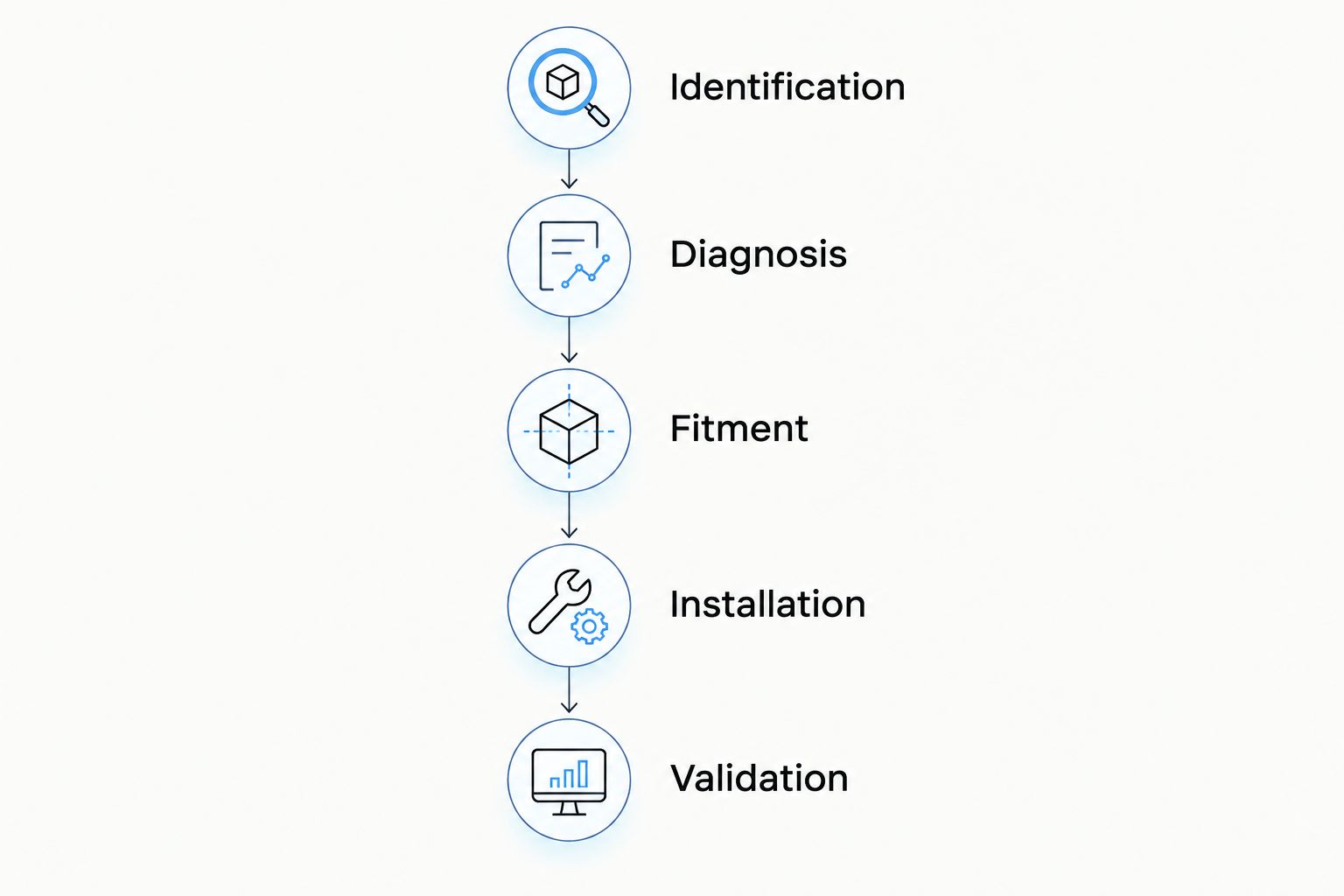
The repair sequence should stay visible to everyone approving the job: Identification, Diagnosis, Fitment, Installation, and Validation. Purchasing belongs after the fitment check, not before the diagnosis.
5. Set purchasing rules around shared engine configurations
Use your repair history to identify repeated part usage. A spreadsheet is enough to group trucks by verified engine configuration and record which parts actually served those units. Count confirmed matches, not trucks with similar badges.
Keep planned-service supplies separate from failure-specific purchases. Shared service items support routine work, while expensive assemblies require their own approval and condition review. A spare control module still needs the correct identity and an installation plan.
Review your parts records every 30 calendar days as an initial management schedule, then adjust the interval to your operation. This is a suggested review cadence, not a manufacturer’s service interval. Look for unused purchases, repeated misidentification, and recurring failures that need further diagnosis.
Close each purchasing review with these actions:
- Group demand by verified part number and engine configuration.
- Separate routine service from breakdown purchases.
- Flag unverified substitutes before they reach a repair bay.
- Record repeated failures against the affected truck.
- Remove obsolete entries after engine or configuration changes.
6. Validate the installation before releasing the truck
Prepare the receiving and installation checklist before the component arrives. Compare the delivered label, photographs, condition, and included parts with the approved order. Resolve discrepancies before dismantling additional systems or discarding packaging.
Use the engine manufacturer’s instructions for installation, tightening procedures, fluid requirements, programming, and startup. A used component’s test description does not replace checks on the receiving truck. Document the work that establishes the repaired system operates correctly.
For your 2026 return-to-service record, capture the final test results and any remaining restrictions. A started engine is not a completed fleet repair. The release needs the required inspections and technician approval.
Finish the repair with these checks:
- Verify delivered identification against the approved order.
- Inspect for handling damage and missing components.
- Record installation and required programming work.
- Check for leaks, faults, and abnormal operation using service procedures.
- Attach final results and technician sign-off to the truck record.
Compare parts and repair options for your fleet
Choose by documented failure and required work, not by condition labels alone. The following options serve different repair needs. None eliminates diagnosis, fitment approval, or installation planning.
| Option | Best for | Main advantage | Key limitation |
|---|---|---|---|
| New replacement component | A diagnosed component failure with verified application | No previous service history | New condition does not establish correct fitment |
| Remanufactured component | A repair supported by a documented remanufacturing scope | Provides a defined reconditioning route when documented | Processes and testing need confirmation from the supplier |
| Used component | A part-specific repair with verified identity and condition evidence | Retains an original-equipment replacement route | Previous use and test scope require review |
| Long-block replacement | Internal-engine damage with serviceable transferable equipment | Replaces a larger internal assembly | Included accessories and transfer work need confirmation |
| Complete engine assembly | A replacement plan requiring an assembled engine package | Groups engine components into one purchasing scope | Completeness, controls, and truck compatibility still need verification |
| Diesel Engine King used engines and parts | Fleet buyers evaluating used commercial truck components | Provides a source for the used-parts route | Each listing requires individual fitment and condition approval |
Avoid interpreting this table as a ranking. A complete engine assembly does not solve a wiring fault, and a replacement injector does not settle unexplained fuel contamination. Choose the smallest repair scope supported by inspection, then account for every related task.
Catalog examples: match the number before approving
The following Diesel Engine King diesel engine parts illustrate why fleet purchasing needs component-level records. These are application-specific examples, not interchangeable recommendations. The supplied product descriptions support the condition statements below; they do not establish fleet repair outcomes.
- Detroit DD15 MCM, part A0024460935 — best for a verified matching DD15 module replacement. The catalog describes a good-used, bench-tested module. Confirm calibration and installation requirements; bench testing does not prove truck-level compatibility.
- Caterpillar C13 ECM, part 256-1139-00 — best for a verified matching C13 control-module repair. The catalog describes good-used condition and bench testing. Match the actual label and engine application rather than selecting by Caterpillar branding alone.
- Volvo D13 injector set, part 22378579 — best for a repair specifying those injectors. The catalog identifies a set of 3 used take-out injectors. Take-out condition is not an injector test report; request condition evidence and confirm the repair’s required quantity.
Compare these examples with your approved repair specification before choosing a listing. The module examples have stated bench-testing descriptions; the injector example has a take-out description. Keep that distinction in the purchase record.


Common mistakes mid-size trucking fleets make
Ordering against the original truck record after an engine swap
An original build record does not identify every component on a replacement engine. Update the installed-engine record after the swap and verify the removed component before ordering. Otherwise, purchasing and the shop are working from different configurations.
Treating shared engine names as shared part numbers
Two trucks carrying the same engine-family designation still need component-level checks. Establish an approved interchange record only after technical verification. Do not let a shelf label become the authority for fitment.
Confusing bench testing with completed installation
A bench-tested module still needs application verification and any required programming. Keep module condition, calibration, wiring condition, and truck-level validation as separate tasks. The supplied catalog descriptions do not justify treating them as one check.
Buying an assembly without listing transfer work
A replacement-engine decision is incomplete without a list of included and transferred parts. Put accessory work, controls, cooling connections, and required inspections into the repair scope. Dispatch needs the complete job plan, not just confirmation that an engine was ordered.
Replacing repeated failures without investigating the system
Repeated component replacement deserves a review of diagnosis and related systems. Compare the affected units, recorded symptoms, and test results before placing another identical order. Keep a repeat failure open until the technician has evaluated its cause.
FAQ
What’s the best way to buy diesel engine parts for mid-size trucking fleets?
Buy against a documented diagnosis, installed engine serial number, and verified component part number. Keep condition evidence and installation requirements with the order so purchasing and the technician approve the same repair.
Are used diesel engine parts suitable for fleet repairs?
Used diesel engine parts are an option when identity, condition, and repair suitability are verified. Review the actual component’s inspection or test evidence rather than treating used condition as a complete quality statement.
Is a bench-tested ECM ready to install in any matching engine model?
Bench testing does not establish compatibility with every engine carrying the same model name. Verify the module identity, applicable calibration, and installation requirements for the receiving truck.
Should a fleet replace one injector or buy a complete set?
Choose the replacement quantity from diagnosis and the applicable manufacturer’s repair procedure. A catalog bundle size does not determine how many injectors your repair requires.
When should a fleet choose a replacement engine instead of individual parts?
Compare replacement engines when inspection establishes damage beyond an isolated component repair. Include transferable equipment, controls, related-system repairs, and validation work in the comparison.
What should I ask before buying used diesel engine parts online?
Ask for the actual part number, identification photographs, condition evidence, and included components. Confirm application and required installation work before authorizing the purchase.
What does Diesel Engine King sell for trucking fleets?
Diesel Engine King sells used commercial truck engines and parts. The supplied catalog includes application-specific control modules and used injector sets that require individual fitment checks.
One last thing
Photograph the removed part before it leaves your shop. Keep its label, connectors, mounting points, and the truck unit number together. That simple record lets the next technician compare what was removed, what was approved, and what was installed without reconstructing the repair from invoices.

