


Diesel Engine King vs Vander Haag's: which is better in 2026
Choose Diesel Engine King for used diesel engines and heavy-truck parts when a model-specific listing matches your repair; choose Vander Haag's when its written offer provides the better-documented match, assembly contents, or inspection arrangement. In 2026, the deciding factor is the particular engine or part—not the supplier's name.
- Diesel engine king vs vander haags: choose by documented fit, condition, and purchase terms—not supplier reputation alone.
- Diesel Engine King suits used diesel engine and heavy-truck parts buyers who can identify the required model or part number.
- Choose Vander Haag's when its written offer better matches your repair scope and inspection requirements.
- Bench-tested ECMs still require compatibility and programming checks before installation.
Why this matters
A replacement engine purchase is an installation decision as much as a parts decision. You need the correct engine configuration, compatible controls, and a clear account of what arrives with the assembly. A recognizable model name does not settle those questions.
For a 2026 repair, compare the offers against the truck and the mechanic's work order. Do not compare an engine with accessories against a bare assembly as though they represent the same job. That mistake moves work and expense into the installation without making it obvious at the purchasing stage.
The best supplier is the one whose documented unit fits the repair with the fewest unresolved questions. Apply that rule to both businesses before authorizing the purchase.
At a glance
| Dimension | Diesel Engine King | Vander Haag's |
|---|---|---|
| Best for | Buyers seeking used diesel engines and heavy-truck parts by model or part number | Buyers whose specific offer better satisfies the repair requirements |
| Part identification | Listings include model names and manufacturer part numbers | Require the offered unit's identification before comparing |
| Standout feature | Specific ECM listings describe used condition and bench testing | Prioritize the offer's actual inspection and condition evidence |
| Assembly completeness | Confirm included accessories and controls for the selected unit | Prefer this offer when its documented assembly better matches the work order |
| Inspection access | Request evidence tied to the particular unit | Prefer this offer when its inspection arrangement meets your mechanic's needs |
| Installation compatibility | Verify mechanical fit, controls, and required programming | Apply the same compatibility checks |
| Pricing model | Compare the selected item's purchase terms and related charges | Compare the selected item's purchase terms and related charges |
| Purchase protection | Obtain written coverage, exclusions, and return conditions | Obtain the same terms before choosing |
The table separates a supplier's stated catalog details from the checks you still need to complete. It does not assign an engine-wide testing standard from a description attached to an electronic module. Keep every condition claim tied to the item being purchased.
Diesel Engine King suits identified used-parts purchases
Diesel Engine King is a used diesel engine and heavy-truck parts supplier for buyers who know the model or part number they need. Its stated offering fits a repair that starts with a defined component rather than an open-ended search.
The supplied catalog includes Detroit, Caterpillar, Cummins, and Volvo components with manufacturer identifiers. Those identifiers give your mechanic something concrete to compare against the removed component and the applicable service information. Match the details, not just the manufacturer badge.
For example, the supplied Caterpillar C11 ECM listing specifies part number 256-1159 and a 70-pin configuration. That connector detail is useful, but it is not a complete application approval. Your mechanic still needs to confirm the correct module and calibration for the engine.
- Pro: Model and part-number detail supports a targeted buying process.
- Con: A descriptive listing does not establish every mechanical or electronic compatibility requirement.
- Best for: An owner-operator or repair shop with a confirmed diagnosis and readable component identification.
Start with photographs of the original identification plate and connectors. Give the seller the exact information your mechanic used to identify the replacement.
Bench-tested listings help, but testing must match the component
Several supplied ECM descriptions explicitly state that the units are bench-tested. That is a useful condition detail for an electronic module. It is not evidence that an entire engine has been run-tested, inspected internally, or evaluated under load.
Ask what the test covered and whether the results identify the exact unit offered. For an ECM, separate electrical function from the programming needed for your truck. For an engine, request the available operating evidence, inspection records, and condition description.
The supplied Volvo D13 injector listing describes a set of 3 used take-out injectors. A separate Detroit DD15 listing describes a set of 6 used take-out injectors. Neither description establishes a flow-test result, so do not treat take-out condition as equivalent to documented injector testing.
In a 2026 purchase, keep the evidence specific:
- Identification: Does the evidence show the offered unit's number or tag?
- Test scope: What function was checked?
- Condition: What wear, damage, or repairs are disclosed?
- Installation: What preparation remains your shop's responsibility?
A test description earns credit only for the component and function it actually covers. Neither supplier wins this dimension through a general statement about quality.
Vander Haag's wins when its assembly matches more of the job
Choose Vander Haag's when its written assembly description covers your mechanic's required scope better than the competing offer. This is a genuine reason to choose the competitor, without assuming that every engine it offers has the same contents.
A complete-looking engine photograph leaves important questions unanswered. Confirm whether the offered assembly includes the turbocharger, fuel-system components, engine controls, wiring, flywheel housing, and any other parts your installer requires. Ask which pictured components are excluded.
A more complete assembly is not automatically better. If your shop intends to reuse known-compatible accessories, extra components do not necessarily improve the repair. Compare the included equipment against the work order rather than counting attachments.
- Pro: A better-matched assembly reduces the number of separate sourcing questions.
- Con: Extra attachments provide little value when they are unsuitable for your truck.
- Best for: A fleet manager replacing an engine whose surrounding components also need attention.
Before choosing either offer, mark each required component as included, reused, or sourced separately. Resolve every blank entry before ordering.
Vander Haag's wins when inspection better fits your repair process
Choose Vander Haag's when the particular offer gives your mechanic a more useful inspection arrangement. The advantage belongs to that arrangement, not to an assumed company-wide policy.
Decide what your shop needs to evaluate before committing: identification photographs, connector close-ups, an operating video, accessible inspection records, or an agreed examination of the unit. Request that evidence from both sellers using the same list.
Physical access is useful only when someone qualified can inspect the component. A visit that produces no identification check, no condition assessment, and no written findings does not resolve the buying risk. Assign the inspection to the person responsible for installation.
- Pro: Better inspection access supports a more informed approval.
- Con: Inspection does not replace written condition disclosures or purchase terms.
- Best for: A repair shop that needs to examine the offered component before accepting it.
Keep the inspection findings with the order. Photographs and notes help distinguish the unit you approved from a different unit with a similar description.
Neither supplier bypasses compatibility checks
Both suppliers face the same requirement: the replacement must suit the truck's mechanical configuration and electronic controls. An engine-family name is a starting point, not permission to install.
Have your mechanic compare the engine identification, relevant manufacturer specifications, mounts, housings, connections, controls, and emissions configuration. For electronic modules, check the part number and the programming work required. Do not assume that matching connectors establish full compatibility.
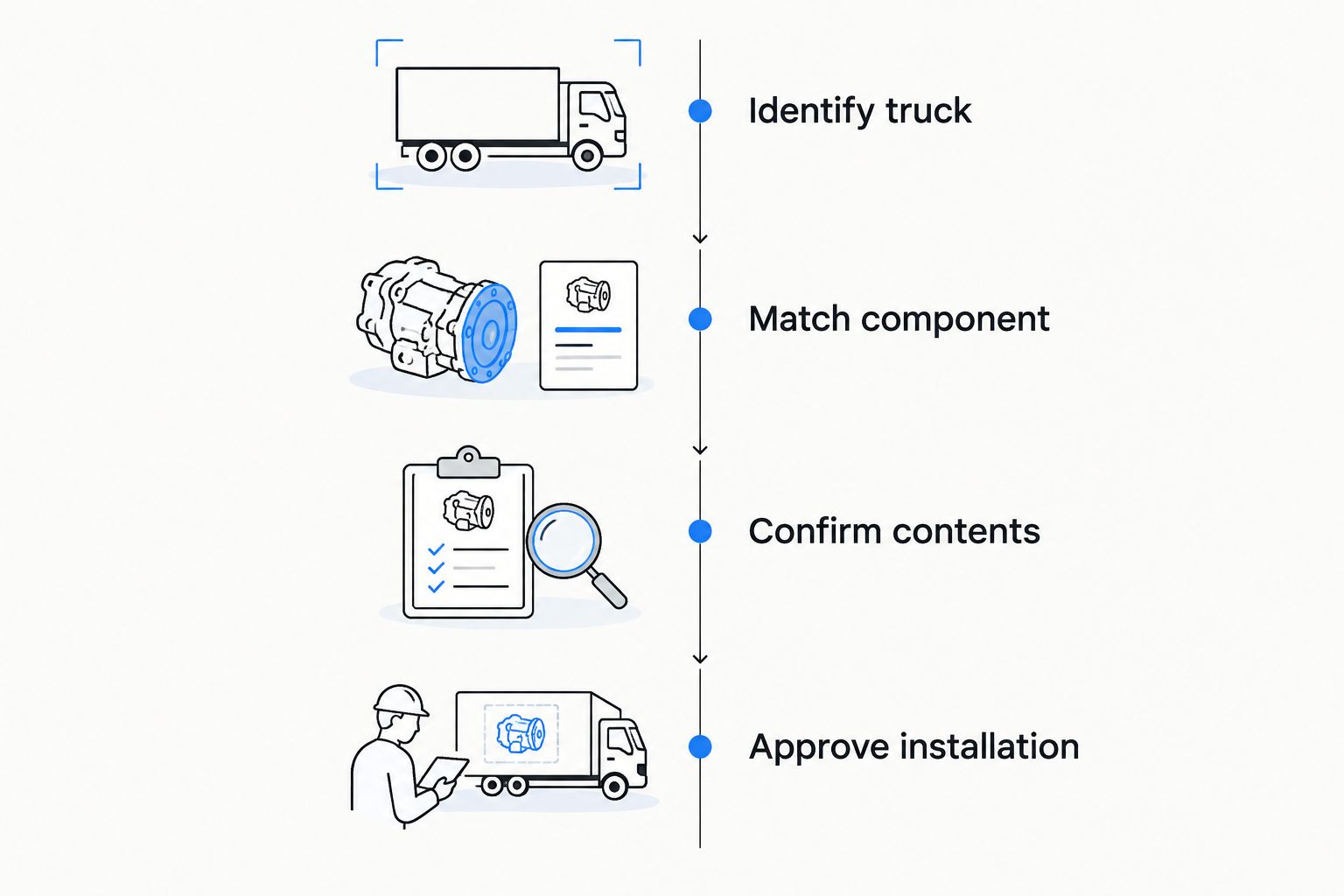
Use this sequence before authorizing a 2026 replacement:
- Identify truck: Record the truck identification and current engine details.
- Match component: Compare the offered unit's identifiers with service information.
- Confirm contents: List included parts and required transfers.
- Approve installation: Have the installer sign off on the replacement plan.
The supplied bench-tested ECM examples below illustrate the level of identification to bring into that process. They are different applications, not interchangeable recommendations. Choose only after your installer confirms the relevant match.


Pricing: compare the transaction, not just the component
For both suppliers, organize the comparison around the particular item's purchase terms. Separate the component, any applicable core arrangement, freight, installation preparation, and programming. Do not assume that either company uses identical terms across engines, transmissions, and electronic modules.
An outright purchase and a core-based exchange create different obligations. An outright purchase avoids a core-return requirement only when the written agreement says so. A core arrangement requires you to understand acceptance criteria, return responsibility, and the credit conditions before committing.
For a 2026 buying decision, ask each seller to specify:
- The exact unit covered by the offer.
- Any applicable core obligation and acceptance requirements.
- Which transport and unloading responsibilities belong to you.
- Which accessories, preparation, and programming are excluded.
- How changes to the agreed assembly affect the transaction.
Predictability comes from a complete written scope, not from a supplier name. Flexibility helps when you need a different assembly configuration, but obtain revised terms before changing the order.
Give your installer both offers in the same format. That prevents a supplier comparison from becoming a comparison between two different repair plans.
Neither supplier wins on protection without written terms
Purchase protection is an item-level decision. Obtain the applicable warranty or coverage terms, exclusions, return conditions, and claim procedure before choosing either supplier. A verbal assurance does not tell your shop how to handle a disputed failure.
Clarify the distinction between a defective component and an incorrect application. Also ask how installation requirements, programming, fluids, and transferred accessories affect coverage. Record the answers with the order rather than relying on a later conversation.
Your mechanic should know what documentation to retain during installation. Photographs, identification records, and the completed work order support a clear account of what was installed and how the job was performed.
Treat this dimension as unresolved until you can compare written terms. Do not award either business a warranty advantage based on assumptions or a general impression of customer service.
Final verdict: choose the offer that clears your repair checklist
Choose Diesel Engine King if you are an identified-parts buyer
Best for: owner-operators and independent repair shops seeking used diesel engines and heavy-truck parts by model or part number. Choose the supplier when the selected listing matches the diagnosis, the condition evidence addresses your mechanic's questions, and the written terms fit the job.
Its useful starting point is the specific component description. Its limit is equally clear: you still need installation approval. Do not turn a matching part number into an assumption about programming, assembly contents, or coverage.
Choose Vander Haag's if its particular offer closes more gaps
Best for: fleet managers and repair shops whose replacement requires a better-matched assembly or a more useful inspection arrangement. Choose Vander Haag's when its offer provides those advantages in writing and your installer approves the component.
The competitor wins through better evidence or a better repair match—not because a broader reputation settles the purchase. Apply the same condition, compatibility, and transaction checks before committing.
For 2026, use this scorecard to keep the decision tied to the actual job:
| Dimension | Winner |
|---|---|
| Defined used-engine and heavy-truck parts search | Client supplier, when its listing matches the required component |
| Part identification | Offer with the verified matching identifiers |
| Testing evidence | Offer with the more relevant unit-specific documentation |
| Assembly completeness | Vander Haag's, when its documented contents better match the work order |
| Inspection arrangement | Vander Haag's, when its arrangement better meets the mechanic's requirements |
| Installation compatibility | Tie: both require installer approval |
| Transaction terms | Offer with the clearer complete scope |
| Purchase protection | Tie until written terms establish a difference |
FAQ
Is Diesel Engine King better than Vander Haag's?
Diesel Engine King fits buyers seeking used diesel engines and heavy-truck parts by model or part number; Vander Haag's is the better choice when its specific offer better matches the repair. Compare the actual unit, condition evidence, assembly contents, and written terms before choosing.
Which supplier should I choose for a used truck engine in 2026?
Choose the supplier whose documented engine matches your truck and your installer's replacement plan. Have the installer confirm mechanical configuration, controls, emissions compatibility, and assembly contents before authorizing the purchase.
Does a bench-tested ECM mean it is ready for my truck?
No, bench testing does not by itself establish vehicle compatibility or correct programming. Confirm the module identification and required calibration with the installer before fitting it.
What should I ask before buying a used diesel engine?
Ask for the engine identification, condition evidence, included-component list, and written purchase terms. Give that information to the mechanic responsible for installation and resolve application questions before ordering.
How do I compare the purchase terms from both suppliers?
Compare offers for the same repair scope, separating the component from any applicable core obligation, transport, preparation, and programming. Require each offer to identify the exact unit and explain exclusions.
Is a more complete replacement engine always better?
No, a more complete assembly is better only when its included components suit your installation. Your shop's plan to reuse existing accessories can make a different assembly the better match.
Can I choose an engine by the truck model alone?
No, the truck model alone does not establish engine compatibility. Verify the engine identification, mechanical configuration, electronic controls, and applicable service information with your installer.
One last thing
Ask the installer to write the replacement requirements before you ask either supplier to finalize an offer. This reverses the usual shopping process: the repair defines the component, instead of the component listing defining the repair.
Include the required identifiers, assembly contents, compatibility checks, and condition evidence in that request. A supplier response becomes much easier to evaluate when every answer has a defined question behind it.

