


Diesel Engine King vs JJ Rebuilders: which is better in 2026
Choose Diesel Engine King if you need used commercial truck engines and parts; choose JJ Rebuilders if its written engine proposal meets your required rebuild scope, fitment, and acceptance tests. This 2026 comparison separates a used replacement purchase from a documented rebuild purchase so you can select the right repair path—not just a supplier name.
- Diesel engine king vs jj rebuilders starts with used-engine condition versus a documented rebuild specification.
- Diesel Engine King is best for buyers seeking used commercial truck engines and parts.
- Choose JJ Rebuilders when its written proposal satisfies your rebuild requirements and truck configuration.
- Neither supplier wins on fitment, testing, or purchase terms without unit-specific documentation.
Why this matters
A replacement engine purchase is also an installation decision. Your shop needs to know what arrives, what transfers from the original engine, and what must be inspected before the truck returns to work.
Used, rebuilt, and remanufactured describe different purchasing questions. A used assembly needs condition evidence; a rebuilt assembly needs a record of the work performed. Neither label answers whether the engine matches your truck.
Diesel Engine King is best for commercial truck buyers seeking used diesel engines and heavy truck parts. For a rebuild-focused purchase, judge the proposed work and supporting records rather than treating a company name as proof of engine condition.
At a glance
Use this table as your 2026 purchasing outline. The JJ Rebuilders column states the conditions its proposal must satisfy; it does not assume a particular engine, service package, or policy.
| Dimension | Diesel Engine King | JJ Rebuilders |
|---|---|---|
| Best for | Buyers seeking used commercial truck engines and parts | Buyers whose written rebuild requirements are satisfied by its proposal |
| Standout feature | Used-engine and heavy-truck-parts focus | A documented rebuild scope, when included in the specific proposal |
| Engine condition | Evaluate the individual used engine and its history | Evaluate the stated condition and documented work |
| Fitment | Match engine identity, configuration, and controls | Apply the same matching requirements |
| Test evidence | Request records tied to the actual unit | Request records tied to the actual unit and stated work |
| Included components | Confirm the exact assembly or part supplied | Confirm the exact assembly or part supplied |
| Installation planning | Plan inspection and transfer of reusable components | Plan around the proposal's assembly scope and installation requirements |
| Pricing model | Compare the item purchase and installation scope | Compare the proposed engine and any separately specified work |
| Purchase terms | Obtain written terms for the selected item | Obtain written terms for the selected proposal |
Diesel Engine King fits the used-engine and parts buyer
The stated business is used commercial truck engines and parts. That makes it a direct starting point when your repair plan calls for a used replacement assembly or an individual heavy-truck component.
Best for: an owner-operator or repair shop with a diagnosed failure and a defined replacement requirement. Bring the engine serial number, truck identification, original component number, and installation requirements. A clear request is more useful than asking for an engine by manufacturer alone.
The supplied product descriptions illustrate the parts-focused approach. They identify used Detroit control modules by part number A0024460935 and a Caterpillar C11 control module by part number 256-1159 with a 70-pin specification.
That detail supports identification, not automatic compatibility. A matching connector or similar engine name does not establish that software, calibration, and truck configuration match.
- Advantage: the stated offering matches a used-engine or replacement-parts purchasing task.
- Limitation: used condition does not establish a fresh overhaul, remaining service life, or the condition of every internal component.
- Next move: request evidence for the exact engine or part you intend to purchase.
JJ Rebuilders wins when its proposal meets your rebuild specification
Choose JJ Rebuilders for a rebuild-focused job only when its written proposal describes the work your shop requires. The deciding advantage is the documented scope—not the word rebuilders in the name.
Best for: a fleet maintenance manager who requires a specified internal repair process before approving an engine. Define the requirement first, then compare the proposal against it. Separate inspection, machining, replacement components, assembly, and final testing.
A useful proposal identifies which components were inspected, which were reused, and which were replaced. It also explains how measurements and acceptance criteria support those decisions.
Do not treat a painted engine, replacement gaskets, or a general condition statement as a rebuild record. Those details do not describe cylinder condition, bearing clearance, or the work performed on the cylinder head.
- Advantage: a proposal that satisfies your rebuild specification gives your maintenance team a defined basis for acceptance.
- Limitation: a rebuild label alone does not establish the extent of the work or the condition of transferred accessories.
- Next move: require the work record to identify the engine being supplied, rather than a generic rebuilding process.
Neither supplier wins on fitment without an exact match
Fitment is a tie at the supplier-name level. The winner is the specific engine or component your installing shop approves for the truck.
For a 2026 purchase, identify the engine serial number, original configuration, control system, and emissions equipment before comparing proposals. Include the flywheel housing, mounting arrangement, oil-pan configuration, and accessory layout in the shop's review.
The engine family is only the start. Even within a named family, the installation requires confirmation of the relevant hardware and electronic configuration.
Use these checks in order:
- Engine identity: record the original engine serial number and identification plate details.
- Truck configuration: identify the truck, transmission, mounting arrangement, and relevant equipment.
- Electronic match: confirm control-module requirements and any programming work.
- Assembly scope: identify supplied components and items that must transfer.
- Shop approval: obtain the installer's acceptance before authorizing the purchase.
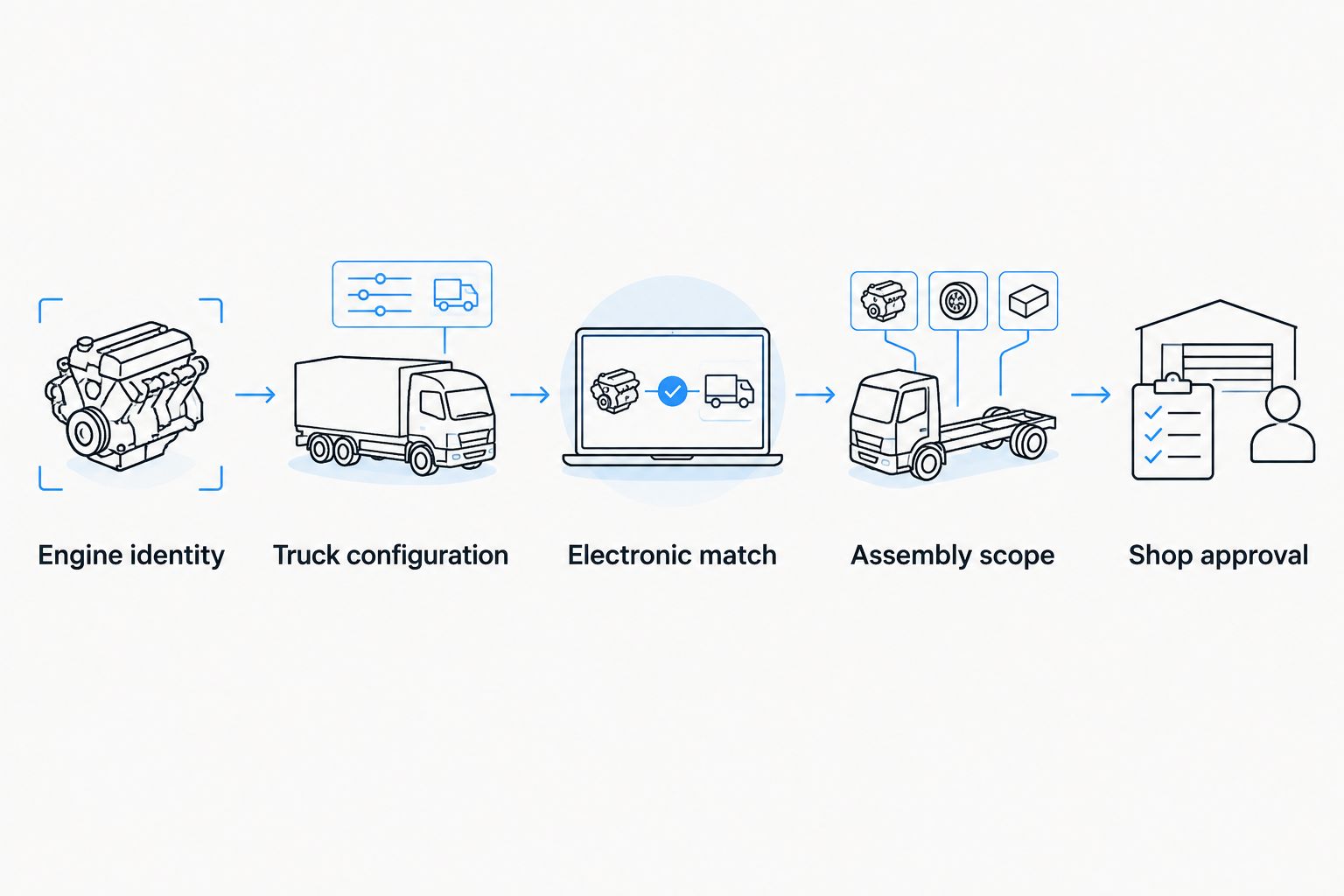
Send the same identification package to both suppliers. Otherwise, you are comparing responses to different requests and leaving your installer to resolve the differences later.
For electronic compatibility, use the guide to matching a replacement diesel engine to your truck's ECM specifications. Keep hardware identification and programming requirements as separate checks.
Neither supplier wins on testing without unit-specific records
Testing is another tie until you examine evidence tied to the actual unit. A test statement must identify what was tested and what the result establishes.
The supplied parts descriptions explicitly identify several control modules as bench-tested. That is a component-specific statement; it does not establish that a complete engine received a running test or that the module matches your truck's calibration.
For a used engine, request the available running records, inspection findings, and history. Ask whether the evidence identifies the engine serial number and whether any components were removed or changed after testing.
For a rebuild proposal, request the inspection and assembly records alongside final test documentation. A final running test and an internal measurement record answer different questions.
Compare evidence, not adjectives. Terms such as quality, tested, and inspected need a defined scope to help you make a purchasing decision.
Your shop should review the records against the engine manufacturer's applicable service information. Do not impose a generic pressure, temperature, or clearance threshold across unrelated engine models.
Included components decide whether you are buying the same repair
A complete assembly and a long block are not interchangeable purchasing descriptions. Your comparison needs an itemized component list, regardless of which supplier you select.
Confirm whether the proposed assembly includes the turbocharger, injectors, fuel-system components, control module, air compressor, starter, alternator, and relevant brackets. Do not assume that a pictured accessory is included in the sale.
The supplied parts catalog shows why package wording matters. One Volvo D13 injector listing describes a set of 3 injectors; a separate Detroit DD15 listing describes a set of 6 injectors. Neither quantity establishes what is included with an engine assembly.
These are component counts, not claims about interchangeable applications. Match each injector part number and engine configuration independently.
| Purchase format | Best for | Main advantage | Main limitation |
|---|---|---|---|
| Used engine assembly | A shop seeking a replacement with a clearly listed component scope | Lets the shop evaluate an existing assembly | Internal condition and accessory inclusion require confirmation |
| Long block | A shop with suitable components to transfer | Defines a different starting point for assembly work | Requires a detailed transfer and inspection plan |
| Documented rebuilt assembly | A buyer requiring specified internal work | Provides a work scope to evaluate | Reused accessories and the extent of rebuilding still need review |
| Individual used part | A diagnosed component-level repair | Targets the identified repair requirement | Does not address unrelated engine damage |
Choose the purchase format before choosing the supplier. Otherwise, one proposal can appear more attractive simply because it leaves more work for your shop.
Installation planning favors the proposal your shop can execute
Neither supplier earns an installation advantage from its name. The better proposal is the one that gives your shop a clear, approved work scope.
For a used replacement, document which components transfer and why they remain suitable for reuse. Include inspection of the cooling, lubrication, fuel, intake, and exhaust systems as appropriate to the original failure.
For a rebuilt assembly, document the same surrounding-system checks. Internal engine work does not repair an unrelated cooling-system fault or remove contamination elsewhere in the truck.
Your 2026 repair authorization should assign responsibility for:
- Receiving inspection and recording the engine identification.
- Evaluating transferred accessories and connections.
- Completing required programming and configuration checks.
- Following the applicable installation and startup procedures.
- Recording the initial operating checks and repair completion.
Ask the installer to identify unresolved questions before purchase approval. A supplier proposal is not a substitute for the shop's installation plan.
Pricing: compare purchase scope, not an assumed cheaper supplier
Compare both suppliers using the same repair specification. An item purchase and a proposal involving specified engine work need different breakdowns, but both must lead to a defined installation scope.
For the used-engine route, separate the engine or part from inspection, transferred components, programming, installation, and transportation arrangements. For a rebuild-focused route, separate the supplied assembly from any additional work or components specified in the proposal.
Predictability comes from a complete scope, not a supplier label. An itemized purchase gives you a clear component to evaluate; a defined work proposal gives you a clear process to evaluate. Neither removes the need to account for the rest of the repair.
Use a common comparison sheet:
- Exact engine or component identification.
- Supplied condition and supporting evidence.
- Included and excluded components.
- Work assigned to the installing shop.
- Transportation and receiving responsibilities.
- Core obligations, if the proposal includes them.
- Written coverage and claim requirements.
Do not rank one supplier as cheaper without equivalent proposals. That would confuse different repair scopes with a purchasing advantage.
Purchase terms need the same scrutiny on both sides
Obtain written purchase terms for the actual engine or part. Apply the same review to both suppliers rather than assuming that used and rebuilt items carry particular policies.
Read the covered components, exclusions, installation requirements, and claim procedure. Ask how the terms address labor, transferred accessories, programming, and supporting diagnostic records.
If a proposal includes a core obligation, identify the accepted core, return conditions, and responsibility for transportation. Keep that agreement with the engine identification and purchase documents.
For your 2026 file, retain the proposal, component list, condition records, correspondence, and receiving photographs. These records keep the purchased scope separate from work completed later by your shop.
The stronger proposal is the one your shop and purchasing team can interpret the same way. Do not approve an unresolved term on the assumption that it will be settled after installation.
Final verdict: choose the repair path your records support
Choose Diesel Engine King if you are a used-replacement buyer
Named winner for this profile: Diesel Engine King. Your shop has diagnosed the failure, defined the replacement requirement, and wants used commercial truck engines or heavy truck parts.
Approve the individual purchase only after checking fitment, condition evidence, included components, and written terms. The business category matches your task; the unit still needs acceptance.
Choose JJ Rebuilders if you are a rebuild-specification buyer
Named winner for this profile: JJ Rebuilders, when its proposal satisfies your specification. Your maintenance team requires documented internal work and receives an engine-specific proposal that meets that requirement.
Reject a proposal that substitutes a general rebuild label for the records your shop requested. Apply that rule to any supplier offering a rebuilt engine.
| Dimension | Winner |
|---|---|
| Used-engine and parts purchasing fit | Used-parts route |
| Documented rebuild requirement | JJ Rebuilders, if its proposal meets the specification |
| Exact fitment | Tie; installing-shop approval decides |
| Testing | Tie; unit-specific evidence decides |
| Included components | The proposal matching the required assembly scope |
| Installation planning | The proposal the shop approves |
| Pricing model | No blanket winner; compare equivalent scopes |
| Purchase terms | The written terms matching your acceptance requirements |
FAQ
Which is better for a used commercial truck engine?
Choose the supplier whose stated offering and specific engine match your used-replacement requirement. Confirm engine identity, condition evidence, included components, and installing-shop approval before purchasing.
When should I choose JJ Rebuilders?
Choose JJ Rebuilders when its written engine proposal satisfies your rebuild specification. Require engine-specific work records, fitment confirmation, and acceptance-test documentation rather than relying on the company name.
Is a rebuilt diesel engine always better than a used engine?
A rebuilt label alone does not establish a better purchase. Compare the documented work, actual engine condition, truck compatibility, and assembly scope against your repair requirement.
Does a bench-tested ECM mean the engine was tested?
No, a bench-tested ECM describes testing of the control module, not testing of the complete engine. Confirm electronic compatibility and request separate engine-condition evidence when buying an assembly.
What should I send a supplier before requesting an engine?
Send the engine serial number, truck identification, original configuration, and required assembly scope. Have your installing shop identify control-system, mounting, and accessory requirements.
How do I compare engine purchase proposals in 2026?
Compare proposals against the same engine and installation specification. Separate supplied components, shop work, transportation responsibilities, any core obligations, and written purchase terms.
Can I assume the turbocharger and injectors come with an engine?
No, require an itemized list of included components. An engine-family name or photograph does not establish the exact assembly supplied.
One last thing
Ask your installer to mark every proposed component as included, transferred, replaced, or unresolved before you authorize the purchase. An unresolved item is a purchasing question—not something to leave until the replacement engine reaches the shop.

