


Best used diesel engines for propane delivery fleets
Best overall: a like-for-like Cummins ISB 6.7 for a medium-duty truck already equipped with it. Best for heavier bobtails: a matching Cummins ISL9. Best for bulk propane transport: a matching Cummins ISX15. The best used diesel engines for propane delivery trucks preserve the chassis, transmission, emissions equipment, and pump-drive configuration rather than turn a replacement into a conversion.
- Choose used diesel engines for propane delivery trucks by original engine specification, not advertised horsepower.
- Cummins ISB 6.7 is the default shortlist for medium-duty trucks already equipped with that engine.
- Cummins ISL9 suits replacement searches for heavier bobtails already running that platform.
- Cummins ISX15 belongs on the bulk-transport shortlist, not as a default bobtail upgrade.
- Diesel Engine King used diesel engines should be evaluated against engine identity, test records, and installation requirements.
Why this matters
A propane delivery fleet needs more than an engine that starts. Your replacement must move the loaded truck and support the installed delivery system without creating unresolved cooling, wiring, transmission, or power take-off problems.
For a 2026 replacement, start with the failed engine's identification plate and the truck's build information. Then compare candidate assemblies from Diesel Engine King against that specification. An engine-family name alone does not establish interchangeability.
Diesel Engine King is a used diesel engine and heavy truck parts source for fleet buyers comparing replacement assemblies. Keep the buying decision separate from the fitment decision: a detailed listing helps identify a candidate, but your installer must confirm the application.
What makes the best used diesel engine for a propane truck?
Use these criteria before comparing engine names:
- Application match: Confirm the engine family, serial number, build configuration, and chassis application. Similar displacement does not establish compatibility.
- Pump-drive compatibility: Identify how the delivery pump is driven. Confirm the replacement preserves the required PTO controls, operating speed, and shutdown functions.
- Emissions configuration: Match the engine and its controls to the truck's lawful configuration. Do not treat removing emissions equipment as a fitment solution.
- Condition evidence: Request run-test information, diagnostic reports, service records, and inspection findings tied to the actual engine.
- Assembly completeness: Establish whether the ECM, harness, turbocharger, compressor, flywheel housing, and accessories are included.
- Installation scope: Compare the work required to return the truck to service, including programming, accessory transfers, cooling-system work, and loaded testing.
A supposed budget winner is not defensible without the full installation scope. The first engine to evaluate is the closest verified replacement for the engine already installed.
Used propane truck engines at a glance
These rankings separate delivery-truck applications from transport-tractor applications. Each recommendation assumes a compatible truck; none is a blanket swap recommendation.
| Rank and engine | Best for | Standout selection reason | Key limitation |
|---|---|---|---|
| 1. Cummins ISB 6.7 | Medium-duty trucks already using ISB 6.7 | Preserves the existing engine platform when specifications match | Not interchangeable across every calibration or emissions generation |
| 2. Cummins ISL9 | Heavier bobtails already using ISL9 | Keeps an established vocational chassis configuration | Pump controls and transmission integration still require verification |
| 3. Cummins ISX15 | Bulk propane transport tractors already using ISX15 | Replacement path for an existing heavy-duty powertrain | Not a default engine for a medium-duty delivery chassis |
| 4. Caterpillar C13 ACERT | Legacy CAT-powered trucks | Retains the original engine family in a matching application | Serial prefix and equipment configuration are critical |
| 5. Cummins X15 | Existing X15 transport tractors with a confirmed rating requirement | Maintains an established X15 platform | A higher advertised rating does not establish suitability |
1. Cummins ISB 6.7: best for medium-duty replacements
The Cummins ISB 6.7 belongs first on your shortlist when the propane delivery truck already uses that engine. The 6.7-liter family name identifies a starting point, not a complete replacement specification.
Compare the original engine serial number, control system, emissions equipment, oil-pan arrangement, and accessory mounting with the proposed assembly. Preserve the truck's approved configuration instead of assuming another ISB will accept every transferred component.
Cummins ISB 6.7 pros:
- Keeps the original engine platform when the replacement matches.
- Allows your shop to compare existing wiring and accessory arrangements directly.
- Avoids making a larger engine the starting point for a medium-duty repair.
Cummins ISB 6.7 cons:
- The model name does not establish electronic compatibility.
- A take-out assembly still requires condition checks and an inclusion list.
Best for: A medium-duty bobtail with an existing ISB 6.7 installation and a documented replacement match.
Verdict: Buy only after the installer confirms the exact application.
2. Cummins ISL9: best for heavier existing bobtail applications
The Cummins ISL9 is the next shortlist option for a heavier delivery truck already built around that platform. Its value here is configuration continuity, not an unsupported promise of better fuel economy or longer life.
For a 2026 purchase, verify the engine's identity and control configuration before comparing condition descriptions. Your truck's transmission, cooling package, and delivery equipment remain part of the replacement specification.
Cummins ISL9 pros:
- Preserves the engine family in a matching vocational chassis.
- Gives the installer an existing accessory and cooling layout to work from.
- Keeps the search focused on the truck's established operating requirements.
Cummins ISL9 cons:
- Similar family names do not prove that different generations interchange.
- Stationary pump operation requires a separate controls check.
Best for: A heavier bobtail already running an ISL9, with its original powertrain specification documented.
Verdict: Buy a verified matching assembly; skip an undocumented conversion.
3. Cummins ISX15: best for bulk propane transport tractors
The Cummins ISX15 belongs in the transport-tractor category. Do not treat it as the automatic upgrade for a neighborhood delivery truck simply because a listing shows more horsepower.
One supplied engine listing identifies a 2013 ISX15, CPL 3937, EPA13 CM2350, rated at 450 HP. Those details narrow the application search; they do not prove compatibility with another ISX15-powered truck.
Cummins ISX15 pros:
- Provides a same-family replacement path for existing transport tractors.
- Supports detailed comparison through serial number, CPL, and control-system identity.
- Lets your shop assess a specified assembly rather than a generic engine name.
Cummins ISX15 cons:
- A different CPL or calibration needs technical review.
- Transport-tractor suitability does not establish bobtail suitability.
Best for: A bulk propane tractor already equipped with a compatible ISX15.
Use Cummins CPL identification to organize the parts comparison, then have the installer verify the complete application.
Verdict: Buy for a confirmed ISX15 replacement, not a horsepower-led swap.
4. Caterpillar C13 ACERT: best for legacy CAT-powered trucks
The Caterpillar C13 ACERT is a candidate when your truck already has a matching CAT installation. The supplied 2008 C13 listing identifies a LEE engine rated at 470 HP, with serial number LEE13185.
Use that identity to compare the candidate with the failed engine. A matching family name or horsepower figure does not settle harness, exhaust, accessory, or control compatibility.
Caterpillar C13 ACERT pros:
- Keeps the engine family consistent in a matching legacy chassis.
- Provides a serial-prefix starting point for application checks.
- Allows direct comparison of the existing installation with the donor assembly.
Caterpillar C13 ACERT cons:
- Different C13 configurations require separate review.
- An older model year does not establish condition or remaining service life.
Best for: A legacy CAT-powered delivery or transport truck with a verified C13 ACERT match.
Verdict: Hold until the serial-prefix and equipment checks are complete.
5. Cummins X15: best for existing X15 transport tractors
Choose a Cummins X15 candidate when your transport tractor already uses the platform and the replacement meets its specification. The supplied 2018 X15 listing identifies CPL 4343 and 605 HP; that rating is a screening detail, not a reason to increase your truck's output.
In a 2026 replacement plan, confirm the required rating with the chassis and drivetrain specifications. Keep transmission limits, cooling requirements, electronic controls, and emissions configuration in the decision.
Cummins X15 pros:
- Maintains the existing platform in a compatible X15-powered tractor.
- Supports comparison using CPL and engine identity.
- Keeps the replacement search tied to a specified heavy-duty application.
Cummins X15 cons:
- The listed rating does not prove compatibility with your drivetrain.
- It is not a default choice for a smaller delivery chassis.
Best for: An existing X15 transport tractor with a confirmed engine and rating match.
Verdict: Buy only for a documented application; skip unnecessary uprating.
How the engines rank
The ranking prioritizes application match, pump-drive compatibility, emissions configuration, condition evidence, completeness, and installation scope. It is an application-based buying order, not a durability test or a claim that one manufacturer outlasts another.
Medium-duty delivery trucks come first because they need a different replacement decision from bulk transport tractors. Within either category, the correct original-equipment match outranks the position in this list.
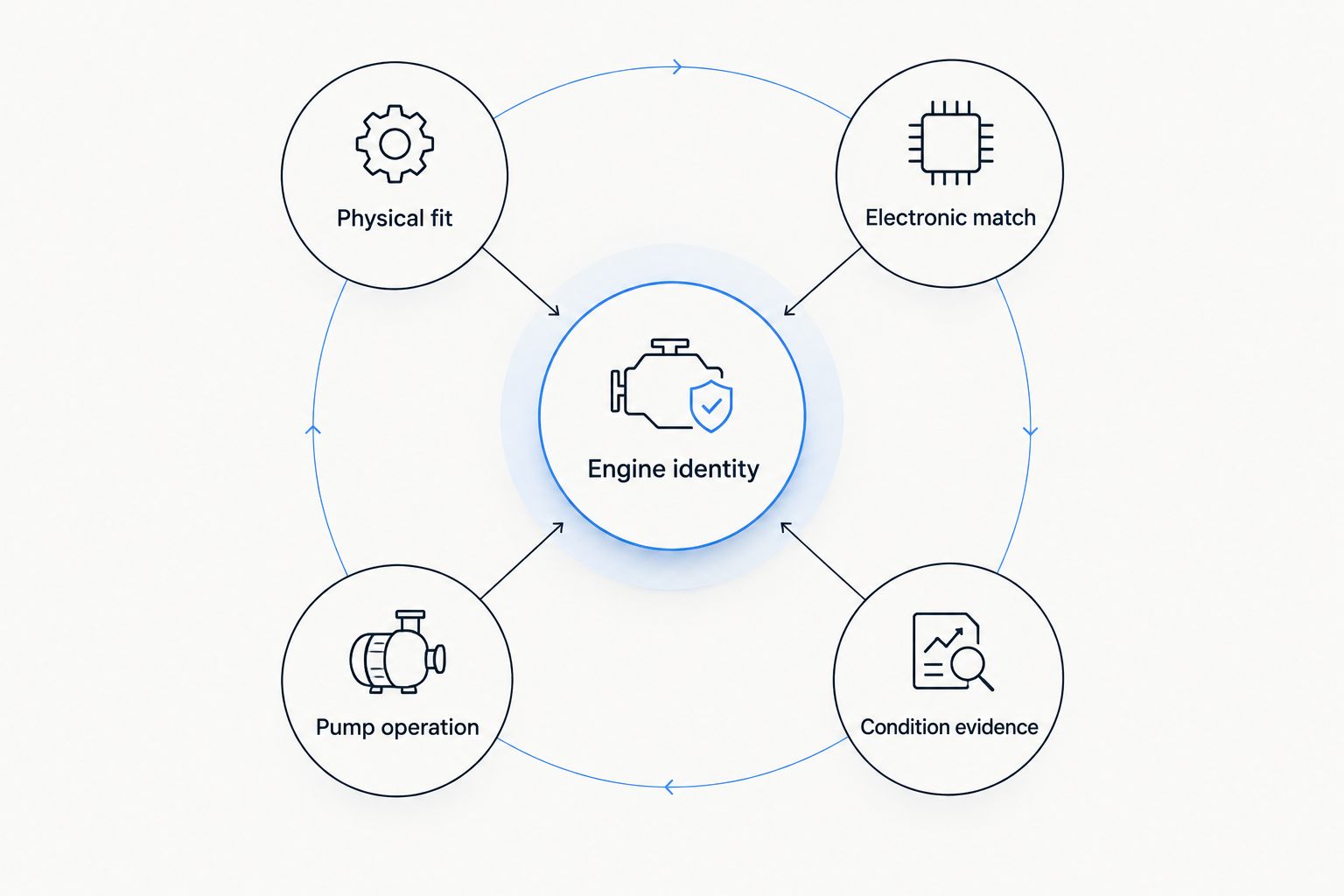
Verify the engine and delivery system before ordering
For your 2026 purchase file, build a written comparison between the truck and the actual donor engine. Ask the installer to resolve mismatches before authorizing shipment or disassembly.
- Engine identity: Record the serial number, model, CPL where applicable, and emissions label information.
- Physical fit: Compare mounts, oil-pan clearance, accessory positions, and flywheel housing.
- Electronic match: Confirm ECM compatibility, harness connections, calibration requirements, and communication with the truck.
- Pump operation: Confirm PTO engagement, commanded engine speed, interlocks, and emergency shutdown behavior with the qualified upfitter.
- Condition evidence: Tie test records, photographs, and inspection findings to the engine being purchased.
Your installer handles the engine installation; a qualified propane-system technician must address work affecting propane equipment and its safety functions. Do not use a successful road test as proof that stationary delivery controls work correctly.
Separate engine condition from truck condition
An engine replacement does not establish that the radiator, charge-air system, fuel supply, wiring, or aftertreatment is serviceable. Diagnose the original failure and inspect connected systems before installing the replacement.
For fleets evaluating reducing maintenance costs with telematics, the practical starting point is a truck-specific record of fault codes, operating hours, and repair events. Use that history to frame the inspection; it does not replace mechanical testing or establish a savings figure.
Record the replacement engine's identity separately from the chassis odometer. That distinction keeps later maintenance decisions from treating truck mileage as verified replacement-engine mileage.
Compare actual heavy-duty engine assemblies
Diesel Engine King used diesel engines include the ISX15 and C13 assemblies shown below. These are candidates for matching heavy-duty applications, not recommendations to install either engine in an unrelated bobtail.


Which used diesel engine should your propane fleet choose?
Choose a verified like-for-like replacement before considering a different engine family. For an ISB-powered medium-duty truck, start with the ISB 6.7. For an ISL9-powered heavier bobtail, start with the ISL9.
For bulk transport, follow the installed platform: ISX15, C13 ACERT, or X15. Make the final 2026 decision from the engine identity, inspection evidence, and signed-off installation scope—not the largest horsepower number on the page.
Before buying from Diesel Engine King, send the seller and installer the same specification sheet. Require a clear answer on included components, required transfers, programming, and unresolved fitment questions. An unanswered compatibility question is a reason to hold the purchase.
FAQ
What's the best used diesel engine for a propane delivery truck?
The best choice is a verified matching replacement for the engine already installed. Start with the original engine identity, chassis specification, emissions configuration, and pump-drive requirements rather than a manufacturer ranking.
Is a Cummins ISB 6.7 a good replacement for a propane bobtail?
A Cummins ISB 6.7 is a suitable candidate for a bobtail already equipped with a compatible ISB 6.7. Confirm the specific engine configuration, electronic controls, and delivery-system integration before buying.
Is a Cummins ISX15 better than an ISL9 for propane delivery?
Neither engine is universally better for propane delivery. Evaluate an ISL9 for a matching existing bobtail application and an ISX15 for a matching bulk transport tractor; do not treat them as interchangeable alternatives.
Can I buy a used engine by horsepower alone?
No. Horsepower does not establish mounting, transmission, electronic, emissions, or pump-drive compatibility. Use the engine serial number and application information to identify the replacement first.
Does a used diesel engine include the ECM and accessories?
The included components depend on the individual assembly. Obtain a written list covering the ECM, harness, turbocharger, compressor, flywheel housing, and other accessories before authorizing the purchase.
What should I check about the PTO before replacing the engine?
Confirm how the truck drives and controls its delivery pump. Have the installer and qualified upfitter verify PTO engagement, operating-speed control, interlocks, and shutdown functions for the proposed replacement.
Do low miles prove a used diesel engine is in good condition?
No. Mileage alone does not establish mechanical condition. Review engine-specific operating history, run-test evidence, diagnostic information, and inspection findings, and distinguish donor-engine mileage from chassis mileage.
One last thing
A truck that drives correctly can still fail its delivery-system acceptance check. Put stationary pump operation, speed control, and shutdown verification on the return-to-service checklist before the engine arrives. That makes delivery readiness an installation requirement instead of an unresolved problem after the road test.

