


Best turbochargers for Cummins ISX15 engines
Best overall: a new, exact-match original-equipment VGT. Best for a documented rebuild: a remanufactured OE VGT. Best for an independent replacement: an application-verified aftermarket VGT. Best for a used-parts repair: a tested OE take-out. This 2026 guide ranks the best turbochargers for Cummins ISX15 engines by fit, actuator compatibility, condition evidence, and installation requirements—not advertised power gains.
- The best turbochargers for Cummins ISX15 engines match the engine serial number, turbo assembly number, and actuator requirements.
- A new, exact-match OE VGT is the default choice for a stock commercial truck.
- Remanufactured and used turbochargers require condition evidence tied to the actual assembly.
- Diesel Engine King serves used commercial truck engine and parts buyers; identify the failed component before ordering replacements.
Why this matters
An ISX15 turbocharger is part of the engine's air-management system, not an isolated bolt-on accessory. Variable-geometry turbocharger operation interacts with boost control, exhaust pressure, and emissions-system operation. A housing that bolts onto the manifold does not establish compatibility.
Diesel Engine King supplies used commercial truck engines and parts. For an ISX15 repair, start with the engine identification and failure diagnosis before choosing between new, remanufactured, aftermarket, and used turbochargers.
The correct replacement restores the specified configuration; a different turbo is not an upgrade merely because it is larger. Keep that rule at the center of your 2026 repair decision.
What makes the best ISX15 turbocharger?
Use these criteria before comparing replacement routes:
- Verified application: Match the engine serial number and current turbo assembly number through the applicable parts information. Truck model alone is insufficient.
- Actuator compatibility: Establish whether the actuator is included, which actuator the assembly requires, and what installation or calibration procedure applies.
- Original operating configuration: Preserve the engine's specified air handling, emissions equipment, and control strategy.
- Condition evidence: Request inspection and test documentation appropriate to a new, remanufactured, or used assembly.
- Complete installation scope: Identify the required gaskets, fasteners, oil connections, coolant connections where applicable, and service procedures.
- Failure correction: Repair the oil-supply, contamination, intake, exhaust, or electrical problem that caused the original fault before returning the truck to work.
Treat the CPL as supporting identification, not the entire order specification. The guide to identifying Cummins engine parts by CPL number explains that identification step.
ISX15 turbocharger options at a glance
These rankings compare replacement routes, not interchangeable part numbers. Every route still requires application verification for your specific engine.
| Rank and option | Best for | Standout feature | Key limitation |
|---|---|---|---|
| 1. New exact-match OE VGT | Restoring a stock working truck | Original-equipment specification verified to the application | Actuator inclusion and installation requirements still need confirmation |
| 2. Remanufactured OE VGT | Buyers who require a documented remanufacturing process | Reconditioned OE assembly with an identifiable rebuild scope | The word remanufactured does not describe every supplier's process |
| 3. Application-verified aftermarket VGT | Shops evaluating an independent replacement | A non-OE replacement selected against the required application | Cross-reference and control compatibility need separate verification |
| 4. Tested used OE VGT | Buyers deliberately selecting a take-out assembly | An identifiable original-equipment unit | Prior service history and remaining life are uncertain |
1. New exact-match OE VGT: best for stock truck repairs
A new original-equipment variable-geometry turbocharger is the default recommendation when your objective is restoring the engine's specified operation. Select the assembly using the engine serial number and current service-part information, including any documented supersession.
For a stock commercial truck in 2026, this route keeps the selection focused on the original application rather than an unsupported performance claim. New condition does not eliminate the need to verify the actuator and installation procedure.
New OE VGT pros:
- Provides a new assembly rather than a previously operated rotating unit.
- Keeps the repair centered on the original-equipment application.
- Allows part-number verification against the engine's service information.
New OE VGT cons:
- Does not correct an external oil-supply restriction or charge-air leak.
- Does not establish that an actuator comes with the assembly.
- Still requires the prescribed installation and setup checks.
Best for: An owner-operator or fleet restoring a stock ISX15 after a confirmed mechanical turbo failure.
Verdict: Buy the new exact-match OE VGT when application verification and a return to stock operation are the priorities.
2. Remanufactured OE VGT: best for a documented rebuild
A remanufactured original-equipment VGT reuses an OE assembly through a rebuilding process. Evaluate the actual process: cleaning, component inspection, replacement criteria, rotating-assembly balancing, and variable-geometry checks should be described rather than assumed.
Ask how the supplier verifies the completed turbocharger and handles the actuator. A remanufactured mechanical assembly and a complete, setup-ready turbo-and-actuator package are different purchase scopes.
Remanufactured OE VGT pros:
- Retains an identifiable OE assembly and application reference.
- Gives you a rebuild process to evaluate through written documentation.
- Supports replacement of worn components when included in the stated scope.
Remanufactured OE VGT cons:
- Rebuild scope differs between suppliers.
- A painted housing does not demonstrate internal condition.
- Actuator replacement, testing, or setup is not established by the remanufactured label.
Best for: A maintenance shop that requires an OE-based assembly and documented remanufacturing details.
For a 2026 purchase, request documentation for the offered unit or product line, not a general statement that every turbo is rebuilt properly. Confirm what the test covers.
Verdict: Buy the remanufactured OE VGT only after the rebuild scope and final verification are documented.
3. Application-verified aftermarket VGT: best for independent sourcing
An aftermarket VGT is a replacement supplied outside the OE service-parts route. Judge the individual assembly by its application documentation, construction information, actuator requirements, and installation instructions—not the aftermarket label alone.
Require a cross-reference to the service assembly your engine needs. A broad description such as ISX15 replacement does not establish the required turbine housing, mounting arrangement, actuator interface, or operating compatibility.
Aftermarket VGT pros:
- Provides an independent replacement route for a verified application.
- Gives a shop another assembly to evaluate against the original specification.
- Allows comparison of documented assembly and actuator scope.
Aftermarket VGT cons:
- A matching flange does not prove operating compatibility.
- Product documentation must establish more than engine-family fitment.
- Unsupported performance claims do not demonstrate durability or emissions compliance.
Best for: A repair shop prepared to verify the exact aftermarket assembly and its control requirements.
Do not substitute an unrelated fixed-geometry conversion for a stock VGT repair. Changing the air-management configuration requires engineering and legal review; it is not an equivalent replacement decision.
Verdict: Hold until the aftermarket VGT has a verified cross-reference and clear installation requirements.
4. Tested used OE VGT: best for a take-out repair
A used original-equipment VGT is a previously operated assembly removed from another engine. Its part number, donor information, physical condition, and test evidence matter more than an unsupported description such as good used.
Diesel Engine King serves used commercial truck engine and parts buyers. Apply the same identification discipline to any used turbo purchase: get photographs of the actual assembly and written details of what was inspected or tested.
Used OE VGT pros:
- Provides an original-equipment assembly with an inspectable identification tag.
- Allows comparison of the actual housing, connections, and actuator arrangement.
- Supports a deliberate take-out repair when condition evidence is adequate.
Used OE VGT cons:
- Prior heat exposure, lubrication history, and contamination are not established by appearance.
- A freely turning shaft does not establish serviceable bearing clearances.
- Donor-engine operation does not establish remaining service life.
Best for: A buyer whose repair plan specifically accepts a used assembly and its condition uncertainty.
Use the manufacturer's inspection limits rather than a generic shaft-play rule. Bearing design and inspection conditions affect what movement means.
Verdict: Hold until the used OE VGT passes application and condition checks; skip undocumented take-outs.
Match the turbo before ordering
For your 2026 order, build a single identification record. Keep the engine information and removed turbo information together so the parts supplier and installer work from the same specification.
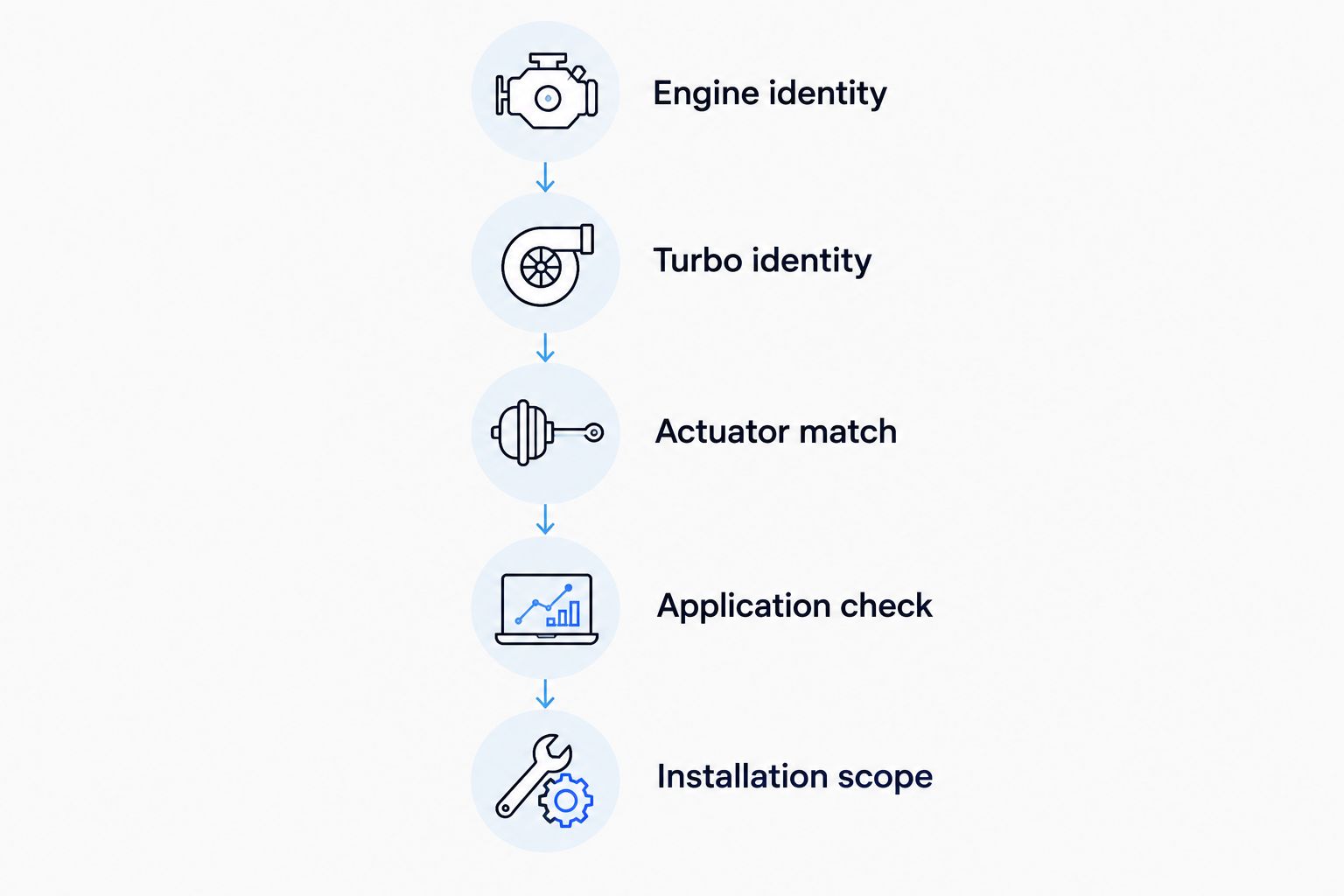
Follow this sequence:
- Engine identity: Record the engine serial number, CPL, and control-module designation.
- Turbo identity: Photograph the turbo identification plate and record the complete assembly number.
- Actuator match: Identify the installed actuator and establish the replacement assembly's requirements.
- Application check: Have the replacement or superseding assembly verified against the engine serial number.
- Installation scope: Confirm included components and the required service procedure before removal work starts.
Horsepower is supporting information, not a turbo part number. The Diesel Engine King engine catalog includes ISX15 examples rated at 400 HP, 450 HP, and 550 HP; those ratings alone do not establish which turbo assembly fits.
Likewise, CM2250 and CM2350 identify control-system families, not complete turbo ordering specifications. Keep the assembly number and serial-number lookup in the purchasing record.
Diagnose the fault before condemning the turbo
Low boost, smoke, poor response, and derate are symptoms—not proof that the rotating assembly has failed. Start with fault-code information and the engine-specific troubleshooting procedure.
Separate the checks into these groups:
- Air path: Inspect the intake, charge-air connections, hoses, clamps, and cooler for restriction or leakage.
- Exhaust path: Check for leaks and restrictions using the applicable diagnostic procedure.
- Control system: Inspect actuator wiring, connectors, communication, and commanded versus actual operation where supported.
- Lubrication: Inspect oil supply and drain conditions and investigate contamination or abnormal oil consumption.
- Mechanical assembly: Check wheel damage, housing contact, geometry movement, and clearances against service limits.
An actuator fault does not automatically require a complete turbocharger. Conversely, replacing an actuator does not repair damaged bearings or sticking internal geometry. Establish which component failed before authorizing parts.
Do not conduct an improvised compressed-air spin test. Use the approved inspection and diagnostic methods, with the engine secured and hot components allowed to cool.
How these replacement routes rank
The ranking prioritizes application certainty, actuator compatibility, condition evidence, and a return to the specified operating configuration. It does not rank unnamed assemblies by fuel savings, boost output, or service life.
New exact-match OE VGT leads because it combines new condition with an OE application reference. Remanufactured OE follows when the rebuilding process is documented; aftermarket and used assemblies need additional evidence specific to the offered replacement.
Which ISX15 turbocharger should you choose?
Choose a new, exact-match OE VGT for a stock working truck unless your repair plan establishes a documented reason to use another route. That is the default recommendation for 2026—not a claim that every engine uses the same turbo.
Choose remanufactured OE when the rebuild scope meets your requirements. Consider aftermarket only with application evidence, and choose used only when you accept its documented condition and uncertain remaining life.
FAQ
What's the best turbocharger for a stock Cummins ISX15?
A new, exact-match original-equipment VGT is the default choice for restoring a stock Cummins ISX15. Verify the assembly through the engine serial number and confirm actuator requirements before ordering.
Do all Cummins ISX15 engines use the same turbo?
No, the ISX15 engine name does not establish a single interchangeable turbocharger. Match the engine serial number, turbo assembly number, and applicable service-part information.
Is a remanufactured ISX15 turbo better than a used turbo?
A documented remanufactured assembly is the stronger choice when you require evidence of internal reconditioning. Compare the actual rebuild and test scope rather than relying on the condition label.
Can I reuse my existing ISX15 turbo actuator?
Reuse depends on actuator condition, compatibility, and the replacement turbo's service procedure. Have the installer verify those requirements rather than assuming the original actuator transfers directly.
Does low boost mean my ISX15 turbo is bad?
No, low boost alone does not prove turbocharger failure. Charge-air leaks, intake restrictions, exhaust faults, and control-system problems also require diagnosis.
Can I choose an ISX15 turbo by horsepower alone?
No, horsepower alone is insufficient to select an ISX15 turbocharger. Use the engine serial number and turbo assembly identification to verify the required replacement.
Should I install a larger turbo on my working truck?
Do not select a larger turbo as a routine replacement for a stock working truck. A different assembly requires verification of air handling, controls, emissions compliance, and the intended operating configuration.
One last thing
Write the original failure cause on the repair order beside the replacement turbo part number. If the diagnosis stops at failed turbo, the job has not explained why it failed. Correcting a restricted oil connection or damaged intake component protects the replacement in a way that choosing a different condition label cannot.

