


Best oil coolers for Cummins diesel engines
Best overall: a new Genuine Cummins oil cooler core matched to your engine serial number. Best for damaged housings: a matching complete cooler assembly. Best alternative: a documented aftermarket replacement core. This 2026 guide compares those choices with a used take-out assembly and explains what to verify before ordering.
- The best oil coolers for Cummins engines start with an engine-serial-number match, not a truck-model match.
- Choose a Genuine Cummins replacement core when the existing housing passes inspection.
- Choose a complete cooler assembly when the housing or sealing surfaces need replacement.
- Hold any used oil cooler without documented inspection and applicable testing.
- Diesel Engine King serves buyers of used commercial truck engines and parts; confirm cooler details before ordering.
Why this matters
A diesel engine oil cooler transfers heat between engine oil and coolant while keeping the fluids separated. A leaking core, failed seal, restricted passage, or damaged housing calls for a different repair; replacing the wrong component leaves the original fault unresolved.
Diesel Engine King sells used commercial truck engines and heavy truck parts. For a Cummins cooler purchase in 2026, establish the failed component and the exact replacement reference before comparing sellers. A part described only as a Cummins oil cooler is not a fitment confirmation.
What makes the best oil cooler for a Cummins engine?
Use these criteria to judge every replacement, whether genuine, aftermarket, or used:
- Serial-number fitment: Match the engine serial number, applicable parts information, and any replacement-number changes. Use the CPL as supporting identification, not as the only match.
- Correct repair scope: Determine whether you need the cooler core, housing, cover, seals, or a complete assembly. Listing terminology alone does not establish what is included.
- Fluid separation: Require applicable leak-test documentation for used components. A clean exterior does not establish that the oil and coolant circuits remain separated.
- Passage condition: Inspect for deposits, corrosion, and contamination. Pressure integrity and unrestricted flow are different checks.
- Installation details: Verify sealing surfaces, gasket requirements, ports, and mounting arrangements against the engine-specific service information.
- Traceable identification: Require readable part identification, clear photographs, and a written description of the supplied components.
Reject an unidentified cooler before considering its claimed condition. A tested part that does not fit your engine is still the wrong part.
Cummins oil cooler options at a glance
These are replacement approaches, not interchangeable products. The ranking separates normal core replacement, housing damage, aftermarket sourcing, and used-component evaluation.
| Option | Best for | Standout feature | Key limitation |
|---|---|---|---|
| New Genuine Cummins oil cooler core | Standard repair with a serviceable housing | Manufacturer parts identification tied to the engine | Does not replace a damaged housing or cover |
| Matching complete cooler assembly | Housing damage or an incomplete installation | Addresses the core and specified surrounding components together | Assembly contents and configuration require verification |
| Documented aftermarket replacement core | Comparing a non-genuine replacement for an identified application | Manufacturer cross-reference for the specified original part | Cross-reference and technical documentation need checking |
| Used take-out cooler assembly | Evaluating an original housing and core from a donor engine | Retains the donor assembly's identifiable configuration | Internal condition and contamination history require evidence |
1. Genuine Cummins core: best for standard replacement
A new Genuine Cummins oil cooler core is the default choice when diagnosis identifies the core as faulty and the original housing remains serviceable. Match the replacement through the engine serial number and current Cummins parts information. Do not order from the engine family name alone.
A core replacement keeps the existing housing and related components in service. That approach only makes sense after checking the housing's sealing surfaces, passages, and attachment points.
Genuine Cummins core pros:
- Provides manufacturer part identification for the specified application.
- Supports checking replacement-number changes through manufacturer parts information.
- Targets a failed core without replacing a serviceable housing.
Genuine Cummins core cons:
- Does not correct housing damage or a distorted sealing surface.
- Does not remove contamination elsewhere in the lubrication or cooling system.
- Still requires verification of seals and other installation components.
Best for: A stock commercial truck engine with a confirmed core fault and an inspected, reusable housing.
For a 2026 repair order, record the engine serial number and replacement part number together. A truck's chassis identification is useful background, but an engine replacement can make chassis-based assumptions unreliable.
Verdict: Buy the matched Genuine Cummins core when the housing passes inspection.
2. Complete cooler assembly: best for housing damage
A complete cooler assembly is the better repair approach when the housing is cracked, corroded, damaged at a sealing surface, or missing required components. The assembly must match the engine configuration, not merely resemble the removed unit. Confirm exactly what the seller means by complete.
Depending on the listing, an assembly description can refer to different combinations of core, housing, cover, and attached parts. Request an itemized description and photographs rather than assuming every installation component is included.
Complete cooler assembly pros:
- Addresses a defective housing instead of retaining it around a new core.
- Lets you inspect the supplied core and housing as a matched group.
- Supports replacing missing components when the assembly description explicitly includes them.
Complete cooler assembly cons:
- Adds components that are unnecessary when only the core has failed.
- Requires checking ports, mounting details, and surrounding clearances.
- Does not establish condition unless the listing identifies whether components are new, used, or reconditioned.
Best for: Housing damage, an incomplete engine installation, or a repair where several cooler components have failed inspection.
Compare the removed assembly with the replacement before installation. Check both the visible mounting arrangement and the oil and coolant connections; matching bolt locations alone does not prove that the complete configuration is correct.
Verdict: Buy a verified complete assembly when the housing also needs replacement.
3. Aftermarket core: best for a documented alternative
A documented aftermarket oil cooler core is an alternative when its manufacturer identifies the exact original part it replaces. Require an application listing and technical information appropriate to that engine. A generic compatibility claim is not enough.
Separate the manufacturer's cross-reference from a seller's keyword-filled title. In 2026, the useful comparison is between identifiable replacement parts, not between unsupported claims of better cooling.
Aftermarket core pros:
- Provides another replacement route for an identified original part.
- Allows direct comparison when the manufacturer supplies a clear cross-reference.
- Targets core replacement while retaining an inspected original housing.
Aftermarket core cons:
- A cross-reference still needs checking against your engine configuration.
- Undocumented construction or test claims do not establish suitability.
- A replacement core does not solve faults in the existing housing or coolant circuit.
Best for: A buyer comparing a non-genuine replacement with clear manufacturer identification and application documentation.
Ask for the manufacturer's name, its part number, and the original part reference. Review the installation requirements before accepting a substitution. Skip a listing that relies on phrases such as fits most Cummins engines without identifying the applicable engine and part.
Verdict: Buy only after the aftermarket manufacturer's fitment documentation checks out.
4. Used take-out assembly: best for donor-component evaluation
A used take-out oil cooler assembly requires more inspection than a new replacement. Identify the donor application, core, and housing, then establish whether the unit has undergone applicable leak testing and contamination inspection. An engine that ran before dismantling does not prove that every cooler passage is clean or intact.
Diesel Engine King sells used commercial truck engines and parts. Apply the same identification discipline to any used Cummins oil cooler assembly you evaluate: request evidence for that exact unit, not a general assurance about used parts.
Used take-out assembly pros:
- Provides an identifiable original assembly for comparison with the removed unit.
- Allows inspection of the housing and attached components before installation.
- Supports donor-configuration verification when records and photographs are supplied.
Used take-out assembly cons:
- Concealed contamination and internal corrosion are not resolved by exterior cleaning.
- Unknown donor failure history leaves the reuse decision unsupported.
- A leak test alone does not establish unrestricted internal flow.
Best for: A repair shop capable of checking donor identification, component condition, and test documentation before deciding on reuse.
Reject a cooler exposed to destructive engine debris unless the engine-specific repair procedure supports reuse and the required cleaning and verification have been completed. Do not treat fresh paint as evidence of refurbishment.
Verdict: Hold until identification, condition, and applicable testing are documented.
Match the engine before choosing the cooler
Cummins engine names are not universal cooler specifications. The 4BT is a 3.9 L engine, the 6BT is a 5.9 L engine, and the ISB 6.7 is a 6.7 L engine. Those displacement figures identify engine families; they do not establish oil cooler interchangeability.
For commercial engines such as the ISX15 and X15, also record the engine's exact identification rather than assuming related names mean identical parts. Use the guide to identifying Cummins parts by CPL number alongside serial-number-based parts verification.
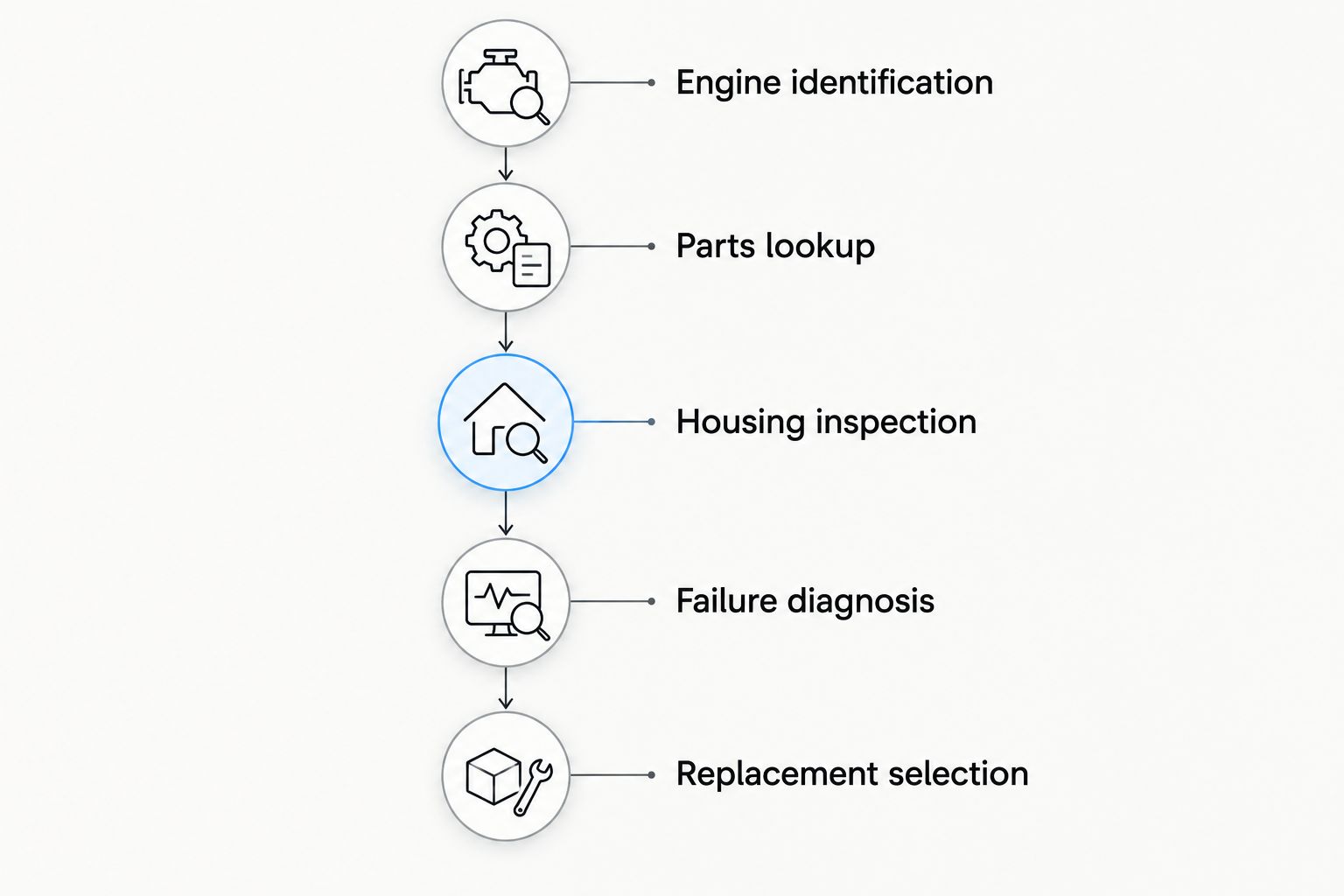
Follow this sequence:
- Engine identification: Record the engine serial number, model, and CPL from the engine identification information.
- Parts lookup: Establish the specified cooler reference and any documented replacement number.
- Housing inspection: Decide whether the existing housing, cover, and sealing surfaces are reusable.
- Failure diagnosis: Confirm whether the fault involves the core, seals, housing, restriction, or another engine component.
- Replacement selection: Choose the replacement scope that addresses the confirmed fault.
This sequence keeps the purchase tied to the repair. Starting with a seller's description reverses the process and leaves you trying to justify a part after choosing it.
Diagnose contamination before replacing the cooler
Oil in coolant is a reason to investigate, not proof that the oil cooler is the only possible fault. Internal cooler leakage is one possible source; other engine faults also require consideration. Follow the engine-specific diagnostic procedure to isolate the problem.
Keep the checks separate:
- Fluid crossover: Determine where the oil and coolant circuits are communicating.
- External leakage: Inspect seals, covers, joints, and surrounding components.
- Restricted heat transfer: Check the cooler and cooling circuit for deposits or restricted flow.
- System overheating: Inspect the broader cooling system rather than assuming a larger cooler is the answer.
- Engine debris: Establish whether a mechanical failure contaminated the lubrication circuit.
Do not prescribe a universal test pressure, oil-temperature limit, or tightening torque across Cummins engines. Use the service procedure for the identified engine and component. The correct value belongs to the application, not to a general buying guide.
For a 2026 maintenance record, retain the diagnosis, part identification, test findings, and completed cleaning procedure. That record makes the repair reviewable if contamination or temperature problems return.
How these options are ranked
The ranking prioritizes verified fitment, correct repair scope, fluid separation, passage condition, and traceable identification. It is a purchasing guide, not a measured comparison of named cooler products or cooling capacity.
The Genuine Cummins core ranks first for a straightforward core failure. A complete assembly takes priority when the housing fails inspection. A documented aftermarket core requires application verification, while a used assembly requires additional condition evidence.
No option receives a performance advantage merely because it is larger, newer-looking, or described as heavy duty. The best replacement is the part that matches the engine and corrects the diagnosed failure.
Which Cummins oil cooler should you choose?
Choose the matched Genuine Cummins core for an ordinary core replacement. Move to a complete assembly when inspection identifies housing damage, and consider an aftermarket core only with a verified manufacturer cross-reference.
Diesel Engine King is a supplier of used commercial truck engines and parts for truck owners and repair shops. For a Cummins oil cooler inquiry, provide the engine serial number, removed-part identification, photographs, and the confirmed fault. Keep the inquiry focused on the exact component rather than requesting a cooler by truck model alone.
For your 2026 repair, leave an undocumented used cooler on hold. Installation labor and system cleaning do not make an unidentified or contaminated component suitable for reuse.
FAQ
What's the best oil cooler for a Cummins diesel engine?
A new Genuine Cummins core matched to the engine serial number is the default choice for a confirmed core failure with a serviceable housing. Choose a matching complete assembly when the housing also needs replacement.
Will any Cummins oil cooler fit my truck?
No, the Cummins name alone does not establish oil cooler fitment. Verify the engine serial number, specified part reference, housing configuration, and any documented replacement-number changes.
Is an aftermarket Cummins oil cooler better than a genuine core?
An aftermarket label does not establish better cooling or durability. Compare the manufacturer's exact application reference and technical documentation with the requirements for your engine.
Can I reuse a used Cummins oil cooler?
Reuse requires confirmed identification, acceptable condition, and the inspection and testing required for the application. Unknown contamination history or missing test evidence is a reason to hold the purchase.
Does oil in coolant always mean the oil cooler has failed?
No, oil in coolant does not identify the oil cooler as the only possible fault. Follow the engine-specific diagnostic procedure to distinguish cooler leakage from other engine problems.
Should I replace the cooler core or the whole assembly?
Replace the core when the fault is confined to the core and the existing housing passes inspection. Replace the appropriate assembly when the housing, cover, or other required components also need replacement.
What should I send Diesel Engine King for a Cummins parts inquiry?
Send the engine serial number, model, CPL, removed-part identification, and clear photographs. Include the diagnosed fault so the inquiry distinguishes a cooler core from a housing or complete assembly.
One last thing
A cooler that passes a leak test has passed a fluid-containment check, not every condition check. Restricted passages and retained contamination remain separate concerns. Before installation, verify both the applicable test result and the engine-specific cleaning or replacement requirements; neither a clean exterior nor a donor engine's running history replaces those checks.

